DOI:https://doi-0004.org/6812/17948203507575
Ikhlef Djamel Eddine
University of Continuing Education, Algeria,
E-mail: djameleddine.ikhlef@univ-msila.dz
Received: 13/08/2026 ; Published: 16/11/2026
Abstract
This study addresses the question of how wastewater treatment plants contribute to sustainable development. It aims to highlight the significant role played by these plants, with particular attention to the plant under study and its achievements. The research concludes that such plants contribute to sustainable development in several ways: preventing various forms of pollution, creating employment opportunities, supporting water resources, protecting public health, generating energy, and supporting the agricultural sector.
Keywords: pollution; sustainable development; agriculture; health; water resources.
1. Introduction
Sustainable development is among the most important topics addressed across a range of disciplines, including economics, sociology, and political science. In the present era, states have become obliged to take the principles of this type of development into account when carrying out their various activities. Some countries have already adopted measures aimed at achieving sustainable development goals, particularly in the environmental domain, in response to growing pressure from citizens, the media, associations, and other advocacy groups.
This research examines the extent to which wastewater treatment plants contribute to sustainable development, focusing in particular on the plant under study. Specifically, it investigates how such plants contribute to sustainable development.
1.1 Research Hypotheses
Based on the research problem outlined above, the following hypotheses are proposed:
First hypothesis: Wastewater treatment plants contribute to sustainable development by supporting its economic dimension.
Second hypothesis: Wastewater treatment plants contribute to sustainable development by supporting its social dimension.
Third hypothesis: Wastewater treatment plants contribute to sustainable development by supporting its environmental dimension.
Fourth hypothesis: Wastewater treatment plants contribute to sustainable development by supporting its technological dimension.
1.2 Research Objectives
- Raising awareness of the importance of wastewater treatment plants.
- Enriching the topic of sustainable development with useful information.
- Determining the extent to which wastewater treatment plants contribute to sustainable development.
- Highlighting the significance of the plant under study and clarifying its achievements.
1.3 Research Methodology
This study relies on the descriptive method, a widely used approach in scientific research that aims to describe the phenomenon under investigation through the collection and analysis of data. Data were drawn from a range of sources, including books, dissertations, conference proceedings, academic journals, and websites, to arrive at a detailed description of the study variables (the independent and the dependent) and the relationship between them. For the empirical component, data were gathered through interviews with the plant director and laboratory manager, direct observation, and a review of administrative documents.
2. Theoretical Framework
2.1 The Concept of Sustainable Development and Its Objectives
2.1.1 The Concept of Sustainable Development
The concept of sustainable development emerged during the 1972 Stockholm Conference on the Human Environment, organized by the United Nations, which marked a step toward global environmental concern. The conference established that development and the environment are inseparable processes with interconnected objectives: while the environment refers to the conditions surrounding human beings, development represents humanity’s pursuit of improving its natural and living conditions. The Stockholm Conference was also the first to address environmental issues in relation to poverty and the absence of development worldwide, declaring poverty and underdevelopment to be the environment’s greatest enemies. It further criticized states and governments that continued to disregard environmental considerations in their development planning.[1]
Sustainable development has been defined in a number of ways. From an economic perspective, it refers to reducing energy and resource consumption while employing resources to raise living standards and reduce poverty. From a social perspective, it involves efforts to stabilize population growth and improve health and education services, particularly in rural areas. Environmentally, it refers to protecting natural resources and making optimal use of agricultural land, water, and other natural resources. Finally, from a technological standpoint, it entails moving society toward clean industries that use environmentally friendly technologies and produce minimal greenhouse gas emissions and ozone-depleting substances.[2]
The United Nations Environment and Development Programme defines sustainable development as development that meets the needs of the present generation without compromising the ability of future generations to meet their own needs.[3]
Others define sustainable development as the management of available resources in a manner that secures future generations’ access to these resources in both quantity and quality. This includes achieving an environmental quality acceptable to society through pollution control. In other words, it involves striking a balance between growth and resources so as to secure the needs of future generations, implying that economic activity must take the natural environment into account.[4]
Building on the definitions above, sustainable development can be summarized as development that meets the needs of present society without compromising the needs of future societies.
2.1.2 Objectives of Sustainable Development
Researchers differ in identifying clear objectives for sustainable development, though several perspectives on the matter can be outlined below.
First perspective: Sustainable development aims to bring about fundamental changes in society without negatively affecting the environment. This includes the following:[5]
a. Increasing national income: Increasing national income is among the most important objectives of sustainable development in developing countries, since the primary motivation driving these countries toward sustainable development lies in their poverty and low standards of living. Increases in income nonetheless depend on a country’s capabilities; the greater the availability of capital and skilled labor, the higher the potential increase in national income.
b. Improving living standards: Improving living standards is one of the key objectives pursued by sustainable development. An increase in national income does not necessarily lead to improved living standards, since population growth that outpaces income growth makes it difficult to raise per capita income. Unequal income distribution can likewise concentrate most gains among a specific group of individuals. Increases in income should therefore be linked to population planning and equitable income distribution. Sustainable development thus works to improve individuals’ quality of life by focusing on the qualitative aspects of growth, which requires meeting the basic needs of current and future generations and improving quality of life through employment, education, healthcare, and social services, alongside respect for individual rights and participation in decision-making.
c. Reducing income and wealth inequality: This falls within the social dimensions of sustainable development. Developing countries in particular suffer from significant disparities in income distribution, where the majority of the population holds a small share of wealth and a modest portion of national income, while a small segment holds a large share of both.
d. Rationalizing the use of natural resources: Improving human quality of life should not come at the expense of the environment. This requires preserving natural resources and using them rationally, ensuring that consumption does not exceed their natural regeneration rates. It also requires seeking alternative resources to preserve natural resources over the long term, and ensuring that waste generation does not exceed the environment’s absorptive capacity.
e. Linking modern technology to societal goals: Modern technology should be employed in ways that serve societal objectives, raising public awareness of its importance and of how to use it to improve quality of life, while seeking solutions to control the risks and environmental problems that technology use can generate.
Second perspective: Sustainable development seeks to achieve four main objectives:[6]
a. Social equity: Equity ranks among the central social concerns of sustainable development, reflecting to a large extent the quality of life and the degree of public participation. It is linked to the level of justice and inclusiveness in resource distribution, access to opportunities, and decision-making, and includes equal employment opportunities for all members of society, the fight against poverty, and the provision of public services such as health and education.
b. Public health: There is a close relationship between health and sustainable development. Access to clean drinking water, healthy food, and healthcare are among its central principles. As health remains a matter of major concern, healthcare needs must be met, particularly in rural areas, alongside effective disease control.
c. Education: Education is a fundamental requirement for achieving sustainable development and has received considerable attention, since it is a resource people can draw on to succeed in life. A country’s level of education tends to correlate directly with its social and economic progress; many countries have achieved tangible success in education and in training their populations in modern knowledge, contributing to their prosperity.
d. Employment: More employment opportunities must be created and unemployment reduced, since improving quality of life depends on the availability of jobs.
2.2 Requirements for Sustainable Development and Responsibility for Achieving It
2.2.1 Requirements of Sustainable Development
These requirements can be classified according to the following domains:[7]
a. Economic domain: several requirements can be identified in this domain, namely:
- Rational and optimal use of natural resources, meaning resource conservation through reducing wasteful energy consumption by shifting consumption patterns, for example toward solar energy.
- Reducing the dependency of developing countries on developed countries.
- Ensuring equity in resource distribution, reducing income inequality, and combating unemployment.
- Setting priorities for government spending that promote economic growth while reducing military expenditure.
b. Social domain: several requirements can be identified in this domain, namely:
- Achieving a balanced distribution of population across regions, given that current trends toward urban expansion in large cities carry serious environmental consequences.
- Providing security and health services and controlling disease.
- Eliminating poverty and illiteracy.
- Providing and developing education services.
- Reducing unemployment by creating jobs across various sectors.
c. Environmental domain: several requirements can be identified in this domain, namely:
- Protecting agricultural land from urban expansion and desertification.
- Protecting water resources by addressing all sources of pollution.
- Protecting the climate from global warming, which increasingly threatens future generations.
d. Technological domain: several requirements can be identified in this domain, namely:
- Using cleaner technologies across all sectors, particularly in industrial areas.
- Intensifying research and development activities.
- Making broader use of information technologies.
- Strengthening the training of individuals in science, technology, and innovation to raise the scientific, cognitive, and living standards of society.
2.2.2 Responsibility for Contributing to Sustainable Development
Responsibility for achieving sustainable development lies with the following parties:[8]
a. The individual: Each individual must bear responsibility for considering others around them as well as future generations. Since sustainable development is centered on human beings and on improving their quality of life, every individual, whether a citizen attending to their own needs and those of their children, or an employee fulfilling professional duties, must strive to achieve the best outcomes for all who benefit from their actions. As the individual sits at the core of sustainable development, the individual is also the foundation on which it is built.
b. The family: The family plays a major role in raising a generation that is aware of and connected to its society and country, and that seeks an acceptable and comfortable standard of living for everyone. The family serves as the primary model for behavior acquired from an early age; a family attentive to its surroundings tends to produce members who are equally so. The family is therefore the first teacher of the principles of sustainable development, shaping and strengthening awareness of the need to care for others.
c. Society: Society plays a crucial role in addressing environmental and sustainable development issues, acting as the primary driving force behind the process. This requires a society that is aware and understanding of the rights of all its members, in which social equity and justice are achieved, while also raising generations that preserve their environment and ensure that future generations inherit a sound one. Society also plays an important role in achieving sustainable economic growth through economic and social initiatives aimed at increasing income.
d. Government: The government exercises an oversight role over all aspects of development through personnel trained in the concepts of sustainable development. The government apparatus must also align with global directions for achieving this type of development, participating in relevant international agreements and treaties, translating this orientation into the local context through a national strategy, and working to implement it through state institutions.
e. The private sector: Private sector investment plays an important role in serving society and citizens through active participation in employment creation and economic growth. The private sector has recently emerged as an influential global actor with a considerable impact on environmental trends.
f. The legislature: The legislature bears significant responsibility for enacting laws that contribute to sustainable development, and can also oversee the government’s implementation of these laws.
2.3 Sustainable Development and Wastewater Treatment Plants
Algeria’s sewage network has expanded considerably since the implementation of the national sewage network program, which has enabled the elimination of a large share of polluted wastewater discharge, particularly in urban areas, and the closure of numerous open sewage channels across the country, reducing the risk of waterborne disease. With respect to wastewater treatment plants specifically, in 1999 there were an estimated 12 plants with a combined capacity not exceeding 90 million m3 per year. Today, Algeria has 177 plants with a combined capacity of 805 million m3 per year, of which 49 plants with a capacity of 6 million m3 are located in major coastal cities (Algiers, Oran, Ain Temouchent, Skikda, Annaba, Jijel, Boumerdes, and others), in line with Algeria’s commitments under the Barcelona Convention to eliminate all wastewater discharges into the Mediterranean Sea. In addition, the water resources sector includes 69 plants currently under construction with an estimated capacity of 244 million m3 per year. Within the framework of cooperation between the European Union and Algeria, the water resources sector has also received support for its further development.[9]
Wastewater treatment plants contribute to sustainable development through the following elements:
a. Prevention of pollution in its various forms: Treatment plants purify urban wastewater, helping to create a better environment for the communities of these cities. Left untreated, wastewater would pollute rivers and seas, contaminate the air and soil, and even taint food supplies, since some farmers use untreated wastewater to irrigate their crops. These plants therefore play a major role in the environmental domain, a central dimension of sustainable development.
b. Job creation: The establishment of treatment plants creates both direct and indirect employment. Direct employment refers to plant staff, while indirect employment includes individuals working outside the plants in activities generated by their establishment, such as tanker drivers transporting treated water to farmers, suppliers providing the materials needed to operate the plants, and customers purchasing treated water or organic fertilizer. Job creation is thus one of the objectives of sustainable development.
c. Support for urban water resources: Water from some plants, once treated, flows into locations such as dams and lakes that constitute urban water resources. Because water is the lifeblood of society, supporting these resources makes a real contribution to sustainable development.
d. Protection of public health: Leaving wastewater untreated in riverbeds leads to the spread of disease, particularly conditions transmitted by insects and rodents living in such waters, while polluted coastal waters can cause illness among swimmers. Protecting public health is therefore among the objectives of sustainable development.
e. Energy generation: Some plants generate electrical energy, and energy remains a key concern of sustainable development.
f. Support for the agricultural sector: Treatment plants provide farmers with water suitable for irrigation as well as fertilizer, since plant sludge is chemically treated to produce fertilizer. They also help protect fish and other wildlife by preventing the pollution of seas, dams, and lakes. Because food security remains a central concern of sustainable development, this support for agriculture matters a great deal.
3. Empirical Framework
3.1 Overview of the Timgad Wastewater Treatment Plant (STEP de Timgad)
3.1.1 Introducing the Timgad Wastewater Treatment Plant
This is a public economic institution of a commercial nature, affiliated with the Batna unit under the National Sanitation Office (Ministry of Water Resources and Environment). It is responsible for treating the wastewater of the city of Timgad, Batna. The plant’s historical milestones are as follows:
a. Construction work began on 23 July 2006.
b. The plant began temporary operation on 21 July 2009, under the German company PASSAVANT RODIEGER.
c. The plant was provisionally handed over by the aforementioned German company on 21 September 2011.
d. Final handover of the plant by the same company took place on 26 January 2014.
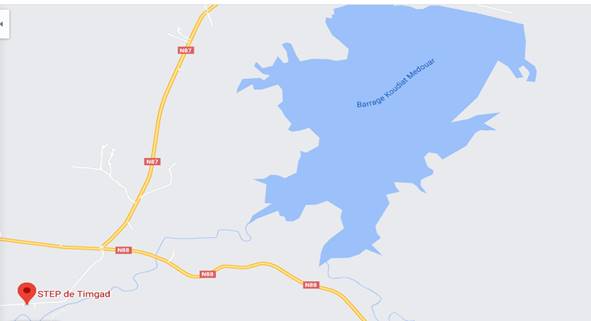
The plant was established to protect the Soultes River from environmental pollution, since the river flows into the Kadiat El-Meddour Dam, which supplies drinking water to several municipalities in the wilayas of Batna and Khenchela, as shown in the following figure:
Figure 1: Geographic location of the plant
Source: Search engine (Google Maps)
3.1.2 Technical Information about the Plant
a. Capacity in terms of population equivalent:
- In 2018, the plant had a capacity of 13,800 population equivalents.
- By 2033, the capacity is projected to reach 25,651 population equivalents.
- Beyond 2033, an expansion of the plant will become necessary.
b. Hydraulic capacity: The volume of wastewater entering the plant can be described as follows:
- Average daily flow: 1,950 m3 per day, equivalent to 81 m3 per hour.
- Maximum flow during dry weather: 162 m3 per hour, or 45 liters per second.
- Maximum flow during rainy weather: 243 m3 per hour, or 68 liters per second.
- Minimum flow required for plant operation: 500 m3 per day.
c. Pollutants removed by the plant: The quantity of pollutants removed from wastewater by the plant is presented in the following table:
Table 1: Quantity of pollutants removed by the plant
| Substance | Quantity (kg/day) | Concentration (mg/l) |
| MES (suspended solids) | 1071 | 549 |
| BOD5 | 828 | 425 |
| COD | 1656 | 849 |
| TKN | 125 | 64 |
| N-NH4 | 95 | 49 |
| Organic N | 30 | 15 |
| N-NO3 | 04 | 2 |
| P (phosphorus) | 25 | 13 |
Source: Plant documents
3.2 Organizational Structure, Staff Composition, and Plant Workflow
3.2.1 Organizational Structure
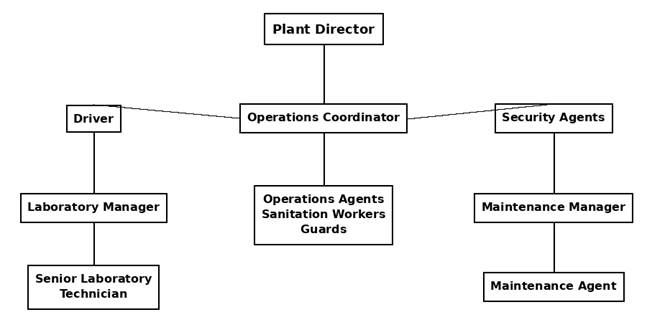
The plant’s organizational structure is presented in the following figure:
Figure 2: Organizational structure of the Timgad wastewater treatment plant
Source: Plant documents
3.2.2 Staff Composition
The plant’s staff is composed as follows:
- Operational staff: 31
- Supervisory staff: 2
- Management staff: 2
3.2.3 Plant Workflow
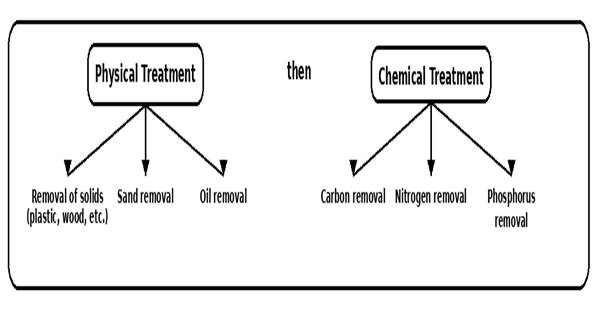
The plant removes pollutants from water through two treatment processes, as shown in the following figure:
Figure 3: Plant workflow diagram
Source: Laboratory manager at the plant
3.3 Water and Sludge Treatment Mechanisms
3.3.1 Water Treatment Mechanism
The plant’s water treatment mechanism proceeds through the following stages:
a. Lifting station: Wastewater first enters the lifting station, located in a separate building outside the main plant, before being conveyed to the treatment plant. The plant has a capacity of 1,950 m3 per day, and three pumps extract water from the sewage network of the city of Timgad.
b. Pre-treatment stage
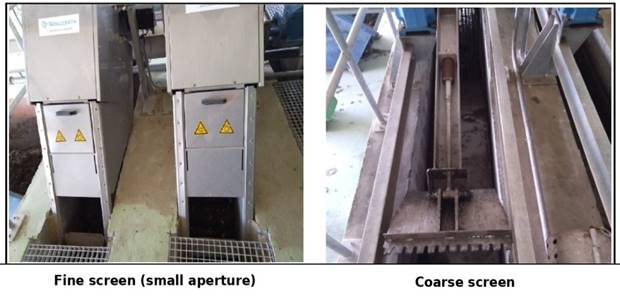
Screening: The volume of water entering the treatment plant is continuously measured using a water meter, along with conductivity sensors and pH sensors for acidity and alkalinity. Wastewater first passes through a coarse screen (shown in the following figure) to remove large materials; a conveyor screw then compacts the extracted waste, which is discarded into a waste container. The water then passes through a fine screen (also shown below) for further filtration, in order to prevent blockage of the conveying pipes.
Figure 4: Water screening grids
Source: Photographed by the researcher
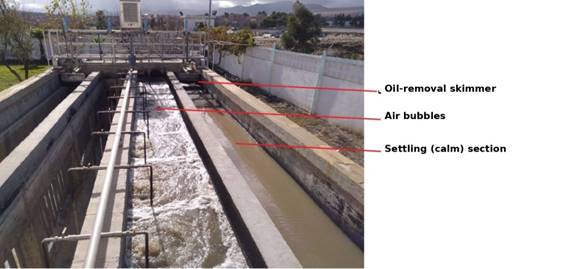
Oil and grit removal: At this stage, wastewater is aerated with medium-sized bubbles to facilitate the separation of oils and sand. The water then passes to a settling section (shown in the following figure), where oils float to the surface and are skimmed into a designated area, while sand settles at the bottom of the tank; a sand pump extracts it and discharges it into a sand washer before it is placed in a container. Washing removes organic matter, ensuring that the discarded sand produces no strong odor. Samples are also taken to the laboratory at regular two-hour intervals to assess the degree of preliminary treatment.
Figure 5: Oil and grit removal area
Source: Photographed by the researcher
c. Biological treatment: This takes place in the biological basin, through which water passes to remove three chemical elements, namely carbon, nitrogen, and phosphorus, among the most damaging substances for dams. Their presence promotes the growth of harmful aquatic vegetation such as algae, which consumes the oxygen present in dam water and leads to fish mortality. Treated water is discharged into the Soultes River, which flows into the Kadiat El-Meddour Dam in Timgad. Treatment in this basin relies on activated sludge, meaning bacteria-based treatment, and the biological basin is divided into three sections as follows:
Aerobic basin: The purpose of passing wastewater through this basin is to eliminate carbon, together with part of the nitrogen and phosphorus, through cellular metabolism. Oxygen is introduced via pipes to achieve the following reaction:
Organic matter + oxygen → carbon dioxide (CO2) + water (H2O)
Through the release of carbon dioxide into the air, carbon is eliminated in the aerobic basin, while a portion of the nitrogen and phosphorus remains, to be removed in the subsequent basins.
Anoxic basin: This refers not to a complete absence of oxygen but to oxygen bound to other chemical compounds, such as PO4-, NO3+, and NO2+. In this basin, nitrogen is definitively removed.
Anaerobic basin: This refers to the complete absence of oxygen. In this basin, phosphorus is definitively removed.
d. Settling stage: If sludge is placed in a glass of water and left for a period of time, it will settle at the bottom of the glass; this is the operating principle of the settling tanks, which have a sludge suction pipe and pump at the bottom to extract the settled sludge.
e. Disinfection stage: This is the final stage the water passes through. It takes place in a labyrinth-shaped basin, in which a disinfectant, such as bleach, is added to kill bacteria, viruses, and parasites. The water passes slowly through this basin to ensure the disinfectant’s effectiveness. After this stage, the plant supplies farmers with water suitable for irrigation or discharges it into the Soultes River.
3.3.2 Sludge Treatment
The sludge used in treatment, recovered from the settling tank, is partly returned to the biological basin, while the remainder undergoes further treatment through three stages:
a. Thickening: Sludge is thickened in a dedicated tank, following the same principle as the settling process.
b. Stabilization: Sludge passes from the thickening tank to the stabilization tank, where the principle of the food chain is applied, meaning that microorganisms consume one another.
c. Drying: Polymer is added to the sludge to coagulate it, facilitating its drying and transport.
4. Conclusion
In conclusion, sustainable development can be defined as development that meets the needs of present society without compromising the needs of future societies. Its objectives include increasing national income, improving living standards, rationalizing the use of natural resources, linking modern technology to societal goals, achieving social equity, improving public health, and providing education and employment, while its domains span the economic, social, environmental, and technological dimensions. Wastewater treatment plants play a significant role in achieving sustainable development, and the findings of this research can be summarized as follows:
a. Prevention of pollution in its various forms (water, air, soil, and food pollution).
b. Creation of both direct and indirect employment opportunities.
c. Support for urban water resources, such as dams and lakes.
d. Protection of public health from diseases caused by wastewater.
e. Energy generation through electricity production.
f. Support for the agricultural sector, along with the protection of fish and animal resources.
With respect to the empirical findings, the most important results can be summarized as follows:
a. The Timgad wastewater treatment plant was established to protect the Soultes River from environmental pollution, given that it flows into the Kadiat El-Meddour Dam, which supplies drinking water to several municipalities in the wilayas of Batna and Khenchela. The plant has thus contributed to preventing various forms of pollution in the city of Timgad and Batna, supporting an important water resource for the wilayas of Batna and Khenchela, namely the Kadiat El-Meddour Dam, protecting citizens’ health from disease in the city of Timgad, protecting the dam’s fish resources, and supplying farmers with water suitable for irrigation.
b. The establishment of the plant created approximately 35 jobs.
c. The plant removes pollutants from wastewater through both physical and chemical treatment processes.
Based on these findings, the study puts forward the following recommendations:
a. Establishing more wastewater treatment plants across the country’s municipalities, particularly in areas experiencing severe water pollution, such as wastewater discharged directly into the sea or flowing through uncovered, uncemented riverbeds.
b. Wastewater treatment plants should adopt occupational health and safety systems as well as environmental management systems, in order to optimize their environmental performance and strengthen their contribution to sustainable development.
c. Encouraging private sector investment in wastewater treatment plants, given the potential for profit through the sale of treated water or fertilizer to farmers.
5. References
1. Haizia Kacem and Kalthoum El Bez, “Combating Unemployment and Achieving Sustainable Development: Why and How?”, International Forum on Government Strategy for Eliminating Unemployment and Achieving Sustainable Development, 15–16 November 2011, University of M’sila, Algeria.
2. Rassli Djamel Kaddour and Ahmed Mohamed Mishaal, “The Role of Knowledge in Sustainable Development”, International Conference on the Economics of Environment and Globalization, 20–23 April 2009, Al-Zaytoonah University, Jordan.
3. Rachid Salmi, “The Impact of Environmental Pollution on Economic Development in Algeria”, unpublished doctoral dissertation, Faculty of Economic Sciences, University of Algiers, Algeria, 2006.
4. Samia Ben Ramdane, “Sustainable Development and Its Relationship to the Professional Integration of Unemployed Youth: Current Reality and Future Challenges”, International Forum on Government Strategy for Eliminating Unemployment and Achieving Sustainable Development, 15–16 November 2011, University of M’sila, Algeria.
5. Abderrahmane Mohamed El Hassan, “Sustainable Development and Its Requirements”, International Forum on Government Strategy for Eliminating Unemployment and Achieving Sustainable Development, 15–16 November 2011, University of M’sila, Algeria.
6. Kalthoum Hamidi and Hayoula Iman, “Pathways to Achieving Full Employment under Sustainable Development”, International Forum on Government Strategy for Eliminating Unemployment and Achieving Sustainable Development, 15–16 November 2011, University of M’sila, Algeria.
7. Nasser Mourad, “Sustainable Development and Its Challenges in Algeria”, Arab Economic Research Journal, Center for Arab Unity Studies, Issue 46, 2009, Egypt.
8. Ministry of Water Resources (Algeria), “Sanitation”, accessed 8 January 2022, https://www.mre.gov.dz/?page_id=1934.
[1]Haizia Kacem and Kalthoum El Bez, op. cit., p. 5.
[2]Rachid Salmi, op. cit., pp. 99–100.
[3]Kalthoum Hamidi and Hayoula Iman, op. cit., p. 5.
[4]Rassli Djamel Kaddour and Ahmed Mohamed Mishaal, op. cit., p. 1.
[5]Nasser Mourad, op. cit., pp. 110–111.
[6]Samia Ben Ramdane, op. cit., p. 4.
[7]Kalthoum Hamidi and Hayoula Iman, op. cit., pp. 5–7.
[8]Abderrahmane Mohamed El Hassan, op. cit., pp. 9–12.
[9]Ministry of Water Resources (Algeria), “Sanitation”, accessed 8 January 2022, https://www.mre.gov.dz/?page_id=1934