DOI:https://doi-0004.org/6812/17949829469077
Author 1:CHEHAT Ryma1
Author 2: MEZIANI Elmahdi2
1National School of Statistics and Applied Economics (Algeria), chahatryma2010@hotmail.fr
2 National School of Statistics and Applied Economics (Algeria), mehdi_meziani10@hotmail.com
Summary:
The assessment of Algeria’s public finances using the Financial Sustainability Index (FSI) developed by Croce and Juan-Ramón (2003) indicates that fiscal sustainability was generally maintained during part of the 2020–2025 period. Despite substantial public spending, the country’s fiscal position remained relatively resilient between 2021 and 2023. This favorable outcome was supported by low nominal interest rates, relatively high inflation, and positive economic growth. Negative real interest rates reduced the real burden of public debt, creating conditions similar to financial repression. Fiscal sustainability also benefited from the predominance of public banks and the very low level of external debt, which limited financing and exchange rate risks.
Key words: the Financial Sustainability Index, sustainability, financial repression, Fiscal Reaction.
Introduction:
The issue of public finance sustainability has become a major concern in macroeconomic analysis, particularly in economies that are highly dependent on natural resources and exposed to recurrent external shocks. In the case of Algeria, this issue is of particular importance due to the strong budgetary dependence on hydrocarbon revenues, the volatility of oil prices, as well as the transformations that have characterized the financing methods of public deficits in recent years.
The decline in oil prices starting in 2014 altered the country’s fiscal and monetary balances. The deterioration of budget balances, the gradual depletion of the Revenue Regulation Fund, and the growing financing needs of the Treasury led public authorities to adopt new financing mechanisms, notably the use of unconventional financing beginning in 2017. This transformation in the financing method of public deficits reignited the debate over the viability of the government’s fiscal trajectory, the sustainability of public debt, and the macroeconomic risks associated with deficit monetization.
However, the sustainability of public finances cannot be assessed solely through the level of debt or the severity of budget deficits. It also depends on the quality of institutions, the credibility of public policies, and the ability of authorities to implement disciplinary mechanisms capable of ensuring a coherent and sustainable fiscal trajectory over the long term. From this perspective, the literature on financial transition governance highlights the importance of transition plans, institutional commitment mechanisms, as well as incentive and alignment arrangements in achieving financially sustainable trajectories. This approach emphasizes the central role of the credibility of public commitments and the quality of financial governance in the ability of states to maintain sustainable trajectories, beyond mere regulatory or accounting compliance.
In the context of Algeria, several recent structural reforms reflect this willingness to strengthen fiscal and financial governance. The adoption of Organic Law No. 18-15 relating to finance laws constitutes an important step in the national budgetary framework. It gradually introduces performance-based public management, Medium-Term Expenditure Framework, as well as strengthened transparency and budget oversight. This reform aims to improve the efficiency of public resource allocation, rationalize government spending, and reinforce mechanisms of accountability and fiscal discipline. In this regard, it contributes to the establishment of an institutional framework capable of enhancing the credibility of the fiscal trajectory and strengthening the sustainability of public finances over the medium and long term.
Within the same reform momentum, the new monetary and banking law of 2023 represents a key phase in the modernization process of the Algerian financial system. This reform aims to strengthen the depth of the financial market, improve banking intermediation mechanisms, and diversify the instruments used to finance the economy. It also reflects a willingness to gradually adapt the monetary and financial framework to the new requirements of financial transition and the transformations affecting international banking systems. Moreover, this law has contributed to broadening the scope of monetary policy instruments while adapting them to the specificities of banking operations, particularly those related to Islamic finance and green finance. These developments contribute to the emergence of new financial segments capable of promoting savings mobilization, financial inclusion, and the financing of sustainable projects. They also strengthen the disciplinary mechanisms of public financing by gradually reducing dependence on direct monetary financing of the budget deficit.
Assessing the sustainability of Algerian public finances therefore requires a dynamic approach that simultaneously incorporates the trajectory of public debt, macroeconomic conditions, and the effective capacity of fiscal authorities to respond to financial imbalances. From this perspective, this study employs the Financial Sustainability Index (FSI) developed by International Monetary Fund researchers Ernesto Croce and Hugo Juan-Ramon in their 2003 study. This indicator is based on a dynamic modeling of public debt founded on the comparison between, on the one hand, the snowball effect resulting from the gap between the real interest rate and the economic growth rate and, on the other hand, the fiscal reaction capacity of public authorities in response to debt deviations. The main advantage of this index lies in its ability to transform the intertemporal budget constraint into a synthetic indicator that can be directly calculated from observed macroeconomic data, thereby making it possible to assess the speed of convergence or divergence of public debt toward a sustainable level.
The main objective of this article is to assess the sustainability of Algerian public finances over the period 2020–2025 through the construction and analysis of the Financial Sustainability Index (FSI). More specifically, the study examines the extent to which Algerian fiscal authorities have been able to respond to debt imbalances induced by the various macroeconomic shocks that have affected the national economy, particularly oil price shocks, the expansion of public expenditure, and the use of monetary financing for the budget deficit. The study also seeks to assess the extent to which recent reforms of Algeria’s fiscal and financial framework contribute to strengthening mechanisms of fiscal discipline, the credibility of public commitments, and the governance of financial transition.
The rest of the article is organized as follows. The second section presents the literature review on public finance sustainability. The third section presents the theoretical framework of fiscal sustainability and the analytical development of the Financial Sustainability Index. The fourth section outlines the empirical results and the discussion of the public finance sustainability in Algeria. Finally, the last section concludes the study.
1- Literature Review
The sustainability of public finances has constituted a central field of macroeconomic analysis since the seminal work on the government intertemporal budget constraint. In this perspective, fiscal policy is generally considered sustainable when the state is able to honor its current and future obligations without resorting to explosive debt accumulation or excessively costly fiscal adjustments. Early contributions, particularly those of Blanchard et al. (1990), proposed an operational interpretation of sustainability based on the gap between the real interest rate, economic growth, and the primary balance required to stabilize public debt.
A second generation of studies sought to empirically test sustainability based on the dynamic behavior of public debt and deficits. Bohn (1998) significantly reshaped this literature by showing that sustainability does not depend solely on the stationarity of debt, but rather on the response of fiscal authorities to the accumulation of debt. In this framework, fiscal policy is considered sustainable when the primary surplus reacts positively to an increase in the debt-to-GDP ratio. This fiscal reaction function thus makes it possible to assess the credibility of fiscal adjustment and the state’s ability to correct debt imbalances.
Building on these approaches, Croce and Juan-Ramón (2003), IMF researchers, developed a Financial Sustainability Index aimed at making the assessment of sustainability more operational. Their contribution is based on a recursive algorithm derived from the dynamics of the debt-to-GDP ratio and a fiscal reaction function linking the adjustment of the primary balance to the deviation of debt from a sustainable target. The value of this indicator lies in its ability to synthesize, in a single measure, the snowball effect, driven by the differential between the real interest rate and economic growth, and the fiscal response of public authorities. When the index is below unity, debt converges toward its target; when it exceeds unity, fiscal dynamics become potentially unsustainable.
This literature has subsequently been extended in several applied studies on emerging and developing economies, where fiscal sustainability is often affected by the volatility of public revenues and exposure to external shocks. Cruz-Rodríguez (2014), for instance, applies the Croce and Juan-Ramón approach to assess fiscal sustainability in several developing countries, confirming the usefulness of this indicator for comparing fiscal trajectories in heterogeneous macroeconomic environments. Recent contributions significantly enrich the analysis of fiscal sustainability by extending Croce and Juan-Ramón (2003)-type dynamic frameworks through more advanced structural and empirical approaches. Thus, Cao et al. (2025) develop a measure of maximum sustainable debt based on P-theory, explicitly incorporating financial conditions, sovereign risk premia, and fiscal distortions, thereby making it possible to endogenize public debt sustainability thresholds at the international level.
In a complementary perspective, Amedanou (2024) proposes a DSGE model applied to the West African Economic and Monetary Union, in which fiscal sustainability is analyzed through the introduction of fiscal fatigue, debt structure, and macroeconomic shocks, highlighting highly nonlinear debt trajectories that are dependent on institutional constraints. Finally, Canofari and al. (2025) provide an empirical analysis on a panel of countries showing that governments do indeed adjust their primary balance in response to the accumulation of public debt, confirming the existence of Ricardian-type fiscal behavior and the absence of Ponzi-type financing. All these contributions converge toward a central idea: fiscal sustainability relies on a recursive debt dynamics, an endogenous fiscal reaction rule, and financial conditions (notably the interest rate–growth differential), which constitute the core pillars of modern extensions of the original approach of Croce and Juan-Ramón (2003).
In the case of Algeria, the issue of fiscal sustainability presents important specificities related to hydrocarbon dependence. Studies on Algeria highlight that fiscal balances remain highly sensitive to oil price fluctuations, while the capacity for fiscal adjustment largely depends on the control of public expenditure and the diversification of financing sources. Chibi et al. (2022) thus show that fiscal sustainability in Algeria has become a central issue since the deterioration of fiscal balances observed following the 2014 oil counter-shock.
Recent literature also emphasizes the role of institutions and financial governance in the sustainability of public finances. In this context, Organic Law No. 18-15 represents an important reform of the Algerian budgetary framework, insofar as it defines the principles governing the preparation, presentation, execution, and control of finance laws, while introducing a performance- and accountability-based approach to public management. The new Monetary and Banking Law No. 23-09 of 2023, in turn, is part of a financial modernization process, expanding monetary policy instruments and adapting the banking framework to the specificities of Islamic finance and green finance.
In parallel with the fiscal and financial reforms undertaken in recent years, Algeria has gradually strengthened its strategic framework for climate transition and sustainable development through several international commitments and national instruments. The Nationally Determined Contribution (NDC), adopted under the Paris Agreement, sets out targets for reducing greenhouse gas emissions as well as commitments regarding adaptation and energy transition. The National Climate Plan (NCP), designed as an operational instrument for implementing the NDC, identifies priority projects in mitigation, adaptation, climate governance, and financing of transition actions. In the same vein, the First Biennial Transparency Report (BTR1) and the national reports submitted to the UNFCCC reflect a willingness to strengthen monitoring mechanisms, transparency, and institutional coordination of climate policies.
These commitments also fall within a broader alignment with the Sustainable Development Goals (SDGs), particularly those related to energy transition, climate resilience, and the preservation of natural capital. Moreover, the National Biodiversity Strategy and its action plan reflect a gradual integration of biodiversity, green finance, and environmental sustainability issues into national public policies. In line with recent work on the governance of financial transition, these instruments contribute to strengthening the credibility of public commitments, improving the alignment of financial policies with sustainability objectives, and consolidating the institutional mechanisms required for a long-term sustainable fiscal trajectory.
Thus, this literature review shows that the analysis of the sustainability of Algerian public finances must articulate three complementary dimensions: the macroeconomic dynamics of debt, the fiscal reaction of public authorities, and the quality of financial governance. It is precisely within this perspective that the present article is situated, by employing the Financial Sustainability Index of Croce and Juan-Ramón to assess Algeria’s fiscal trajectory over the period 2000–2024.
2-Methodology:
2.1- Definition of Variables and Institutional Context of the Study:
The assessment of the sustainability of public finances in Algeria using the Financial Sustainability Index (FSI) developed by Ernesto Croce and Hugo Juan-Ramón (2003) requires the use of a set of macroeconomic variables that make it possible to simultaneously capture the dynamics of public debt, the fiscal constraints of the state, and the ability of public authorities to maintain a sustainable fiscal trajectory in a context characterized by strong economic, social, and environmental pressures.
In the case of Algeria, this issue presents important specificities. Public finances remain heavily dependent on hydrocarbon revenues, while a significant share of public expenditure remains difficult to adjust downward. Social spending, price support mechanisms, public transfers, investments in strategic infrastructure, as well as major projects related to energy, water resources, mining, transport, and housing, strongly limit short-term fiscal adjustment margins. At the same time, maintaining a certain level of public spending remains essential to support economic growth, preserve social stability, and accompany economic diversification policies.
From this perspective, several macroeconomic variables are used in the construction of the Financial Sustainability Index.
a) Public Debt-to-GDP Ratio
The variable represents the ratio of public debt to Gross Domestic Product (GDP).
This variable constitutes the central indicator of public debt dynamics. In the Algerian context, its evolution reflects both the fiscal imbalances observed following the 2014 oil price shock, the growing financing needs of public expenditure, and the transformations in the methods used to finance the budget deficit, particularly after the introduction of non-conventional financing in 2017 and the Special Refinancing Program of 2021.
b) Primary Balance
The primary balance corresponds to the fiscal balance excluding interest payments on public debt.
This variable measures the actual fiscal effort undertaken by public authorities. However, fiscal adjustment remains particularly challenging in the Algerian context due to the weight of non-discretionary expenditures and the persistent need to support economic growth. Strategic public investments, social expenditures, and commitments related to the energy and environmental transition significantly constrain the scope for short-term expenditure reductions. In this context, the reforms introduced under the LOLF[1] are specifically intended to improve the efficiency of public spending while preserving the strategic investments required for economic development and a sustainable transition.
c) Real Interest Rate
The real interest rate measures the real cost of financing public debt after adjusting for inflation.
where:
denotes the nominal interest rate;
-
denotes the inflation rate.
This variable plays an important role in public debt dynamics. The expansion of monetary policy instruments introduced by the 2023 Monetary and Banking Law is specifically intended to strengthen the effectiveness of monetary regulation and improve the mechanisms for financing the economy in a context characterized by the need to preserve macro-financial stability.
d) Real Economic Growth Rate
The real economic growth rate measures the evolution of real Gross Domestic Product (GDP).
In the Algerian context, maintaining economic growth is a strategic objective of public policy. Public expenditure plays a key role in driving national economic activity through the financing of infrastructure, major development projects, and sectoral support programs. Consequently, any fiscal consolidation strategy must take into account the need to preserve productive investment and support economic diversification objectives.
e) Debt Dynamics Coefficient OR discount factor ()
The parameter measures the combined effect of the real interest rate and the economic growth rate on the evolution of public debt.
When the real interest rate exceeds the economic growth rate, the debt snowball effect becomes positive and may lead to a mechanical increase in the debt-to-GDP ratio.
f) The Public Debt Target
The model introduces a sustainable debt target denoted . This variable represents the debt level toward which public authorities aim to converge the debt trajectory.
In the Algerian case, this target must take into account not only traditional macroeconomic balances, but also the financing needs related to structural investments, the energy transition, climate commitments, and the Sustainable Development Goals. In this regard, and based on commonly accepted definitions of sustainable debt ratios, we argue that Algeria should aim to return to the debt levels that prevailed before the introduction of unconventional financing.
g) Target Primary Balance
The target primary balance corresponds to the fiscal surplus that is consistent with stabilizing public debt at its target level.
This variable makes it possible to assess the level of fiscal adjustment that is theoretically required to ensure the long-term sustainability of public debt.
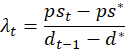
h) Fiscal Reaction Coefficient ()
The coefficient measures the ability of fiscal authorities to adjust their fiscal policy in response to deviations in public debt.
This variable constitutes an indicator of fiscal discipline, institutional credibility, and the quality of financial governance. In the Algerian context, it also provides a means of assessing the ability of public authorities to reconcile the requirements of fiscal stability with the imperatives of economic growth, social cohesion, energy transition, and sustainable finance.
2.2– Methodology for Constructing the Financial Sustainability Index (FSI)
The methodology developed by Ernesto Croce and Hugo Juan-Ramón (2003) is based on the intertemporal dynamics of public debt. The starting point of the model is the standard equation describing the evolution of the debt-to-GDP ratio:
1
This equation indicates that the level of public debt in period depends on the stock of debt inherited from the previous period, adjusted for the combined effect of the real interest rate and the economic growth rate
, as well as the primary balance
achieved by the fiscal authorities.
Building on this relationship, the authors introduce a sustainable debt target, denoted by , together with a benchmark primary balance,
, that is consistent with long-term debt stabilization:
2
The model then assumes that fiscal authorities adjust their fiscal policy in response to the gap between the observed debt level and the target debt level. This fiscal reaction function can be expressed as follows:
3
where measures the intensity of the fiscal response.
By substituting this fiscal rule into the dynamic debt equation, the authors obtain:
4
This equation shows that debt dynamics depend directly on the coefficient , which represents the difference between:
- The pressure exerted by the interest rate/growth dynamic;
- The fiscal correction capacity of public authorities.
The sustainability condition is then defined by:
5
When this condition is satisfied, public debt gradually converges toward its target level; otherwise, the debt trajectory becomes divergent and potentially unsustainable.
On this basis, Croce and Juan-Ramón construct the Financial Sustainability Index (FSI):
6
By substituting and
with their respective empirical expressions, the final index becomes:
7
The interpretation of the index is relatively straightforward:
< 1: public finances are sustainable;
= 1: critical situation or fragile stability;
> 1: potentially unsustainable public debt dynamics.
The main advantage of this approach lies in its operational nature. Unlike traditional approaches based exclusively on intertemporal solvency, the FSI makes it possible to dynamically assess fiscal sustainability using actually observed macroeconomic data and to measure the credibility of the fiscal response of public authorities to debt imbalances.
3-Results and discussion: Financial Sustainability Index (FSI)
The results obtained from the Financial Sustainability Index show that Algeria experienced phases of fiscal sustainability over the study period (2021-2023). However, this sustainability appears to have been largely supported by monetary and inflationary factors rather than by strict fiscal discipline.
Nevertheless, the FSI results also reveal the emergence of growing tensions from 2024 onwards. The indicators gradually become less favorable due to the combined effect of a slowdown in inflation, an increase in public financing needs, and an insufficient fiscal response to the dynamics of state obligations.
The relative decline in inflation mechanically reduces the real erosion effect on public debt, thereby limiting the implicit revenue from the inflation tax that had previously contributed to stabilizing public finances. At the same time, public expenditure remains high due to the expansion of structural and non-discretionary spending.
From this perspective, the FSI results also highlight a gradual transition from a passive sustainability model, based on inflation and low interest rates, towards the need for active sustainability based on fiscal consolidation, productivity, and structural economic transformation.
Table 1: Financial Sustainability Index
| Variable names | Variables | 2020 | 2021 | 2022 | 2023 | 2024 | 2025 |
| Real GDP growth | g | -5.00 | 3.80 | 3.60 | 4.10 | 3.70 | 4.40 |
| inflation rate | π | 2.42 | 7.23 | 9.27 | 9.30 | 4.05 | 1.82 |
| Nominal interest rate | i | 1.82 | 1.05 | 2.51 | 2.84 | 1.78 | 1.78 |
| discount factor | β | 1.05 | 0.90 | 0.90 | 0.90 | 0.94 | 0.96 |
| primary surplus to GDP | ps | -7.74 | -5.47 | -0.14 | -3.00 | -12.5 | -14.5 |
| debt ratio | d | 45.95 | 55.12 | 48.07 | 47.27 | 47.76 | 52.23 |
| Policy reaction parameter | λ | -0.09 | -0.05 | 0.02 | -0.02 | -0.14 | -0.17 |
| Financial Sustainability Index | IFS | 1.13 | 0.95 | 0.88 | 0.92 | 1.08 | 1.12 |
The analysis of the macroeconomic variables used in the calculation of the Financial Sustainability Index (FSI) highlights that prior to the 2024–2025 period (notably the 2021–2023 period), the Algerian macro-financial environment exhibited relatively favorable conditions for public debt sustainability. This configuration was primarily based on a combination of low nominal interest rates, relatively high inflation, and overall positive economic growth, although volatile and heavily dependent on expenditure linked to hydrocarbon revenues.
Indeed, the inflationary dynamics observed over several years of the period under study contributed to reducing the real value of public liabilities. In a context where interest rates remained below the rate of price increases, real interest rates became negative. This situation could be considered a form of financial repression, in the sense of McKinnon (1973) and Shaw (1973), in which monetary authorities artificially maintain low financing costs to facilitate budget financing and reduce the real burden of public debt.
This configuration was reinforced by several structural factors. On the one hand, the shallow depth of the financial market and the predominance of public banks allowed the government to benefit from particularly favorable financing conditions. On the other hand, the near-total absence of external debt significantly limited exposure to exchange rate risks and the constraints imposed by international financial markets. Thus, unlike many emerging economies facing sustainability crises linked to external debt, Algeria has been able to maintain a relatively stable debt trajectory thanks to essentially domestic and monetary financing.
Table 2: Dynamics of the real interest rate
| Year | INTEREST EXPENSE (% OUTSTANDING LOANS) | Policy Rate % | Inflation % | Real Interest Rate % |
| 2018 | 1.34 | 3.79 | 4.27 | -2.81 |
| 2019 | 1.20 | 3.57 | 1.95 | -0.73 |
| 2020 | 1.82 | 3.39 | 2.42 | -0.58 |
| 2021 | 1.05 | 3.08 | 7.23 | -5.76 |
| 2022 | 2.56 | 3.07 | 9.27 | -6.14 |
| 2023 | 2.51 | 3.00 | 9.30 | -6.21 |
| 2024 | 2.84 | 3.00 | 4.05 | -1.16 |
| 2025 | 2.84 | 2.88 | 1.82 | 1.00 |
Moreover, episodes of rising hydrocarbon prices simultaneously supported economic growth, fiscal revenues, and foreign reserves, indirectly contributing to improved sustainability indicators. With nominal GDP growth remaining above the average effective cost of debt, the debt “snowball effect” remained contained over a large part of the period under review.
However, this sustainability was largely dependent on nominal variables rather than on a structural consolidation of public finances. In other words, the reduction in the real debt burden resulted more from inflationary erosion and administered financial conditions than from a lasting improvement in the primary balance or an effective diversification of the economy.
The FSI highlights that periods of sustainability generally correspond to phases characterized by:
- Relatively high inflation allowing a reduction in the real value of public debt;
- Low interest rates;
- Very limited external indebtedness;
- Favorable hydrocarbon revenues supporting macroeconomic balances;
- And nominal GDP growth exceeding the real cost of government financing.
In this context, inflation implicitly played the role of an inflation tax, enabling a transfer of resources from holders of monetary assets to the state. This mechanism helped ease the government’s intertemporal budget constraint without a substantial reliance on external borrowing. Thus, the observed sustainability appears to reflect a monetary sustainability rather than a strictly fiscal sustainability.
The deterioration observed over the last two years (2024–2025) can be explained by several factors:
- the decline in inflation;
- The financing of major infrastructure projects;
- The increase in social spending and public transfers to preserve household purchasing power;
- Rising needs related to the energy transition and Algeria’s international commitments under the Sustainable Development Goals (SDGs).
Taken together, these commitments progressively reduce the state’s fiscal space and increase medium and long-term financing needs. At the same time, continued dependence on hydrocarbon revenues keeps public finances exposed to fluctuations in international energy markets.
The results therefore suggest that the future sustainability of Algerian public finances will depend less on financial repression mechanisms or inflationary erosion than on the authorities’ capacity to undertake deep structural reforms. This notably implies:
- Broadening the non-hydrocarbon tax base;
- Improving the efficiency of public spending, particularly through the rigorous application of the requirements of the Organic Law on Budget Laws (LOLF);
- development of the domestic financial market through better exploitation of the improvements brought about by the 2023 Monetary and Banking Law;
- Productive diversification based on economic land reforms;
- And establishing a credible long-term fiscal governance strategy.
Conclusion
The assessment of the sustainability of Algerian public finances using the Financial Sustainability Index (FSI) developed by Ernesto Croce and Hugo Juan-Ramon (2003) highlights several key findings regarding Algeria’s budgetary trajectory during the period 2020–2025. The results show that, despite the significant public spending undertaken during the last two decades, particularly through economic support policies, social transfers, and investments in infrastructure projects, Algerian public finances remained generally sustainable for a part of the period studied.
The analysis of the macroeconomic variables included in the FSI calculation reveals, in particular, that prior to the 2024–2025 period, and especially between 2021 and 2023, the Algerian macro-financial environment presented characteristics relatively favorable to the sustainability of public debt. This configuration was based on a combination of low nominal interest rates, relatively sustained inflation, and overall positive economic growth, although heavily dependent on public spending financed by hydrocarbon revenues. In this context, the inflationary dynamics contributed to reducing the real value of public liabilities. With interest rates remaining below the rate of price increases, real interest rates became negative, creating a situation akin to a form of financial repression in the sense of McKinnon (1973) and Shaw (1973). This configuration made it possible to contain the real cost of public financing and to alleviate the debt burden on the economy.
This situation was reinforced by several structural characteristics of the Algerian economy. The predominance of public banks and the near-total absence of external debt allowed the government to benefit from particularly favorable financing conditions while limiting its exposure to exchange rate risks and the constraints imposed by international financial markets. Furthermore, periods of rising hydrocarbon prices simultaneously supported government revenues, economic growth, and foreign exchange reserves. Since nominal GDP growth remained above the apparent cost of debt, the “snowball effect” associated with debt dynamics remained contained for a part of the period under review.
However, the results of the IFS also suggest that this sustainability relied more on monetary and nominal factors than on a structural strengthening of public finances. Indeed, the reduction in the real debt burden stemmed primarily from inflationary erosion, negative real interest rates, and administered financing conditions, rather than from a sustained improvement in the primary balance, increased non-hydrocarbon tax revenue, or effective economic diversification. In other words, a significant portion of the observed sustainability appears to have been supported by an implicit form of inflation tax rather than by structural fiscal adjustments.
This conclusion is corroborated by the gradual deterioration of indicators observed from 2024 onward. The slowdown in inflation mechanically reduces the effects of real debt erosion that had previously helped to support public finances. At the same time, the government’s financing needs continue to grow due to high levels of public spending, large-scale infrastructure projects, and long-term fiscal commitments. The results of the IFS thus indicate the emergence of a phase of heightened vulnerability where the fiscal response appears insufficient to offset the diminishing favorable effects associated with inflation and low financing costs.
The use of unconventional financing, widening budget deficits, and the persistence of high levels of public spending reflect the emergence of increasing budgetary constraints likely to affect the long-term sustainability of public finances. From this perspective, maintaining an expansionary fiscal policy now constitutes a particularly demanding macroeconomic gamble.
This approach can only be sustainable in the medium and long term if the public spending undertaken today generates significant structural effects on future economic growth. The economic and social profitability of public investments thus becomes a central variable for fiscal sustainability. Structuring projects undertaken in infrastructure, energy, transport, water resources, the energy transition, and economic diversification must progressively produce productivity gains, improve the competitiveness of the national economy, and enable the emergence of new, sustainable sources of growth and public revenue. Otherwise, the persistence of high levels of public spending could exacerbate budget imbalances and increase the risks associated with public debt dynamics.
In this context, the institutional reforms recently undertaken by public authorities offer potential advantages for a gradual improvement in budgetary and financial governance. Organic Law No. 18-15 on Finance Laws, through program-based budgeting, performance-based management, and Medium-Term Expenditure Framework, can contribute to strengthening the efficiency of public spending and the credibility of the State’s budgetary commitments. Similarly, the new Monetary and Banking Law of 2023 opens up significant opportunities for financial modernization, deepening the financial market, and diversifying the instruments for financing the economy.
Nevertheless, the effectiveness of these reforms will largely depend on their ability to produce credible disciplinary mechanisms, improve the allocation of public resources, and strengthen the alignment between the objectives of growth, macroeconomic stability, and fiscal sustainability. The challenge no longer lies solely in maintaining a high level of public spending, but in the capacity of the economic and institutional system to transform this spending into productive growth, economic diversification, and financial resilience.
Furthermore, the future sustainability of Algerian public finances will be closely linked to the country’s ability to effectively integrate the new requirements of the international financial transition. Commitments made within the framework of the Sustainable Development Goals (SDGs), Nationally Determined Contributions (NDCs), biennial transparency reports (BTRs), energy transition policies, and biodiversity conservation strategies will entail considerable financing needs over the coming decades. These commitments, while essential for ensuring the environmental and social sustainability of development, could further reduce short-term fiscal space.
In this context, activating economic and financial diplomacy appears as a major strategic lever to enable Algeria to gain broader access to international sustainable development financing mechanisms, climate funds, and green finance schemes. The country’s considerable potential in the areas of solar energy, green hydrogen, and low-carbon energy infrastructure could constitute a determining factor in the transformation of the national economic model in the medium and long term.
Références :
Abderrahim Chibi & Sidi Mohamed Chekouri & Mohamed Benbouziane & Hadjer Boulila, 2022. “Essays on Fiscal Sustainability in Algeria,” Working Papers 1540, Economic Research Forum, revised 20 Feb 2022.
Alexis Cruz-Rodríguez. “Assessing fiscal sustainability in some selected countries,” Theoretical and Applied Economics, Asociatia Generala a Economistilor din Romania / Editura Economica, vol. 0(6(595)), June 2014, pages (7-22).
Blanchard, O.J., Chouraqui, J., Hagemann, R.P. and Sartor, N. The Sustainability of Fiscal Policy: New Answers to an Old Question. OECD Economic Studies, 15, 1990, pages (7-36).
Briere, Marie and Pouget, Sebastien and Ureche-Rangau, Loredana, Blackrock vs Norway Fund at Shareholder Meetings: Institutional Investors’ Votes on Corporate Externalities (March 13, 2018).
Cao, Y., Jiang, W., Lam, W. R., & Wang, N. Maximum sustainable debt across countries: An assessment using P-theory. International Monetary Fund Working Paper No. 2025/223, 2025.
Elroy Dimson & Oğuzhan Karakaş & Xi Li. “Editor’s Choice Active Ownership,” The Review of Financial Studies, Society for Financial Studies, vol. 28(12), 2015, pages (3225-3268).
Enzo Croce & V. Hugo Juan-Ramon. “Assessing Fiscal Sustainability: A Cross-Country Comparison,” IMF Working Papers 2003/145, 2003, International Monetary Fund.
Henning Bohn. “The Behavior of U. S. Public Debt and Deficits,” The Quarterly Journal of Economics, vol. 113(3), August 1998, pages (949-963).
Isaac Amedanou. “Fiscal Fatigue, Public Debt Structure and Sustainability: A DSGE Model for West African Economic and Monetary Union,” International Economic Journal, Taylor & Francis Journals, vol. 38(2), April 2024, pages (312-344).
McKinnon, R. “Money and Capital in Economic Development” Brookings Institution. Washington, DC, USA, 1973, 184 pages.
Paolo Canofari & Alessandro Piergallini & Marco Tedeschi. “Do Governments React to Public Debt Accumulation? A Cross-Country Analysis,” Papers 2507.13084, arXiv.org, 2025.
Shaw, E.S. Financial Deepening in Economic Development. Oxford University Press, 1973, 260 pages
ANNEX :
Annex 1: Underlying assumptions for reaching the debt target
| target variables | variables | 2020 | 2021 | 2022 | 2023 | 2024 | 2025 |
| Discount factor | β* | 0.95 | 0.95 | 0.95 | 0.95 | 0.95 | 0.95 |
| The Public Debt Target | d* | 30 | 30 | 30 | 30 | 30 | 30 |
| The primary surplus ratio | ps* | -1.63 | -1.63 | -1.63 | -1.63 | -1.63 | -1.63 |
[1] Organic Law 15/18 relating to the laws of finance