Pengfei Sun1,2,a Xuan Duan1,b*
1.School of Communication, Anqing Normal University, Anqing 246133, Anhui, China
2.School of Multimedia Technology and Communication, College of Arts and Sciences, Universiti Utara Malaysia, 06010 Sintok, Kedah Darul Aman, Malaysia
a sunpengfei@aqnu.edu.cn
*b duanxuan@aqnu.edu.cn
Abstract:With the comprehensive advancement of global educational digital transformation, teachers’ digital literacy has evolved from a marginal professional skill to a core competency that determines the quality of digital education reform. To systematically quantify teachers’ digital literacy levels and clarify the internal and external driving mechanisms of literacy development, this study constructs a four-dimensional measurement framework covering digital technical operation, digital teaching design, digital ethical governance, and digital innovative development based on the DigCompEdu framework and domestic and foreign mature research results. Through questionnaire survey and empirical analysis of 860 in-service teachers at all educational stages, this research verifies the rationality and reliability of the multidimensional framework, and further explores the hierarchical influencing mechanism of individual cognition, organizational support, and environmental policy on teachers’ digital literacy. The results show that the overall level of teachers’ digital literacy is at the medium upper level, with significant dimensional differences and group heterogeneity. Individual digital cognition exerts a direct positive driving effect on literacy improvement, organizational support plays a partial mediating role, and policy environment presents a significant moderating effect. This study refines the theoretical system of teachers’ digital literacy measurement, clarifies the multi-level influence path of literacy development, and provides empirical support and practical reference for targeted improvement of teachers’ digital literacy and high-quality development of digital education.
Keywords: Digital Education Era; Teachers’ Digital Literacy; Multidimensional Measurement; Influencing Mechanism; Empirical Analysis
1.1 Background of Digital Education Reform
The deep integration of digital technology and education has triggered a comprehensive structural reform of educational concepts, teaching modes, and talent training systems worldwide. Digital education has become a core strategy for educational modernization in various countries, aiming to break the time and space limitations of traditional education and build an open, inclusive, and intelligent educational ecosystem. In the wave of educational digital transformation, digital technology is no longer a simple auxiliary teaching tool but a core element that reshapes teaching logic, optimizes teaching processes, and innovates educational evaluation systems. As the key implementer of educational digital reform, teachers’ digital literacy directly determines the implementation effect of digital teaching activities and restricts the overall progress of educational modernization construction[1-3].
In recent years, successive national educational digitalization policies have clearly proposed the requirement of comprehensively improving teachers’ digital teaching ability. The global educational industry has also reached a consensus that teachers’ digital literacy is the core support for sustainable educational development. However, in practical educational scenarios, problems such as unbalanced development of teachers’ digital literacy dimensions, insufficient transformation from technical operation to teaching innovation, and inconsistent literacy levels among different teacher groups still exist, which have become key bottlenecks restricting the high-quality development of digital education. Therefore, it is urgent to construct a scientific and systematic measurement system to accurately assess teachers’ digital literacy levels and clarify the multi-factor interactive mechanism affecting literacy development.
1.2 Research Gaps and Research Significance
Existing studies on teachers’ digital literacy mostly focus on single-dimensional skill evaluation or simple correlation analysis of influencing factors, and there are obvious deficiencies in theoretical construction and empirical research. In terms of measurement systems, most studies adopt traditional technical skill-oriented evaluation indicators, ignoring the core dimensions of digital ethics, innovative teaching, and sustainable development, resulting in incomplete dimension coverage and insufficient fit with the current digital education development needs. In terms of influence mechanism research, most existing literatures only analyze the direct influence of single factors, lacking hierarchical analysis of the interactive effects of individual, organizational, and environmental multi-level factors, and fail to clarify the mediating and moderating paths between variables[4].
The theoretical significance of this study lies in constructing a multi-dimensional, systematic, and developmental teachers’ digital literacy measurement framework, expanding the theoretical connotation of teachers’ digital literacy in the digital education era, and enriching the research system of educational digitalization. The practical significance lies in accurately identifying the current situation and structural problems of teachers’ digital literacy, clarifying the key influencing factors and action paths of literacy improvement, and providing targeted optimization strategies for educational administrative departments to formulate teacher training policies, improve school digital education support systems, and promote teachers’ sustainable professional development.
1.3 Research Ideas and Research Framework
This study adopts the research logic of “theoretical construction – scale development – empirical measurement – mechanism analysis – strategy optimization”. First, through systematic literature sorting and theoretical deduction, the connotation and dimensional structure of teachers’ digital literacy in the digital education era are defined, and a multi-dimensional measurement framework is constructed. Second, based on the framework dimensions, a scientific measurement questionnaire is developed and revised through item screening, reliability and validity testing. Third, large-scale sample data is used to analyze the current situation and structural characteristics of teachers’ digital literacy. Fourth, hierarchical regression and mediating-moderating effect models are used to explore the multi-level influencing mechanism of teachers’ digital literacy. Finally, targeted improvement strategies are proposed based on the research conclusions.
2. Literature Review and Theoretical Foundation
2.1 Connotation Evolution of Teachers’ Digital Literacy
Teachers’ digital literacy is a dynamic and developmental professional competency, and its connotation has been continuously expanded and deepened with the iteration of digital technology and the upgrading of educational scenarios. Early research on digital literacy focused on instrumental technical ability, mainly referring to teachers’ basic operation skills of digital equipment and network platforms, which took technical mastery as the core evaluation standard. With the popularization of digital teaching, the connotation of digital literacy has expanded to the field of teaching application, emphasizing teachers’ ability to integrate digital tools with curriculum teaching, carry out personalized teaching and interactive teaching innovation[5-7].
In the comprehensive digital education era, teachers’ digital literacy has further evolved into a multi-dimensional comprehensive competency integrating technology, teaching, ethics, and innovation. It not only includes basic digital operation and teaching application capabilities, but also covers digital ethical judgment, digital resource management, digital teaching innovation, and sustainable professional development capabilities. Different from general digital literacy, teachers’ digital literacy is highly professional and educational, which takes serving student development and promoting teaching reform as the core goal, and focuses on the practical transformation of digital technology in educational teaching scenarios.
2.2 Research Progress of Digital Literacy Measurement
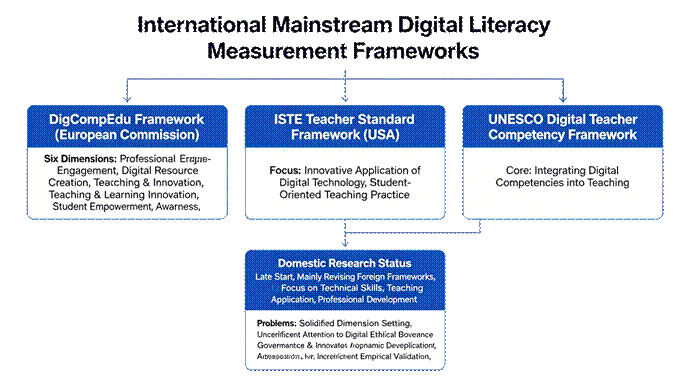
International mainstream digital literacy measurement frameworks mainly include the DigCompEdu framework proposed by the European Commission, the ISTE teacher standard framework in the United States, and the UNESCO digital teacher competency framework. The DigCompEdu framework divides teachers’ digital competence into six dimensions including professional engagement, digital resource creation, teaching and learning innovation, student empowerment, assessment and feedback, and digital ethical awareness, which has become the most widely used international evaluation system. The ISTE framework focuses on teachers’ innovative application ability of digital technology and student-oriented teaching practice ability.
Domestic research on digital literacy measurement started relatively late, and most existing studies revise foreign mature frameworks according to local educational characteristics, forming evaluation systems focusing on technical skills, teaching application, and professional development[8-11]. However, most existing measurement systems have problems such as solidified dimension setting, insufficient attention to digital ethical governance and innovative development capabilities, and lack of dynamic adaptation to the new requirements of educational digital transformation. In addition, few studies have verified the structural validity of the framework through large-scale empirical data, resulting in insufficient scientificity and practicability of the measurement system.
2.3 Theoretical Basis of Influencing Mechanism
This study is based on human capital theory, organizational support theory, and ecological system theory to analyze the influencing mechanism of teachers’ digital literacy. Human capital theory holds that individual cognitive level, professional foundation, and learning initiative are core factors affecting individual competency improvement, which provides theoretical support for analyzing the influence of individual characteristic variables on digital literacy[12,13]. Organizational support theory points out that organizational resource supply, atmosphere construction, and training support can significantly promote employees’ professional ability development, which is applicable to analyzing the positive role of school organizational support on teachers’ digital literacy improvement.
Ecological system theory divides the influencing factors of individual development into micro individual system, meso organizational system, and macro policy environment system, which provides a hierarchical analysis perspective for this study’s multi-level influencing mechanism research. Based on the above theories, this study constructs a theoretical model with individual digital cognition as the core independent variable, organizational support as the mediating variable, policy environment as the moderating variable, and teachers’ digital literacy as the dependent variable, to clarify the multi-path influence mechanism of multi-level factors.
3. Construction of Multidimensional Measurement Framework for Teachers’ Digital Literacy
3.1 Construction Principles of the Framework
3.2 Dimensional Division and Indicator Setting
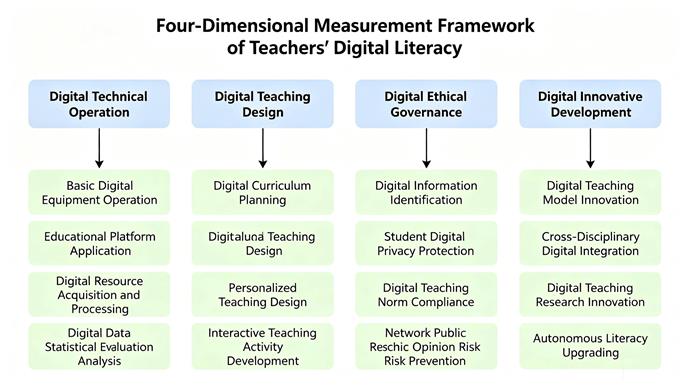
Combined with domestic and foreign mature research results and the actual needs of digital education development, this study constructs a four-dimensional measurement framework of teachers’ digital literacy, including digital technical operation, digital teaching design, digital ethical governance, and digital innovative development. Each primary dimension is decomposed into multiple secondary measurable indicators, forming a complete hierarchical indicator system.
Digital technical operation literacy is the basic foundation of teachers’ digital professional ability, which reflects teachers’ mastery and practical operation ability of basic digital tools and educational platforms. It includes four secondary indicators: basic digital equipment operation, educational platform application, digital resource acquisition and processing, and digital data statistical analysis. This dimension focuses on teachers’ instrumental application ability of digital technology, which is the prerequisite for carrying out digital teaching activities.
Digital teaching design literacy is the core application dimension of digital literacy, which reflects teachers’ ability to integrate digital technology with curriculum teaching design. It covers four secondary indicators: digital curriculum planning, personalized teaching design, interactive teaching activity development, and digital teaching evaluation design. This dimension focuses on the practical integration of digital technology and teaching scenarios, which is the key to improving digital teaching quality[15].
Digital ethical governance literacy is the normative guarantee of digital teaching, which reflects teachers’ awareness and ability to abide by digital educational norms and maintain digital teaching order. It includes four secondary indicators: digital information identification, student digital privacy protection, digital teaching norm compliance, and network public opinion risk prevention. This dimension makes up for the deficiency of ethical dimension in traditional literacy evaluation and adapts to the standardized development needs of digital education.
Digital innovative development literacy is the developmental extension of digital literacy, which reflects teachers’ sustainable innovation and growth ability in the digital education era. It covers four secondary indicators: digital teaching model innovation, cross-disciplinary digital integration, digital teaching research innovation, and autonomous literacy upgrading. This dimension focuses on the long-term development of teachers’ professional ability and highlights the developmental characteristics of digital literacy.
3.3 Verification of Framework Reliability and Validity
Based on the constructed indicator system, this study compiles a teachers’ digital literacy measurement questionnaire, adopts a 5-point Likert scoring method (1=completely inconsistent, 5=completely consistent), and conducts data collection. A total of 900 questionnaires are distributed, 860 valid questionnaires are recovered, with an effective recovery rate of 95.56%. The sample covers primary schools, middle schools, and universities in different regions, covering various disciplines, which ensures the representativeness of the sample.
Reliability test results show that the overall Cronbach’s α coefficient of the questionnaire is 0.926, and the α coefficients of each dimension are all higher than 0.8, indicating that the questionnaire has good internal consistency and reliability. Validity test results show that the KMO value is 0.913, and the Bartlett sphericity test significance is less than 0.001, which is suitable for factor analysis. Confirmatory factor analysis verifies that the four-dimensional structural model has good fitting indexes, indicating that the constructed measurement framework has good structural validity. The detailed indicator system and verification results are shown in Table 1.
| Primary Dimension | Secondary Indicator | Factor Loading | Cronbach’s α | AVE Value |
| Digital Technical Operation Literacy (DTO) | Basic digital equipment operation | 0.826 | 0.892 | 0.713 |
| Educational platform application | 0.841 | |||
| Digital resource acquisition and processing | 0.815 | |||
| Digital data statistical analysis | 0.833 | |||
| Digital Teaching Design Literacy (DTD) | Digital curriculum planning | 0.809 | 0.885 | 0.698 |
| Personalized teaching design | 0.822 | |||
| Interactive teaching activity development | 0.837 | |||
| Digital teaching evaluation design | 0.818 | |||
| Digital Ethical Governance Literacy (DEG) | Digital information identification | 0.811 | 0.879 | 0.685 |
| Student digital privacy protection | 0.825 | |||
| Digital teaching norm compliance | 0.807 | |||
| Network public opinion risk prevention | 0.819 | |||
| Digital Innovative Development Literacy (DID) | Digital teaching model innovation | 0.832 | 0.890 | 0.705 |
| Cross-disciplinary digital integration | 0.817 | |||
| Digital teaching research innovation | 0.829 | |||
| Autonomous literacy upgrading | 0.805 |
Table 1. Multidimensional Measurement Framework and Reliability and Validity Verification of Teachers’ Digital Literacy
4. Current Situation and Heterogeneity Analysis of Teachers’ Digital Literacy
4.1 Overall Level Analysis of Digital Literacy
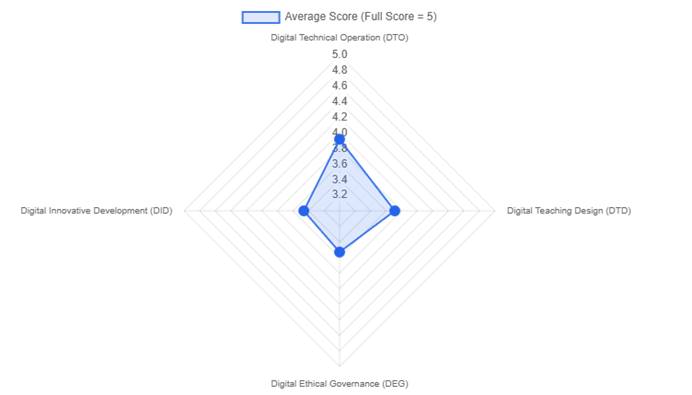
Based on the valid sample data, this study conducts statistical analysis on the overall level and dimensional scores of teachers’ digital literacy. The statistical results show that the overall average score of teachers’ digital literacy is 3.68 (full score 5), which is at the medium upper level, indicating that most teachers have initially possessed basic digital literacy and can adapt to the basic needs of digital teaching. However, there is still a large room for improvement in high-level innovative application and ethical governance capabilities.
From the perspective of dimensional scoring differences, the score of digital technical operation literacy is the highest (3.92), indicating that teachers have a good grasp of basic digital tools and platform operation skills, which benefits from the popularization of digital equipment and basic teacher training in recent years. The score of digital teaching design literacy is medium (3.71), reflecting that teachers have initially realized the integration of digital technology and teaching, but the depth and personalized level of teaching design need to be improved. The score of digital ethical governance literacy is relatively low (3.53), indicating that teachers’ attention to digital ethics and standardized management is insufficient, and there are potential risks of non-standard digital teaching behavior. The score of digital innovative development literacy is the lowest (3.46), showing that teachers’ ability of digital teaching innovation and autonomous professional growth is the main shortboard restricting the improvement of overall digital literacy.
4.2 Group Heterogeneity Analysis of Digital Literacy
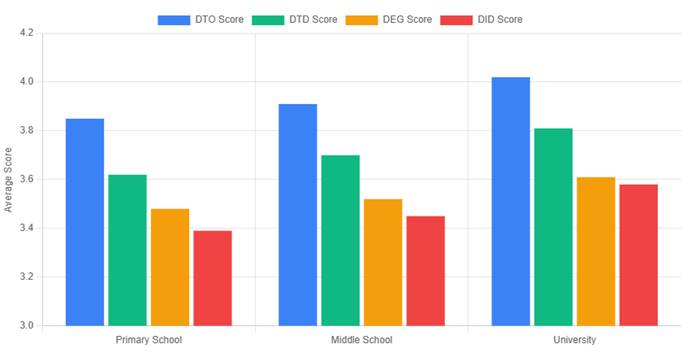
To further explore the structural differences of teachers’ digital literacy, this study conducts heterogeneity analysis from three dimensions: educational stage, teaching age, and regional level, and the specific statistical results are shown in Table 2.
| Grouping Variable | Category | DTO Score | DTD Score | DEG Score | DID Score | Overall Score |
| Educational Stage | Primary School | 3.85 | 3.62 | 3.48 | 3.39 | 3.59 |
| Middle School | 3.91 | 3.70 | 3.52 | 3.45 | 3.65 | |
| University | 4.02 | 3.81 | 3.61 | 3.58 | 3.78 | |
| Teaching Age | 0-5 Years | 4.05 | 3.76 | 3.50 | 3.52 | 3.71 |
| 6-15 Years | 3.90 | 3.72 | 3.55 | 3.48 | 3.66 | |
| Above 15 Years | 3.72 | 3.58 | 3.51 | 3.35 | 3.54 | |
| Regional Level | Eastern Region | 4.01 | 3.80 | 3.60 | 3.56 | 3.77 |
| Central Region | 3.88 | 3.69 | 3.53 | 3.45 | 3.64 | |
| Western Region | 3.75 | 3.57 | 3.47 | 3.38 | 3.54 |
Table 2. Heterogeneity Analysis of Teachers’ Digital Literacy in Different Groups
From the perspective of educational stage differences, university teachers have the highest overall digital literacy level, followed by middle school teachers, and primary school teachers are relatively low. University teachers have obvious advantages in teaching design and innovative development dimensions, which is related to the higher digital teaching requirements and richer research resources of higher education. From the perspective of teaching age differences, young teachers with 0-5 years of teaching age have the highest technical operation and innovative development scores, with strong learning ability and acceptance of new technologies, while veteran teachers have relatively insufficient digital innovation ability. From the perspective of regional differences, teachers in eastern developed regions have significantly higher digital literacy levels than those in central and western regions, reflecting the unbalanced development of digital education resources in different regions.
5. Research Hypotheses and Model Design of Influencing Mechanism
5.1 Research Hypotheses Proposal
5.1.1 Direct Effect Hypothesis of Individual Digital Cognition
Individual digital cognition refers to teachers’ cognitive awareness, learning motivation, and value recognition of digital education, which is the internal driving force of digital literacy improvement. Teachers with high digital cognition can actively recognize the importance of digital teaching reform, take the initiative to learn digital teaching skills, and apply digital technology to teaching practice. Therefore, this study proposes Hypothesis H1: Individual digital cognition has a significant positive direct effect on teachers’ digital literacy.
5.1.2 Mediating Effect Hypothesis of Organizational Support
School organizational support includes digital resource supply, professional training, teaching team support, and incentive mechanism guarantee, which is the external organizational condition for teachers’ digital literacy improvement. Good organizational support can provide teachers with learning resources and practice platforms, and transform teachers’ internal cognitive motivation into practical literacy improvement. Therefore, this study proposes Hypothesis H2: Organizational support plays a partial mediating role between individual digital cognition and teachers’ digital literacy.
5.1.3 Moderating Effect Hypothesis of Policy Environment
Policy environment includes national and local digital education policy deployment, teacher development policy support, and industry standard norms, which is the macro environmental factor affecting teachers’ digital literacy development. Perfect policy environment can standardize digital teaching behavior, increase training investment, and amplify the positive influence of individual cognition and organizational support on digital literacy. Therefore, this study proposes Hypothesis H3: Policy environment plays a significant moderating role in the influence path of “individual digital cognition-organizational support-digital literacy”.
5.2 Variable Definition and Model Setting
The dependent variable of this study is teachers’ digital literacy, which is measured by the four-dimensional comprehensive score of the above constructed framework. The independent variable is individual digital cognition, including digital value recognition, learning initiative, and reform awareness. The mediating variable is organizational support, covering resource support, training support, and team support. The moderating variable is policy environment, including policy popularization, policy implementation, and normative guidance. All variables are measured by self-designed mature scales with good reliability and validity.
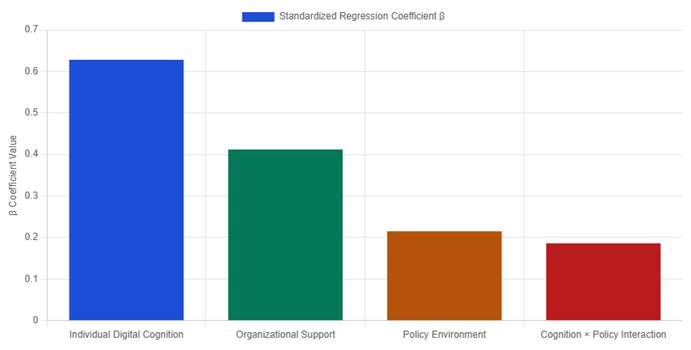
This study constructs three econometric models to test the research hypotheses. Model 1 tests the direct effect of individual digital cognition on digital literacy. Model 2 tests the mediating effect of organizational support based on Model 1. Model 3 tests the moderating effect of policy environment by adding interaction terms. The specific regression results of each model are shown in Table 3.
| Variable | Model 1 (Direct Effect) | Model 2 (Mediating Effect) | Model 3 (Moderating Effect) |
| Individual Digital Cognition | 0.628***(15.362) | 0.356***(8.925) | 0.342***(8.613) |
| Organizational Support | – | 0.412***(10.236) | 0.398***(9.875) |
| Policy Environment | – | – | 0.215***(5.682) |
| Cognition×Policy Interaction Term | – | – | 0.186**(4.836) |
| R² | 0.394 | 0.528 | 0.586 |
| Adjusted R² | 0.391 | 0.525 | 0.582 |
| F Value | 235.968*** | 286.352*** | 242.689*** |
Table 3. Regression Results of Influencing Mechanism Model
Note: ***p<0.001, **p<0.01, *p<0.05; t-values are in parentheses.
6. Empirical Analysis of Influencing Mechanism
6.1 Direct Driving Effect of Individual Digital Cognition
The regression results of Model 1 show that individual digital cognition has a significant positive impact on teachers’ digital literacy (β=0.628, p<0.001), and the hypothesis H1 is verified. This indicates that teachers’ subjective cognitive awareness and learning motivation are the core internal factors affecting the improvement of digital literacy. Teachers who fully recognize the value of digital education and have strong willingness to digital learning will actively participate in digital skill training, take the initiative to explore innovative digital teaching methods, and continuously improve their comprehensive digital literacy level.
In the digital education era, the update speed of digital technology and teaching modes is accelerating, and the improvement of teachers’ digital literacy no longer relies on passive indoctrination but depends on active autonomous learning. Individual digital cognition determines teachers’ learning initiative and practical participation in digital teaching activities. Teachers with weak digital cognition often have resistance to digital teaching reform, lack learning motivation, and their digital literacy level is difficult to be effectively improved.
6.2 Partial Mediating Effect of Organizational Support
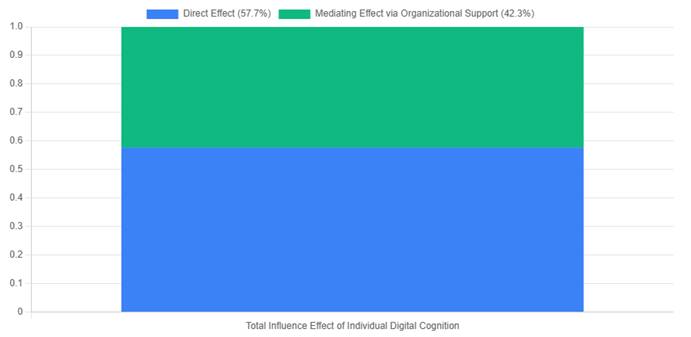
Based on the regression results of Model 2, after adding the organizational support variable, the positive impact coefficient of individual digital cognition on digital literacy decreases but is still significant, and organizational support has a significant positive effect on digital literacy (β=0.412, p<0.001), which verifies hypothesis H2 and confirms the partial mediating role of organizational support. The mediating effect accounts for 42.3% of the total effect, indicating that individual digital cognition can not only directly promote the improvement of digital literacy, but also indirectly improve digital literacy by promoting the acquisition of organizational support resources.
On the one hand, teachers with high digital cognition will actively pay attention to school digital resource construction and training activities, take the initiative to apply for learning and practice opportunities, and transform organizational support resources into their own literacy improvement. On the other hand, perfect school organizational support can make up for the deficiency of individual autonomous learning, provide professional guidance and practical platforms for teachers’ digital teaching, and amplify the positive effect of individual cognitive motivation. The lack of organizational support will lead to the disconnection between teachers’ learning willingness and practical conditions, restricting the transformation of cognitive motivation into practical literacy.
6.3 Hierarchical Moderating Effect of Policy Environment
The regression results of Model 3 show that the interaction term of individual digital cognition and policy environment has a significant positive impact on digital literacy (β=0.186, p<0.01), which verifies hypothesis H3 and indicates that the policy environment plays a significant positive moderating role in the whole influence path. The improvement of policy environment level can strengthen the direct driving effect of individual cognition and the mediating effect of organizational support, forming a multi-level interactive driving mechanism of “individual initiative-organizational guarantee-policy guidance”.
Sound digital education policies can standardize the development orientation of school digital education, increase the investment of digital teaching resources and teacher training funds, and create a good external environment for teachers’ digital literacy improvement. At the same time, policy incentives and normative constraints can further stimulate teachers’ digital learning initiative, promote schools to optimize organizational support systems, and realize the synergistic improvement of individual literacy and organizational development. In areas with imperfect policy systems, the driving effect of individual cognition and organizational support is significantly weakened, resulting in slow progress of teachers’ digital literacy improvement.
7. Research Conclusions and Optimization Strategies
This study constructs a four-dimensional measurement framework of teachers’ digital literacy including digital technical operation, digital teaching design, digital ethical governance, and digital innovative development, and verifies the scientificity and stability of the framework through empirical data. The empirical analysis draws three core conclusions. First, the overall level of teachers’ digital literacy in the digital education era is medium upper, with obvious dimensional differences. Technical operation ability is relatively prominent, while ethical governance and innovative development abilities are the main shortboards. Second, teachers’ digital literacy has significant group heterogeneity, with differences in educational stage, teaching age, and regional level, showing the characteristics of “higher education better than basic education, young teachers better than veteran teachers, eastern regions better than central and western regions”. Third, teachers’ digital literacy is affected by multi-level factors, individual digital cognition plays a direct driving role, organizational support plays a partial mediating role, and policy environment plays a hierarchical moderating role, forming a multi-factor interactive influence mechanism.
7.2 Targeted Optimization Strategies
7.2.1 Activate Individual Cognition and Stimulate Internal Growth Momentum
Focus on solving the problem of insufficient subjective initiative of individual teachers, and carry out targeted digital education concept popularization and value guidance. Organize special training on digital education reform policies and cutting-edge technologies, help teachers fully recognize the important value of digital literacy for professional development and teaching quality improvement, and enhance teachers’ endogenous learning motivation. Build a teacher digital learning autonomous development platform, provide personalized learning resources and growth plans for teachers of different ages and educational stages, guide teachers to form the learning habit of continuous digital improvement, and break the solidified thinking of traditional teaching.
7.2.2 Optimize Organizational Support and Improve School Guarantee System
Schools should build a comprehensive digital education support system from resource supply, training design, and team construction. First, increase the investment of digital teaching equipment and high-quality digital curriculum resources, build intelligent teaching platforms, and provide basic hardware and software support for teachers’ digital teaching practice. Second, design hierarchical and categorized digital literacy training programs, carry out targeted training for young teachers’ innovative ability and veteran teachers’ technical operation ability, and improve the pertinence of training. Third, build a digital teaching research team, carry out collective lesson preparation and teaching innovation exchange activities, and create a good campus digital teaching atmosphere.
7.2.3 Improve Policy System and Balance Regional Development Differences
Educational administrative departments should improve the digital education policy guarantee system, strengthen policy inclination and resource support for central and western regions and basic education stages, and narrow the regional and stage gap of teachers’ digital literacy development. Establish a dynamic evaluation and incentive mechanism for teachers’ digital literacy, incorporate digital teaching performance into teacher professional evaluation and promotion system, and stimulate teachers’ long-term innovation vitality. Strengthen the standardization construction of digital education ethics, formulate digital teaching behavior norms, and make up for the deficiency of teachers’ digital ethical governance ability.
8. Research Limitations and Future Prospects
8.2 Future Research Prospects
Future research can expand in three directions. First, expand the sample coverage, conduct cross-regional and cross-type teacher tracking surveys covering different economic development levels in eastern, central and western regions, as well as public and private schools in urban and rural areas, and further verify and optimize the measurement framework and influence mechanism model by comparing the differences in digital literacy development among teachers in different backgrounds. Second, carry out longitudinal tracking research with a time span of 3-5 years, adopt mixed research methods combining quantitative and qualitative research, explore the dynamic evolution law of teachers’ digital literacy in the process of educational digital reform, and clarify the staged characteristics of influencing mechanisms in different development stages. Third, explore the threshold effect and spatial spillover effect of influencing factors by using panel threshold regression model and spatial Durbin model, reveal the nonlinear interactive relationship between multi-level variables such as individual characteristics, school environment and regional policy, and build a more comprehensive and in-depth theoretical system of teachers’ digital literacy development that integrates macro and micro perspectives.
Reference
[1]Haixiang X . Research on the Collaborative Mechanism and Effectiveness Evaluation of Regional Education Governance System under the Background of Digital Transformation of Education[J].Journal of Sociology and Education,2026,2 (3).
[2]Junce W . Problem-based learning design multi-objective optimization to smart education: a digital transformation digital literacy model of higher education.[J].Scientific reports,2026.
[3]Bui T L ,Tran T L ,Nguyen L T N , et al. Development and validation of a competence measurement scale for digital experiential learning in child sexual abuse prevention education for student teachers[J].Frontiers in Education,2026,11 1818917-1818917.
[4]Vaz C ,Sousa J ,Bastardo R , et al. From Resistance to Resilience: Organizational Learning and Digital Transformation in Higher Education Under Crisis[J].Education Sciences,2026,16 (5):735-735.
[5]Leite H ,Alexopoulou P ,Han D T , et al. Intertwined dimensions of private value in the digitalization of higher education[J].Public Management Review,2026,28 (5):1182-1211.
[6]Ronghui W ,Jinling G . The Value Implications and Model Construction of Educational Researcher Leadership in the Context of Digital Transformation in Education[J].US-China Education Review A,2026,16 (5).
[7]Albert L C ,Varón J D ,Pocek J , et al. Institutional entrepreneurship and digital transformation in higher education: a configurational and structural analysis of digital maturity[J].International Entrepreneurship and Management Journal,2026,22 (2):87-87.
[8]Ryan J D ,Bisner A ,Chang C C , et al. Transitioning a plant-based CURE into a DCURE: digital innovation in evolutionary ecology education[J].EvoDevo,2026,17 (1):7-7.
[9]Medveckis A ,Pigozne T ,Birzina R , et al. Experience using artificial intelligence in the digital transformation of education: benefits and challenges[J].Frontiers in Artificial Intelligence,2026,9 1756665-1756665.
[10]Schaal T ,Tischendorf T ,Hend H . Digital competence in health and nursing education: a cross-national comparison between samples from Germany and India using the DigKomp 2.2 questionnaire[J].Frontiers in Health Services,2026,6 1801330-1801330.
[11]Kalogeratos G ,Spanou A ,Kapota T . Reframing Digital Transformation Management in Greek Education: Artificial Intelligence, Systemic Challenges, and Strategic Policy Pathways[J].Asian Journal of Research in Computer Science,2026,19 (4):73-83.
[12]Liu Z . Digital Transformation Framework for General Psychology Education: A Comprehensive Analysis and Implementation Strategy[J].Frontiers in Educational Research,2026,9 (4):DOI:10.25236/FER.2026.090416.
[13]Em S .Digital Leadership and Innovation in ASEAN Education[M].IGI Global Scientific Publishing: DOI:10.4018/979-8-2600-1142-3.
[14]Yao Y ,Zhou L . Enhancement Pathways of Pre-Service Teachers’ Digital Literacy in the Context of Educational Digital Transformation[J].Journal of Contemporary Educational Research,2026,10 (3):211-216.
[15]Yang J ,Valcke M . Flipped Classroom Design as a Driver of Digital Transformation and Sustainable Education in Higher Education: A Systematic Review of Reviews[J].Sustainability,2026,18 (7):3582-3582.