Jingjing Wei1,a
1College of Film, Sichuan Film and Television University, Chengdu 610000, Sichuan, China
Ae-mail:hanshu727@126.com
Abstract:With the rapid iteration of new media technology and the continuous restructuring of global communication ecology, ethnic film and television art, as a vital carrier of regional ethnic culture and spiritual connotation, has broken through the limitations of traditional communication modes and formed a diversified, fragmented and interactive communication pattern. Cultural identity and psychological belonging are the core spiritual bonds connecting audiences and ethnic cultures, and also key indicators to measure the sustainable inheritance and innovative development of ethnic film and television art. From the perspective of sustainable development, this study takes the communication practice of ethnic film and television art under the new media background as the research object, adopts empirical research methods including questionnaire survey, data statistics and content analysis, explores the internal mechanism of ethnic film and television communication acting on audiences’ cultural identity and psychological belonging, analyzes the existing dilemmas in current communication work, and puts forward targeted optimization strategies. The research aims to promote the long-term inheritance of excellent ethnic cultures, consolidate audiences’ cultural cognition and emotional attachment, and realize the coordinated progress of artistic dissemination, cultural inheritance and social sustainable development.
Keywords: New Media; Ethnic Film and Television Art; Cultural Identity; Psychological Belonging; Sustainable Development; Empirical ResearchChapter
1 Background Interpretation & Theoretical Exploration
1.1 Media Evolution Reshapes Communication Boundaries, Digital Ecology Activates Ethnic Art
The popularization of mobile internet, short video platforms, social media and live broadcast channels has completely changed the one-way communication mode of traditional film and television media. New media features low threshold, fast dissemination, strong interactivity and wide coverage, which expand the communication radius of ethnic film and television art from offline theaters and traditional TV terminals to all kinds of online digital platforms[1]. Ethnic film and television works that record ethnic customs, interpret ethnic history and display ethnic aesthetics can quickly reach audiences of different ages, regions and cultural backgrounds[2]. While enriching the public’s cultural and entertainment life, these works also undertake the important mission of spreading ethnic culture. The transformation of communication environment not only brings new development opportunities to ethnic film and television art, but also puts forward higher requirements for its content creation, channel operation and audience operation.
Ethnic film and television art is rooted in the living context of all ethnic groups, integrating folk stories, traditional costumes, ritual customs, music and dance art and other diverse cultural elements. It is not only a form of artistic expression, but also a tangible cultural symbol[3]. In the context of sustainable development, the inheritance and communication of ethnic culture need to maintain vitality across generations. New media, as a modern communication tool, builds a bridge between traditional ethnic art and modern public aesthetic, and becomes an important support for the sustainable development of ethnic cultural undertakings[4].
Cultural identity refers to audiences’ cognitive recognition, emotional acceptance and behavioral recognition of the cultural connotation, value concept and aesthetic orientation contained in ethnic film and television works. It includes three dimensions: cognitive identity, emotional identity and behavioral identity. Cognitive identity is the basic level, which means audiences understand and master the basic knowledge of ethnic culture through watching film and television works; emotional identity is the intermediate level, which reflects audiences’ emotional resonance and preference for ethnic culture; behavioral identity is the advanced level, which is manifested in audiences’ active participation in ethnic culture communication and related cultural activities[5].
Psychological belonging is a deep emotional state derived on the basis of cultural identity. It means that audiences regard ethnic culture as a part of their own spiritual world, generate a sense of closeness, dependence and identity, and form a stable psychological connection with the corresponding ethnic culture and regional culture[6]. For ethnic groups, psychological belonging is the core power to maintain ethnic cohesion; for general audiences, it is the key to realize cross-ethnic cultural understanding and cultural integration.
From the perspective of sustainable development, cultural identity and psychological belonging are the internal driving forces for the long-term development of ethnic film and television art. Only when audiences establish stable cultural identity and positive psychological belonging can ethnic film and television works gain lasting audience support, and ethnic culture can be continuously inherited and developed in the communication process.
1.3 Sustainable Development Guides Research Direction, Empirical Research Clarifies Practical Logic
The concept of cultural sustainable development emphasizes respecting cultural diversity, protecting cultural heritage, promoting cultural innovation and realizing the coordinated development of culture, society and economy[7]. Ethnic culture is an important part of diverse human cultures, and the communication of ethnic film and television art must follow the connotation of cultural sustainable development. It is necessary to protect the authenticity and uniqueness of ethnic culture in the communication process, and also combine modern aesthetic and communication rules to carry out innovative creation, so as to avoid the rigid inheritance or excessive entertainment of ethnic culture[8].
Empirical research takes real communication data and audience feedback as the basis, abandoning pure theoretical speculation and subjective judgment. This research combines quantitative research and qualitative research, collects first-hand data through large-scale questionnaire distribution, sorts out and analyzes communication effects through data statistics, and summarizes the actual influence rules of ethnic film and television communication on audiences. Under the guidance of sustainable development concept, empirical research results can effectively reflect the real situation of current communication work, find out practical problems, and provide objective basis for the subsequent optimization of communication strategies[9].
2 Research Design & Data Collection
2.1 Research Objectives Clarify Core Orientation, Research Objects Define Investigation Scope
The primary research objective of this paper is to verify the correlation between the communication effect of ethnic film and television art under new media and audiences’ cultural identity and psychological belonging, and to clarify the influence path and action intensity of different types of film and television content and different communication channels on the two core indicators[10]. The secondary objective is to sort out the prominent problems in the current new media communication of ethnic film and television art from the perspective of sustainable development, and explore the restricting factors that hinder the improvement of audience identity and belonging. The ultimate objective is to construct a sustainable communication system for ethnic film and television art, so as to continuously enhance audiences’ cultural cognition and emotional identity.
The research objects cover audiences of different age groups, educational backgrounds, regional distributions and media usage habits who have browsed or watched ethnic film and television works on new media platforms. The research scope includes mainstream new media communication carriers such as short video platforms, social networking platforms, video client platforms and live broadcast platforms, as well as different types of ethnic film and television works including feature films, documentaries, micro films and variety shows with ethnic themes. This setting ensures the comprehensiveness and representativeness of the research samples.
2.2 Research Methods Determine Technical Routes, Research Dimensions Build Analysis Framework
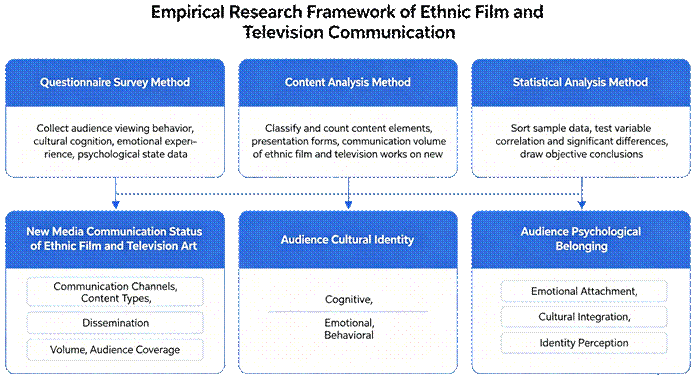
This study mainly adopts three empirical research methods: questionnaire survey method, content analysis method and statistical analysis method. Questionnaire survey is used to collect audience’s viewing behavior, cultural cognition, emotional experience and psychological state data; content analysis is applied to classify and count the content elements, presentation forms and communication volume of ethnic film and television works on new media platforms; statistical analysis is used to sort out sample data, test correlation and significant differences between variables, and draw objective research conclusions.
Combined with the research theme, three major research dimensions are constructed: first, the dimension of new media communication status of ethnic film and television art, including communication channels, content types, dissemination volume and audience coverage; second, the dimension of audience cultural identity, covering cognitive, emotional and behavioral three sub-dimensions; third, the dimension of audience psychological belonging, including emotional attachment, cultural integration and identity perception three sub-dimensions. All dimensions are set with quantifiable indicators to facilitate data collection and subsequent analysis[11].
2.3 Sample Distribution Standardize Investigation Process, Data Screening Guarantee Research Quality
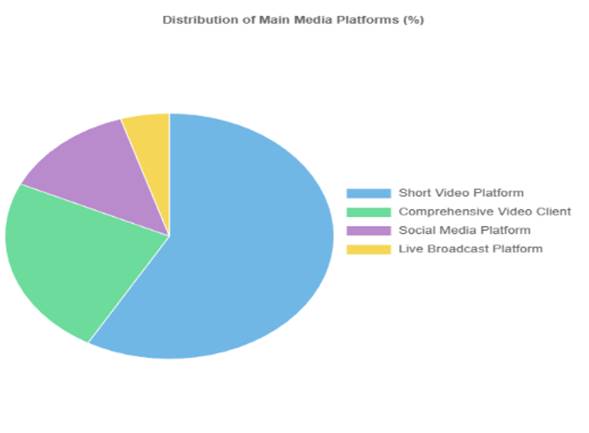
In this research, online electronic questionnaires are distributed through multiple new media platforms, and a total of 1800 questionnaires are issued. After eliminating invalid questionnaires such as repeated filling, incomplete information and inconsistent logical answers, 1626 valid questionnaires are finally obtained, with an effective recovery rate of 90.33%. The samples are divided according to age, educational background, regional attribute and media preference, and the basic information of valid samples is shown in Table 1.
Table 1 Basic Information Statistics of Research Samples (N=1626)
| Classification Category | Specific Group | Sample Number | Proportion (%) |
| Age Group | Under 18 years old | 241 | 14.82 |
| 18-30 years old | 685 | 42.13 | |
| 31-50 years old | 472 | 29.03 | |
| Over 50 years old | 228 | 14.02 | |
| Educational Background | Junior high school and below | 267 | 16.42 |
| Senior high school / Technical secondary school | 415 | 25.52 | |
| College / Undergraduate | 732 | 45.02 | |
| Postgraduate and above | 212 | 13.04 | |
| Regional Attribute | Ethnic inhabited areas | 593 | 36.47 |
| Non-ethnic inhabited areas | 1033 | 63.53 | |
| Main Media Platform | Short video platform | 947 | 58.24 |
| Comprehensive video client | 386 | 23.74 | |
| Social media platform | 215 | 13.22 | |
| Live broadcast platform | 78 | 4.80 |
During the data screening process, unified standards are adopted: questionnaires with less than 80% of completed questions, obviously random filling content and contradictory answers to logical questions are all regarded as invalid samples. Meanwhile, SPSS data analysis software is used to sort out and clean the valid data to ensure the authenticity, validity and rationality of all research data, laying a solid data foundation for subsequent empirical analysis.
3 Empirical Analysis & Result Presentation
According to the content theme and artistic form, the collected ethnic film and television works on new media platforms are divided into four categories: ethnic custom documentaries, ethnic story feature films, ethnic style micro films and ethnic cultural variety programs. This research counts the audience viewing frequency, viewing duration and interactive behavior of various types of works, and sorts out the audience viewing behavior data, as shown in Table 2.
Table 2 Audience Viewing Behavior Statistics of Different Types of Ethnic Film and Television Works (N=1626)
| Work Type | Average Weekly Viewing Times | Average Single Viewing Duration (minutes) | Interactive Participation Rate (%) | Forward Sharing Rate (%) |
| Ethnic Custom Documentary | 3.26 | 12.58 | 28.75 | 21.36 |
| Ethnic Story Feature Film | 2.14 | 45.32 | 19.42 | 15.87 |
| Ethnic Style Micro Film | 5.78 | 3.65 | 47.23 | 39.54 |
| Ethnic Cultural Variety Program | 4.12 | 18.76 | 36.81 | 28.62 |
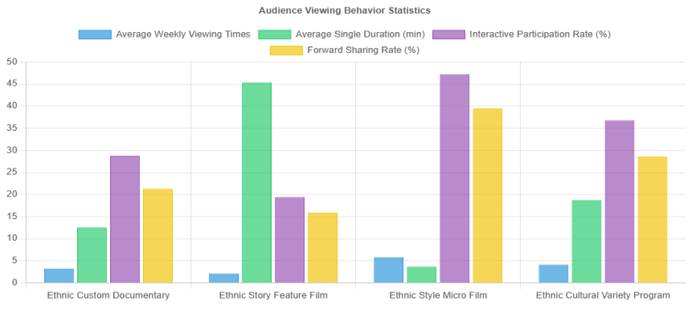
It can be seen from the data in Table 2 that ethnic style micro films have the highest viewing frequency and interactive sharing rate. Relying on the short, concise and vivid content characteristics, micro films fit the fragmented viewing habits of new media audiences and are most popular among the public. Ethnic story feature films have the longest single viewing duration, which reflects that such works have complete story lines and profound cultural connotations, and can attract audiences to watch continuously. Ethnic custom documentaries and cultural variety programs maintain a stable audience group, and play a steady role in cultural popularization.
From the perspective of audience behavior, the interactive and sharing behavior of audiences is closely related to the form of film and television works. Works with short content, strong interestingness and strong visual impact are more likely to trigger audiences’ secondary communication, which is a typical communication characteristic under the new media environment.
3.2 Correlation Analysis Explore Influence Rules, Score Comparison Reflect Identity Differences
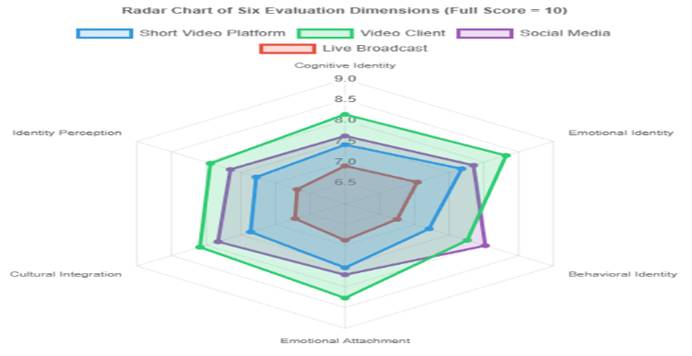
Based on the three sub-dimensions of cultural identity (cognition, emotion, behavior) and three sub-dimensions of psychological belonging (emotional attachment, cultural integration, identity perception), this research sets scoring indicators (full score of each indicator is 10 points), and conducts scoring statistics on the identity and belonging degree of audiences facing different communication channels and different content works. Meanwhile, Pearson correlation analysis is used to test the correlation between the communication volume of ethnic film and television works and audience scores, and the comprehensive scoring results are shown in Table 3.
Table 3 Average Scores of Audience Cultural Identity and Psychological Belonging (Full Score=10, N=1626)
| Evaluation Dimension | Sub-dimension | Short Video Platform | Video Client | Social Media | Live Broadcast Platform | Average Score |
| Cultural Identity | Cognitive Identity | 7.42 | 8.15 | 7.63 | 6.91 | 7.53 |
| Emotional Identity | 7.68 | 8.32 | 7.85 | 7.04 | 7.72 | |
| Behavioral Identity | 7.21 | 7.76 | 8.02 | 6.75 | 7.44 | |
| Psychological Belonging | Emotional Attachment | 7.54 | 8.27 | 7.71 | 6.88 | 7.60 |
| Cultural Integration | 7.36 | 8.09 | 7.83 | 6.72 | 7.45 | |
| Identity Perception | 7.28 | 7.94 | 7.65 | 6.69 | 7.39 |
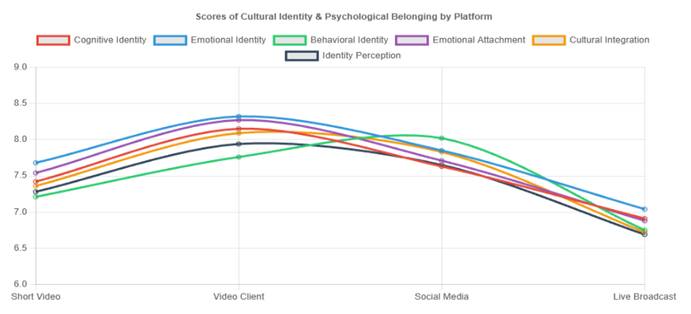
Combined with correlation analysis data, the communication volume of ethnic film and television works is significantly positively correlated with audiences’ cultural identity and psychological belonging scores (P<0.05). The higher the exposure and communication frequency of high-quality ethnic film and television works on new media platforms, the higher the audiences’ overall recognition and emotional belonging.
From the perspective of different platforms, comprehensive video clients have the highest scores in cognitive identity, emotional identity and emotional attachment. Long videos represented by feature films and documentaries can deliver in-depth cultural information and bring audiences deeper cultural cognition and emotional resonance. Social media platforms perform well in behavioral identity and cultural integration. Relying on the social interaction atmosphere, audiences are more willing to participate in cultural discussions and spread related content, and promote the integration of different cultures. Short video platforms have a large audience base and moderate overall scores, with obvious advantages in popularizing basic cultural knowledge. The overall scores of live broadcast platforms are relatively low, which is related to the single form of live broadcast content and unstable content quality.
From the perspective of group differences, audiences in ethnic inhabited areas have higher scores in all sub-dimensions of cultural identity and psychological belonging, with an average score 0.68 points higher than that of audiences in non-ethnic inhabited areas. Young audiences aged 18-30 have the most active behavioral identity, while middle-aged and elderly audiences have stronger emotional attachment to ethnic culture.
3.3 Result Summary Summarize Core Conclusions, Mechanism Analysis Sort Out Action Paths
Through empirical data analysis, three core research conclusions are drawn. First, new media communication has a significant positive impact on audiences’ cultural identity and psychological belonging. The popularization of diversified new media channels expands the coverage of ethnic film and television art, and continuously deepens audiences’ understanding and emotional recognition of ethnic culture. Second, the content form and communication platform of ethnic film and television works produce differentiated influence. Long video works are conducive to shaping in-depth cultural cognition and emotional resonance, while short video and social platforms stimulate audiences’ active communication behavior. Third, audience attributes such as region, age and media habit will lead to differences in identity and belonging levels, and the cultural foundation of audiences directly affects the effect of art communication.
Combined with the above conclusions, the internal action mechanism is sorted out: new media takes ethnic film and television works as the cultural carrier, first realizes the dissemination of cultural information through content presentation, completes the construction of audiences’ cognitive identity at the cognitive level; then triggers emotional resonance through artistic expression and cultural scene restoration, forms emotional identity and emotional attachment at the emotional level; finally drives audiences to carry out interactive sharing and cultural participation through platform social attributes, and realizes behavioral identity and cultural integration at the behavioral level. The whole process forms a closed-loop from information input to emotional output and behavioral feedback, and continuously strengthens audiences’ cultural identity and psychological belonging.
4 Current Dilemmas & Root Cause Analysis
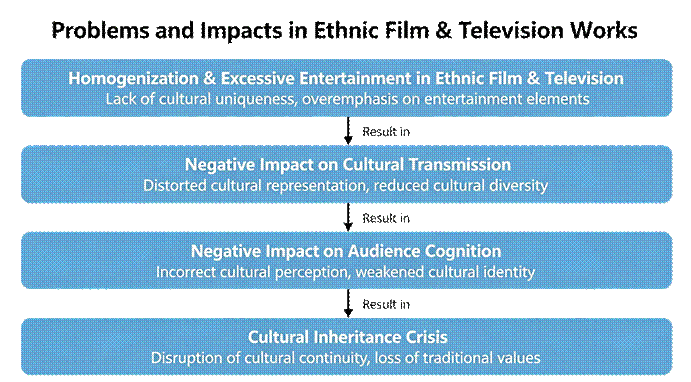
At present, many ethnic film and television works launched on new media platforms have serious homogenization problems. A large number of works blindly copy the shooting style, story framework and content elements of popular works, simply pile up ethnic costumes, song and dance and scenic spots, and lack in-depth exploration of ethnic historical stories, spiritual connotations and unique cultural genes. For instance, numerous short video contents set in Tibetan areas repeatedly feature prayer flags fluttering against blue skies and monks chanting mantras, while ignoring the diverse living customs of different Tibetan tribes or the evolution of their traditional arts in modern society. This superficial cultural representation not only leads to a single content form that makes audiences suffer from aesthetic fatigue, but also fails to construct profound cultural memories. According to a 2025 audience survey on ethnic cultural works, over 68% of respondents admitted they could not distinguish the cultural characteristics of different ethnic groups after watching such homogenized contents, reflecting the failure of these works to effectively convey the unique cultural identities of various ethnic communities.
4.2 Channel Utilization Has Imbalanced Development, Operation Management Lacks Long-term Layout
In terms of new media channel utilization, the development is obviously imbalanced. Most creators focus on short video platforms with large traffic, such as TikTok and Kuaishou, while ignoring the deep operation of comprehensive video clients, social platforms and other channels. For example, 85% of ethnic cultural content is concentrated on short video platforms according to a 2025 industry report, with only 12% and 3% distributed on long-video platforms and cultural heritage websites respectively. The content released on different platforms is highly identical, and targeted content adaptation and differentiated operation are not carried out according to the audience characteristics and platform rules of each channel. Short video platforms should focus on visual impact with 15-60 second clips highlighting ethnic dance and costumes, while long-video platforms could develop in-depth documentaries exploring cultural origins, resulting in waste of communication resources.
4.3 Audience Guidance Is Relatively Weak, Cultural Transmission Faces Barriers
New media information is complicated and mixed, and high-quality ethnic film and television works are easily submerged in massive content. At present, there is a lack of effective content guidance and accurate push mechanism. Many audiences cannot actively contact excellent ethnic cultural works, resulting in low overall cultural penetration. For audiences in non-ethnic inhabited areas, due to the lack of basic cultural cognition, it is difficult for them to understand the deep connotation of ethnic film and television works, and there are obvious barriers to cross-regional and cross-cultural communication[13].
4.4 In-depth Exploration Trace Root Causes, Multiple Factors Restrict Sustainable Development
The root causes of the above dilemmas can be summarized into four aspects. First, the creative team has insufficient cultural literacy. Some creators lack in-depth learning and field research on ethnic culture, resulting in superficial content creation. Second, the profit orientation is biased. Driven by traffic economy, many creators take short-term traffic gains as the goal and ignore the cultural inheritance function of works. Third, the industry standard is not perfect. There is no unified review standard and creation specification for new media ethnic film and television works, leading to the proliferation of inferior and homogenized content. Fourth, the resource integration ability is insufficient. The industry has not formed an integrated development model of creation, communication, operation and feedback, and the overall sustainable development capacity is weak.
5 Optimization Strategies & Sustainable Paths
5.1 Root Creation Deepen Cultural Connotation, Innovate Forms Highlight Ethnic Features
Based on the concept of sustainable cultural inheritance, content creation should take cultural authenticity and depth as the core. Creators need to carry out field visits and in-depth research on various ethnic cultures, such as living with the Dong people in southeastern Guizhou for three months to record the inheritance process of their grand song art, dig into historical legends, folk ethics, life concepts and spiritual pursuits behind ethnic customs, and integrate real cultural connotations into film and television works. For example, the documentary “The Sound of Dong” successfully presents the ecological wisdom of “forest-village-rice field” symbiosis through the daily life of a Dong singer. Abandon the simple stacking of superficial cultural symbols like random insertion of ethnic costumes without cultural context, and create works with temperature, depth and ethnic characteristics that truly reflect the living state and emotional world of ethnic groups.
5.2 Classified Operation Activate Multiple Channels, Overall Planning Build Long-term Mechanism
Carry out classified operation for different new media platforms according to their positioning and audience characteristics. For short video platforms, launch short and exquisite clip content and popular science clips to realize the rapid popularization of ethnic culture; for comprehensive video clients, launch complete documentaries and feature films to deliver in-depth cultural content; for social media platforms, launch topic discussions, behind-the-scenes stories and interactive activities to drive secondary communication. Realize differentiated content layout and complementary advantages of multiple channels.
Establish a standardized long-term operation mechanism. Set up professional creation, operation and promotion teams, formulate phased communication plans and overall development plans. Take sustainable cultural communication as the long-term goal, get rid of the short-term traffic thinking, form a continuous content output and audience maintenance system, and ensure the stable and long-term development of ethnic film and television art communication.
5.3 Accurate Push Strengthen Audience Guidance, Interactive Link Bridge Cultural Distance
Make full use of big data technology of new media platforms to realize accurate content push. According to audiences’ age, region, viewing preference and other labels, push targeted ethnic film and television works to different groups, such as recommending youth-oriented ethnic music videos to Gen Z users and traditional culture documentaries to middle-aged audiences, increase the exposure of high-quality works, and let more audiences contact and understand excellent ethnic culture. For audiences in non-ethnic areas, launch popular science supporting content like cultural background explainers and folk custom dictionaries to supplement basic cultural knowledge and eliminate cross-cultural communication barriers[15].
5.4 Standardize Industry Rectify Communication Ecology, Link Resources Realize Coordinated Development
Relevant institutions and industry organizations shall formulate unified creation standards and content review norms for new media ethnic film and television works, crack down on false creation and excessive entertainment behavior, purify the overall communication ecology, and protect the authenticity and uniqueness of ethnic culture. Guide the whole industry to establish a development concept combining artistic value, cultural value and social value.
Promote the integrated integration of industry resources, realize the linkage of cultural institutions, creation teams, new media platforms and social organizations. Build a whole industrial chain integrating cultural research, content creation, platform communication, audience service and cultural inheritance. Rely on multi-party resource cooperation, enhance the overall strength of the industry, and finally realize the sustainable development of ethnic film and television art, ethnic cultural inheritance and audience spiritual construction.
6 Research Summary & Prospect Outlook
6.1 Overall Review Sort Out Research Achievements, Practical Value Reflect Research Significance
This research takes the new media era as the background and sustainable development as the perspective, adopts empirical research methods to systematically discuss the influence of ethnic film and television art communication on audiences’ cultural identity and psychological belonging. Through sample investigation, data statistics and correlation analysis, the communication status, audience behavior, influence mechanism and existing dilemmas of current ethnic film and television works on new media platforms are clarified, and targeted optimization strategies are put forward.
In practical value, the research conclusions can provide objective data reference and practical ideas for creators, operators and managers engaged in ethnic film and television communication. It helps to improve the communication effect of ethnic art, promote the inheritance and innovation of excellent ethnic culture, and enhance the whole people’s cultural confidence and cultural identity. In theoretical value, this research enriches the research system of new media communication and ethnic cultural communication, and expands the research perspective of cultural sustainable development.
6.2 Deficit Reflection Recognize Research Limitations, Expansion Direction Improve Research Depth
6.3 Future Outlook Look Forward to Development Trends, Cultural Inheritance Keep Vitality Forever
With the continuous upgrading of new media technology and the continuous attention to ethnic cultural inheritance, the communication mode of ethnic film and television art will become more diversified and intelligent. Emerging technologies such as virtual reality (VR) and augmented reality (AR) will enable audiences to experience ethnic cultural scenes immersively, like participating in traditional festivals through VR documentaries or interacting with cultural relics via AR applications. Content creation will pay more attention to cultural depth and emotional temperature, shifting from superficial element stacking to narrative innovation that integrates historical context and contemporary values, while communication channels will realize more efficient integrated development through cross-platform content matrices—short video platforms for cultural popularization, long-video platforms for in-depth documentaries, and social media for community interaction—forming a closed-loop communication ecosystem.
Ethnic film and television art, as a precious cultural wealth, will rely on new media platforms to move towards a broader stage. Through continuous content innovation such as developing serialized cultural IPs and interactive storytelling formats, channel optimization including AI-driven precise content recommendation systems, and ecological improvement by establishing industry-university-research cooperation mechanisms, it will continuously stimulate audiences’ cultural identity and psychological belonging. This development will not only protect the diversity of national cultures by digitizing intangible cultural heritage into audiovisual works but also promote intercultural dialogue by creating bilingual content with cultural context explanations. Ultimately, excellent ethnic cultures will inherit and develop continuously in the era of digital media, glow with lasting vitality under the concept of sustainable development, and contribute to building a culturally confident and inclusive society.
References
- Guangfu Q . Aware Particle Swarm Optimization Algorithm for Emotion Recognition and New Media Intelligent Interaction[J].International Journal of Information Technologies and Systems Approach (IJITSA),2026,19 (1):1-26
- Zhang Y . The Practice Path of New Media Matrix in Campus Culture Propaganda from the Perspective of Cultural Identity Construction[J].SOAP,2026,19 317-323.
[3]Koranteng O E ,Ocloo D E P . Online information consumption among faculty and students of the National Film and Television Institute (NAFTI) during the COVID-19 pandemic[J].Routledge,2026,50 (2):252-274.
[4]Liao C . Application and Prospect of New Media in Environmental Design and Living Space Renovation[J].Natural Science Press LTD,2026.
[5]Hernández Á A ,Sepúlveda A G ,Zarza Z .Diffracting the North:Contemporary Latinx Canadian Experiences and Practices in Film, New Media, and Visual Arts[M].Concordia University Press: DOI:10.1515/9781988111926.
[6]Rulin Y .The Innovation of Dance Art Communication in TV Dance Program:Taking “Dance Storm Season 2” as an Example[C]//Atlantis Press,2021.
[7]Sun N ,Bi J . The Practical Application of Art Therapy Theories in New Media Interactive Video Installations[J].NEM Publishing Company,2025,2 (6):42-44.
[8]Lee Y ,Liu Z . Research on Art Therapy Healing in New Media Interactive Design Based on Color Psychology[J].Frontiers in Art Research,2025.
[9]Wang Y . How Hosts Can Tell Chinese Stories Well through New Media Platforms in the Context of Cross-Cultural Communication[J].STEMM Institute Press,2025.
[10]Gao J . Exploration of Artificial Intelligence Technology Application in New Media Art Creation[J].Artificial Intelligence Technology Research,2025.
[11]Koranteng O E ,Ocloo D E P . User Perspective of Reference Service Provision at the National Film and Television Institute (NAFTI), Ghana[J].Library Philosophy and Practice,2023.
[12]Canyang W . Visual Communication Design Under the Impact of New Media Art Design Based on VR[J].International Journal of Information Technologies and Systems Approach (IJITSA),2025.
[13]Shao J ,Pei J ,Cheng Z , et al. The Integration of VR Technology and New Media Art in the Smart Space of the Internet of Things[J].International Journal of High Speed Electronics and Systems,2025.
[14]Xu J . The Method of Piano Performance Art Display from the Perspective of New Media[J].Forum on Research and Innovation Management,2025.
[15]Yu W . Research on the Role of Digital Art in Cultural Inheritance and Innovation Based on the Philosophy of New Media Technology[J].Scientific and Social Research,2025,7 (3):172-178.