DOI:https://doi-0004.org/6812/17907826448239
Unités d’entraînement proposées basées sur les jeux réduits durant la phase de préparation physique générale et leur impact sur le développement de l’endurance chez les footballeurs de moins de 17 ans
Dr. Hachi Khaled*1,
University of Djelfa, Laboratory of Physical and Sports Activities in Algeria, Algeria,
Email: k.hachi87@univ-chlef.dz
Dr. Saihi Fouad 2,
University of Djelfa, Laboratory of Physical and Sports Activities in Algeria, Algeria,
Email: fouad.saihi@univ-mosta.dz
Dr. Rafes Badis 3,
University of Chlef, Laboratory of Creativity and Motor Performance.
Email: b-rafas86@univ-chlef.dz
Dr. Khelfaoui lazhari 4,
University of Djelfa, Laboratory of Physical and Sports Activities in Algeria, Algeria,
Email: l.khalfaoui@univ-djelfa.dz
Dr. Ben Rached Yacine5,
University of Djelfa, Laboratory of Physical and Sports Activities in Algeria Algeria,
Email: benrachedyacine@univ-tissemsilt.dz
Received: 23/03/2026 Accepted: 05/08/2026 Published: 10/09/2026
Abstract:
This study aimed to propose training units based on small-sided games (SSGs) during the general physical preparation phase and investigate their impact on developing endurance (maximal aerobic speed) among under-17 soccer players. To achieve this, the researchers adopted an experimental approach utilizing a one-group pre-test and post-test design, applied to a purposive sample consisting of 18 players from the Djelfa U-17 youth team. The training units were implemented between 17/10/2025 and 31/10/2025 within a 15-day mesocycle. Following the post-test and statistical processing (using the paired samples t-test), the results revealed statistically significant differences in favor of the post-test regarding maximal aerobic speed (MAS/VMA) measured via the Yo-Yo intermittent recovery test. This confirms the effectiveness of the proposed training units in enhancing the targeted physical indicator.
Keywords: Training Units, Small-Sided Games (SSGs), General Physical Preparation, Maximal Aerobic Speed (MAS), Yo-Yo Test, Soccer, Under-17 Category. ط
Résumé:
Cette étude visait à proposer des unités d’entraînement basées sur les jeux réduits durant la phase de préparation physique générale et à examiner leur impact sur le développement de l’endurance (vitesse maximale aérobie) chez les footballeurs de moins de 17 ans. Pour ce faire, les chercheurs ont adopté une approche expérimentale selon un plan à groupe unique avec pré-test et post-test, appliqué à un échantillon intentionnel composé de 18 joueurs de l’équipe de jeunes de Djelfa, catégorie moins de 17 ans. Les unités d’entraînement ont été mises en œuvre du 17/10/2025 au 31/10/2025, dans le cadre d’un mésocycle d’une durée de 15 jours. À l’issue du post-test et du traitement statistique des données au moyen du test t de Student pour échantillons appariés, les résultats ont révélé des différences statistiquement significatives en faveur du post-test concernant la vitesse maximale aérobie (VMA/MAS), mesurée à l’aide du test intermittent de récupération Yo-Yo. Ces résultats confirment l’efficacité des unités d’entraînement proposées dans l’amélioration de l’indicateur physique ciblé.
Mots-clés : unités d’entraînement, jeux réduits, préparation physique générale, vitesse maximale aérobie (VMA), test Yo-Yo, football, catégorie des moins de 17 ans.
1. Introduction
Physical preparation, particularly at the beginning of the competitive season, is considered one of the fundamental stages in preparing a soccer player, as it forms a crucial foundation for achieving an appropriate level of physical readiness and athletic performance throughout the season. Physical conditioning in soccer relies on developing an interrelated set of physical attributes—including endurance, strength, speed, and agility—aligned with the demands of performance and competition.
Endurance is recognized as one of the essential physical attributes required by soccer players, given the nature of competitive activity that demands repeated high-intensity or near-maximal efforts alternated with varying recovery periods. In this context, Boufaden (2016) highlights the importance of endurance for modern soccer players from both aerobic and anaerobic perspectives, (Boufaden, 2016) while emphasizing maximal oxygen uptake (VO2max) and maximal aerobic speed (MAS) as key indicators linked to aerobic capacity and physical performance.
Furthermore, Bishop et al. (2011) explain that soccer requires players to repeat high-intensity efforts over short periods interspersed with recovery phases, rendering repeated-sprint ability a vital element in the intermittent performance characterizing soccer activity. Consequently, developing aerobic capacities and recovery capabilities constitutes an essential part of player preparation and enhances their ability to maintain performance levels across different phases of a match (Bishop & al, 2011, pp. 741–756).
On the other hand, the development of physical capacities cannot be separated from technical and tactical aspects. Akli (2018) points out a close correlation between motor capacities and skill performance levels; a player needs an appropriate physical and motor foundation to execute fundamental skills of the specialized activity efficiently, making physical readiness a vital factor in implementing the coach’s philosophy and game plan (Akli, 2018).
In light of modern trends in sports training, it has become imperative to transcend the rigid separation between physical, technical, and tactical aspects, relying instead on training methods that allow these dimensions to be developed in an integrated and overlapping manner. Among these methods is small-sided games (SSGs) training, which allows players to experience situations closely mirroring competitive demands within specific dimensions, player counts, and rules.
In this context, Bénezet and Hasler (2012) view small-sided games as a training tool through which the physical dimension of soccer players can be developed (Bénezet & Hasler, Hansruedi, 2012), while Zakaria et al. (2012) indicate their utility in cultivating various physical attributes required by players. Moreover, Sahraoui et al. (2014) demonstrate that ball-oriented training in constrained spaces places players in situations similar to those encountered during competition, combining physical, technical, and competitive demands.
Stemming from the importance of endurance in soccer player preparation and the role small-sided games play in integrating various training dimensions, this study was designed to propose training units based on small-sided games during the general physical preparation phase and to examine the changes occurring in endurance levels among under-17 soccer players. Accordingly, the research problem can be formulated through the following question:
Do the proposed training units based on small-sided games during the general physical preparation phase contribute to developing endurance in under-17 soccer players?
2. Materials and Methods
Following the adoption of the experimental approach, it was necessary to define the research population and select an appropriate sample representing the target group of the study. The following provides further details:
1.2. Research Methodology
The researchers adopted an experimental approach utilizing a one-group pre-test and post-test design. This involved measuring the endurance level prior to applying the proposed training units and re-measuring it upon completion. This design was selected to match the nature and objectives of the study, enabling the monitoring of changes occurring in the measured physical indicator during the training intervention period.
2.2. Research Population and Sample
The research population consisted of under-17 soccer teams affiliated with the Blida Regional League, comprising nine (09) teams with a total of 207 players. The research population refers to all elements or units belonging to the phenomenon under study regarding which the researcher seeks to draw conclusions (Aliyan & Ghunaim, Othman Mohammad, 2000, p. 137).
The research sample represents a subset of the research population selected according to a specific method to study the target phenomenon and generalize findings within the limits of the sample and population characteristics. Obeidat et al. define it as a partial group of the research population chosen via a specific method to conduct the study and utilize results to infer characteristics about the original population (Obeidat & al, 1999, p. 74). The study sample was purposefully selected from the under-17 youth team players of Djelfa, active in the Blida Regional League.
3.2. Study Variables
- Independent Variable: Training units based on small-sided games during the general physical preparation phase.
- Dependent Variable: Endurance, measured via the indicator utilized in the Yo-Yo test to determine maximal aerobic speed (MAS).
- Mediating Variable: Under-17 soccer players from Achaeb El Djelfa Club, competing in the Blida Regional League.
4.2. Research Tools
- Maximal Aerobic Speed (MAS) Assessment via the Yo-Yo Test: The Yo-Yo test was utilized to evaluate aerobic performance and determine maximal aerobic speed (MAS) among sample members. The Yo-Yo test is a recognized field test used to assess players’ capacities for repeated efforts and intermittent running, and its results help estimate parameters associated with aerobic capacity.
- Equipment Used: Playing surface, cones, loudspeaker, smartphone, and the Yo-Yo Test application.
- Data Extraction: Upon test completion and the identification of performance levels (les paliers), the accompanying table in the application is used to determine performance parameters, while total distance covered is directly evaluated.
- Test Description:
- Step 1: The player begins running upon hearing the start signal according to the speed specified in the test protocol, running back and forth between two designated lines while utilizing the prescribed recovery interval between shuttles. Throughout the run, players must synchronize their pacing with the audio signals to ensure compliance with the standardized testing rules. The test progresses incrementally with increasing speed requirements until the player fails to maintain the designated rhythm according to the test’s cessation criteria. Upon completion, the level and distance covered by the player are recorded based on the application’s output, providing an immediate raw dataset of the player’s intermittent endurance performance.
- Step 2: After finishing the test and identifying the level reached by each player, the table accompanying the application is consulted to determine indicators related to the test result, allowing the extraction of the MAS (VMA) value from the data provided by the application. This conversion process translates the total covered distance and completed shuttles into reliable physiological metrics. Consequently, these derived values serve as the primary baseline indicators to evaluate aerobic capacity improvements before and after the training intervention.
Figure 01: Illustration of the Yo-Yo Test
Source: Prepared by the researchers based on the official Yo-Yo Test guidelines.
5.2. Main Experiment
The researchers prepared training units based on small-sided games within a medium-term training cycle (mesocycle) following a set of scientific steps and foundations. These units were presented to a panel of expert judges to gather their feedback and comments for refining the content. In coordination with the team coach, the implementation period for the training units during the general physical preparation phase was set from October 17, 2025, to October 31, 2025.
The training program was structured around employing small-sided games to integrate various components of sports training—particularly physical, technical, and tactical dimensions—rather than treating them in isolation. This approach aims to leverage the nature of small-sided games in simulating match demands while optimizing training time and effort.
Table 01: Table 01: Number of Training Units and Training Load During the General Preparation Period
| Training Cycle | Méso cycle 02 semaines | ||||||||
| Weeks | First | Second | |||||||
| Training Dose | 1 | 2 | 3 | 4 | 1 | 2 | 3 | 4 | |
| Training Load (%) | 100-90 | ||||||||
| 90-80 | |||||||||
| 80-70 | |||||||||
| 70-60 | |||||||||
| 60-50 | |||||||||
| | Physical Objective | -ca | -ca -rsa frc | -pa -frc | -pa -frc cord | -ca -vm | -ca | -pa -frc | –ca | -ca -frc | |
Source: Prepared by the researchers based on the proposed small-sided games training units.
Table 01 presents the organization of the proposed small-sided games training units during the general preparation period, structured over a two-week training cycle. The table outlines the distribution of training sessions across eight units, with training loads ranging from 50–60% to 90–100%, demonstrating variations in intensity according to the objectives of each session. It also highlights diverse physical objectives, including aerobic capacity (CA), anaerobic capacity (PA), repeated sprint ability (RSA), explosive strength (FRC), coordination (Coord), and maximal speed (VM). This progressive structure is consistent with the requirements of the general preparation phase and the target age group, while using small-sided games to integrate physical development with soccer-specific performance demands. Overall, this organization provided the basis for implementing the proposed intervention prior to the post-test assessment.
6.2. Statistical Tools
The study relied on the following statistical tools:
- Arithmetic mean.
- Standard deviation.
- Paired samples t-test to compare pre- and post-measurements.
Data processing was conducted using the Statistical Package for the Social Sciences (SPSS).
3. Results
3.1. Presentation and Analysis of Research Hypothesis Results
Research Hypothesis: The study assumes that the proposed training units based on small-sided games during the general physical preparation phase contribute to developing endurance in under-17 soccer players.
Table 02: Table 02: Pre-Test and Post-Test Results for Endurance
| First Test: Maximal Aerobic Speed (MAS/VMA) (Yo-Yo Test 1) | |||||||
| Mean | Standard Deviation (SD) | Calculated t-value | Critical t-value | Degrees of Freedom (df) | Significance Level | Decision | |
| Pretest | 3033,33 | 613,91 | 5 | 1،74 | 17 | 0،05 | Significant |
| Posttest | 3151,11 | 555,19 | |||||
Source: Prepared by the researchers based on the field data and SPSS statistical analysis.
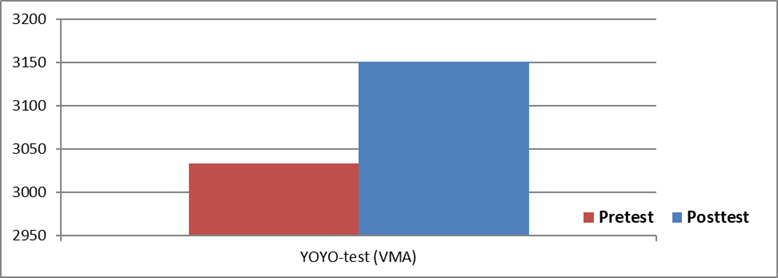
Table 02 shows that participants’ performance on the Maximal Aerobic Speed (MAS) Yo-Yo test improved from the pre-test (mean = 3033.33 ± 613.91) to the post-test (mean = 3151.11 ± 555.19). The calculated t-value of 5 exceeded the critical value of 1.74 (p < 0.05, df = 17), confirming a statistically significant difference in favor of the post-test. These findings indicate that the proposed small-sided games training units effectively improved the measured physical indicator.
Figure 02: Pre-Test and Post-Test Results for the Maximal Aerobic Speed Test
Source: Prepared by the researchers based on SPSS statistical analysis outputs (2021).
As illustrated in Figure 02, the bar chart shows an upward trend between the pre-test and post-test measurements of the participants’ Maximal Aerobic Speed (MAS). The mean performance increased from 3033.33 in the pre-test to 3151.11 in the post-test, indicating an improvement in the measured performance indicator following the implementation of the proposed small-sided games training units.
3.2. Analysis of Maximal Aerobic Speed (MAS / VMA) Results
The results of the pre-test showed an arithmetic mean of 3033.33 with a standard deviation of 613.91, whereas the arithmetic mean in the post-test reached 3151.11 with a standard deviation of 555.19. At a significance level of 0.05 and 17 degrees of freedom, the calculated t-value was 5, which is greater than the critical tabular t-value of 1.74. This indicates the presence of statistically significant differences between the pre-test and post-test measurements in the Yo-Yo test utilized in the study.
These results point toward an improvement in the sample’s performance concerning the measured indicator following the application of the proposed training units compared to the pre-test.
4. Discussion of Results
The results obtained in the present study are discussed in light of the research hypothesis, the characteristics of the proposed training units, and the specific demands of small-sided games in soccer. The discussion also considers the findings of previous studies and the methodological limits of the present research:
4.1. Discussion of the Research Hypothesis Results
The results of the statistical processing revealed statistically significant differences between the pre- and post-measurements in the Yo-Yo test, favoring the post-test. This indicates an improvement in the sample’s performance regarding aerobic capacity and maximal aerobic speed during the period following the implementation of the proposed training units.
This improvement can be explained by the nature of the small-sided games used in the training units, which require players to repeatedly run, change directions, move continuously, and interact with game situations in restricted spaces. This generates recurring physical demands linked to the capacity to exert effort and recover effectively.
Furthermore, designing small-sided games to align with the objectives of the general physical preparation phase allows for the integration of physical conditioning with technical and tactical components. Consequently, players execute physical efforts in contexts closely mirroring soccer match realities rather than isolating them from game-specific situations.
These results align, in general orientation, with findings from prior studies addressing the integration of small-sided games in soccer training, including foundational works by Dellal (2013) and Sahraoui et al. (2014), which highlighted the utility of constrained space drills in enhancing athletes’ physical and motor capabilities (Sahraoui & al, 2014, pp. 424–439).
Moreover, subsequent research by Ben Rabah et al. (2018) and Hejab (2018) further supported these conclusions by demonstrating that structured small-sided game programs significantly contribute to the development of key physical attributes in youth soccer categories. (Hejab & Kamal Ben Mesbah, 2018, pp. 129–143).
Furthermore, Ahmad Najib Abd Razak et al. (2020) highlighted the effectiveness of small-sided games in enhancing performance aspects—such as offensive efficiency—through tactical rotation, confirming their comprehensive value in soccer training environments (Abd Razak & al, 2020, pp. 5954–5963).
Additionally, Ben Rabah et al. (2018) focused on comparing different modern training methods, demonstrating that small-sided games (such as 1v1 and 2v2 formats) play a crucial role in improving explosive power and specific physical adaptations among under-17 soccer players, which closely mirrors the physiological and neuromuscular demands encountered during competitive matches (Ben Rabah & al, 2018, pp. 167–174).
These results align, in general orientation, with findings from prior studies addressing the use of small-sided games in soccer training, including Dellal (2013) (Dellal, 2013, p. 192). Sahraoui et al. (2014), Ben Rabah et al. (2018), Hejab (2018), and Najib et al. (2020), all of which investigated the employment of small-sided games in developing various physical, technical, and tactical traits among soccer players.
Hejab (2018) also noted that training via small-sided games provides diverse motor and competitive scenarios, contributing to the development of multiple physical attributes in soccer players through team play dynamics and continuous movement
Similarly, Ben Rabah et al. (2018) highlighted the importance of small-sided games in developing physical capabilities in under-17 players, while other studies, such as Khelif and Mezari (2019), reported findings supporting the integration of small-sided games into training programs aimed at enhancing specific physical characteristics. (Khelif & Mezari, Fateh, 2019, pp. 463–479)
Furthermore, research by Faghloul (2015) emphasizes the effectiveness of incorporating ball-integrated training methods into conditioning programs to improve the physical traits of young soccer players. ((Faghloul, 2015).
Moreover, Khelif and Mezari (2022) indicated that utilizing small-sided games for appropriate training durations correlates with improved capacities to execute high-intensity efforts and directional agility movements.
Conversely, Akli (2018) suggests that small-sided games allow players to perform multiple motor actions, such as changing direction, acceleration, rapid transitions, lateral movements, and running forward/backward—demands overlapping with several physical capacities required by soccer players (Akli, 2018).
Accordingly, it can be concluded that the results recorded in the current study concur with the consensus emphasizing small-sided games as an effective training medium bridging game demands and physical exertion. The observed enhancement in post-test results reflects positive modifications in the measured indicator subsequent to the intervention.
Therefore, within the limits of the study design, sample, and established timeframe, the findings substantiate the research hypothesis positing significant differences between pre- and post-measurements in favor of the post-test.
4.2. Interpretation of the Findings in Relation to Small-Sided Games Training
The observed improvement in the post-test results may also be interpreted in relation to the specific structure and organization of the proposed training units. The use of small-sided games during the general physical preparation phase provides repeated opportunities for players to perform running actions, accelerations, changes of direction, and continuous movements within game-related situations. Such repeated efforts may contribute to improving the players’ ability to sustain physical activity and respond to intermittent demands characteristic of soccer performance.
In addition, the variation in training loads and physical objectives across the proposed units may have contributed to maintaining an appropriate level of training stimulus throughout the intervention period. The combination of aerobic, anaerobic, speed, strength, and coordination-related demands within small-sided games creates a multidimensional training environment in which physical development is integrated with technical and tactical execution.
However, these findings should be interpreted within the methodological limits of the study. The one-group pre-test–post-test design does not allow the observed changes to be attributed exclusively to the proposed training units, since other factors, such as regular training, maturation, or external influences, may also have contributed to the changes observed between the two measurements. Nevertheless, the statistically significant difference between the pre-test and post-test provides an empirical indication of improvement in the measured performance indicator following the training period.
5. Conclusion
Modern sports training aims to develop players comprehensively through integration among physical, technical, tactical, and psychological dimensions, enabling optimal readiness and competitive performance. Within this framework, small-sided games represent a training tool permitting the amalgamation of these elements within scenarios close to competitive realities.
The results of the current study demonstrated statistically significant differences between pre- and post-measurements in the Yo-Yo test, coupled with post-test improvements in the measured indicator. These findings offer an indicator regarding the feasibility of leveraging small-sided training units during the general physical preparation phase for under-17 soccer players.
Consequently, the proposed training units can serve as a practical instrument for coaches and physical preparers when conditioning youth categories, provided they account for age group characteristics, player fitness levels, training loads, and individual/collective team dynamics.
Finally, the outcomes of this research must be interpreted within the constraints of its experimental design, sample characteristics, and implementation period, and should not be generalized beyond the studied population without accounting for methodological and training variations across distinct sports environments and samples.
6. References
(Faghloul, A.-S. (2015). The Proposed Ball-Integrated Training Method for Developing Certain Physical Traits in Under-17 Soccer Players. Institute of Physical and Sports Activity Sciences and Techniques, Abdelhamid Ibn Badis University of Mostaganem. Algeria: Not specified.
Abd Razak, A. N., & al. (2020). Effects of Small-Sided Game on Offensive Effectiveness Using Tactical Periodization in Youth Football Player. European Journal of Molecular and Clinical Medicine, 7(2), 5954–5963.
Akli, H. (2018). The Impact of Using Small-Sided Games (5v5 and 2v2) on Developing Certain Physical and Technical Traits in Under-23 Soccer Players. Institute of Physical and Sports Activity Sciences and Techniques, Mohamed Khider University of Biskra. Algeria: Not specified.
Aliyan, R. M., & Ghunaim, Othman Mohammad. (2000). Scientific Research Methods and Techniques (1st ed.). Amman, Jordan: Dar Al-Safa for Publishing and Distribution.
Ben Rabah, K., & al. (2018). A Comparative Study Between Ballistic Training and Small-Sided Games Training (1v1, 2v2) Methods in Developing Explosive Power Among Under-17 Soccer Players. Journal of Physical, Sports and Artistic Activity Sciences and Practices(13), 167–174.
Bénezet, J., & Hasler, Hansruedi. (2012). Football des jeunes. Berneck, Switzerland: Galledia AG.
Bishop, D., & al. (2011). Repeated-Sprint Ability – Part II: Recommendations for Training. Sports Medicine, 41(9), 741–756. doi:10.2165/11590560-000000000-00000
Boufaden, O. (2016). The Impact of Variable-Intensity Interval Training on Improving Anaerobic and Aerobic Metabolic Thresholds in Junior Soccer Players. Institute of Physical and Sports Activity Sciences and Techniques, Sports Training Department, Algeria.
Dellal, A. (2013). Une saison de préparation physique en football (1st ed.). Brussels, Belgium: De Boeck Supérieur / De Boeck Université.
Hejab, E., & Kamal Ben Mesbah. (2018). The Effect of Using Small-Sided Game Drills During a Training Program on Developing Physical Traits in Junior Soccer Players (17–19 Years). Journal of Physical, Sports and Artistic Activity Sciences and Practices(14), 129–143.
Khelif, A., & Mezari, Fateh. (2019). The Impact of a Proposed Training Program Using Special Strength Drills and Small-Sided Games on Developing Explosive Power and Repeated Sprint Recovery Ability in Under-19 Soccer Players. Sports Creativity Journal(2).
Obeidat, M., & al. (1999). Scientific Research Methodology: Rules, Phases, and Applications (2nd ed.). Amman: Wael Publishing House.
Sahraoui, M., & al. (2014). The Effect of Training in Different Playing Areas on Developing Some Physical and Skill Abilities in Intermediate Male Football Players Aged 17–19 Years. Sports Creativity, 5(2), 424–439.