DOI:https://doi-0004.org/6812/17921588224663
Baghdadi Mohamed
Institute of Physical Education and Sports, University of Chlef, Algeria.
Email: m.baghdadi@univ-chlef.dz
Received : 23/05/2026 ; Accepted : 26/09/2026 ; Published : 15/10/2026
Abstract
This descriptive study aimed to determine the level of awareness of artificial intelligence (AI) technologies among students of the Faculty of Physical Education and Sports at the University of Chlef, and the extent of their understanding of the concept, uses, benefits, risks, and ethical aspects of these technologies. A 20-item scale was administered to a purposive sample of 120 male and female students from the three specializations.
The results showed that the level of awareness was moderate (arithmetic mean = 40.2 out of 60; standard deviation = 3.45); 65% of the students had a moderate level of awareness, 30% a high level, and 5% a low level. This result is close to the findings of previous studies conducted in other university settings. This level is likely to reflect a general knowledge of these technologies driven by the digital reality, accompanied by a probable shortage of specialized training and of courses supporting the integration of AI into the sports and educational fields; this interpretation needs to be tested in future studies.
Keywords: Artificial intelligence, awareness, physical education and sports students
First: Problem Statement
In recent years, the world has witnessed rapid development in artificial intelligence technologies, and their applications have become present in many fields, including education and higher education. These technologies have provided students with tools that can be used to search for information, summarize content, translate, analyze data, produce texts, and solve problems, most notably generative AI applications such as ChatGPT and Gemini.
The growing spread of these technologies has created a need for students to possess an appropriate level of awareness of their nature, capabilities, and limits, so that they can use them effectively and responsibly. A student’s awareness of AI is not limited to knowing the names of applications or being able to use them; it also includes understanding the concept, identifying fields of use, recognizing the benefits and risks, being able to evaluate the information these tools provide, and knowing the ethical aspects associated with their use, especially those related to privacy, academic integrity, and over-reliance.
Ibrahim Hussein Ali (2025, p. 3) points out that artificial intelligence includes various technologies such as learning analytics and semantic analysis, that different tools have been developed in this context, and that the era of AI in education has been linked to attempts to address some of the challenges of education and to make the educational model more student-centered.
In the university environment, students’ use of these technologies has become an unavoidable issue in the educational process, which raises the question of the extent to which they possess the knowledge, skills, and awareness needed to deal with them. The level of this awareness may vary according to variables such as gender, specialization, academic level, and experience in using digital technologies; however, the present study is limited to measuring the general level of awareness.
The topic has been addressed by a number of studies, among them the study by Al-Atal and colleagues, which aimed to identify the importance of AI technology in the educational process and the challenges facing its use from the perspective of basic education students in the State of Kuwait, and the study by Zaqqawa and Al-Massous at the University of Relizane, which is presented in detail among the previous studies.
Based on the above, the problem of the study lies in determining students’ level of awareness of AI technologies and the extent of their understanding of the concept, uses, benefits, risks, and ethical aspects. We therefore pose the following question:
What is the level of awareness of AI technologies among students of the Faculty of Physical Education and Sports?
Second: Hypothesis of the Study
General hypothesis: The level of awareness of artificial intelligence technologies among students of the Faculty of Physical Education and Sports is moderate.
Third: Significance of the Study
This study derives its significance from scientific and practical aspects in light of the digital transformation, which can be summarized as follows:
- Keeping pace with technological development: The study comes at a time when universities are witnessing the widespread adoption of generative AI applications, which makes understanding students’ level of awareness vital for guiding their use.
- Focus on a specific specialization: It highlights physical education and sports students, a specialization that needs to link the physical dimension with contemporary digital technologies.
- Supporting academic integrity: Guiding students toward the responsible use of AI and reducing its risks, such as academic plagiarism, over-reliance, and privacy violations.
- Providing indicators for decision-makers: It gives higher education and scientific research officials clear indicators about students’ level of awareness and about the shortage of digital training and education.
Fourth: Objectives of the Study
- To identify the extent of students’ understanding of the concept of AI technologies and their available uses.
- To determine the extent of students’ awareness of both the benefits and the risks of AI.
- To assess the extent of students’ familiarity with the ethical and responsible aspects (such as academic integrity) when using these tools in their research and studies.
Fifth: Defining the Concepts
1) Artificial Intelligence
Conceptual definition: Bushra Hassan defines it as the science concerned with making computers perform tasks that roughly resemble human intelligence processes, including learning, inference, and decision-making (Ghunaym, 2017, p. 19). It is also defined as a branch of computer science concerned with designing programs that simulate human intelligence, enabling the computer to perform certain tasks that require thinking, perception, speech, and movement in a logical and organized manner (Abu Khatwa, 2022, p. 148).
Operational definition: The set of computer technologies and applications that simulate some human mental functions, such as text generation, translation, summarization, and data analysis, and which form the scope of the items measured by the study scale.
2) Awareness
Conceptual definition: An individual’s perception and understanding of the concept of the technology, its capabilities, limits, benefits, risks, and the controls governing its ethical use.
Operational definition: The total score obtained by the student on the AI Technologies Awareness Scale adopted in the study, ranging from 20 to 60 points.
3) The Student
Al-Nasrawi (2017, p. 578) defines the student as any person who is academically affiliated with a university, college, or institute in order to acquire knowledge and obtain a recognized degree that qualifies him or her to pursue a scholarly and professional career.
Operational definition: All individuals enrolled in the Institute of Science and Techniques of Physical and Sports Activities at the University of Chlef.
Sixth: Theoretical Framework
1) Importance of Artificial Intelligence
Artificial intelligence is one of the most prominent modern technologies, as it contributes to accelerating innovation and improving efficiency through intelligent solutions capable of addressing complex challenges in multiple sectors such as health, education, security, and business management. Its importance lies in its ability to analyze huge amounts of data quickly and accurately, which supports more effective decision-making. At the same time, its use raises a growing debate about its risks and potential effects on the labor market and privacy, which calls for a careful balance between benefiting from its advantages and mitigating its drawbacks.
2) Branches and Main Technologies of Artificial Intelligence
The branches and technologies on which AI is based are numerous, the most prominent of which are:
- Machine learning: A branch that enables systems to learn from data and improve their performance without explicit programming for each task, and it is used in classification, prediction, and recommendation. Its educational applications include generating quick feedback for students and automating some grading tasks, which gives instructors more time for teaching.
- Robotics: Machines that combine sensors, computer vision, and algorithms to make decisions in industry, management, and healthcare, and they are distinguished by their ability to work in unfamiliar environments or in places that are hard for humans to reach.
- Artificial neural networks: Computational models inspired by the structure of the human brain, consisting of interconnected units that discover correlations among large amounts of data and classify them. They are used in sales and stock-market forecasting, risk analysis, and more.
- Natural language processing: A branch of computer science and artificial intelligence that enables machines to understand, interpret, and generate human language by analyzing text inputs and extracting information from them.
- Cognitive computing: Systems that enhance human–machine interaction in solving complex problems by simulating some aspects of human thinking, and they are used in fields that require improving solutions at lower cost.
- Computer vision: Technologies that enable the computer to understand digital images and video clips, as models learn from sufficient amounts of visual data how to distinguish one image from another.
Applications relevant to the sports field include video-based performance analysis, wearable devices for monitoring physical indicators, and personalized training programs.
3) Benefits and Advantages of Artificial Intelligence
- Reducing human error: It enhances the accuracy of organized and repetitive processes and reduces errors, but this does not mean that errors disappear, because the quality of its outputs depends on the quality of the data and algorithms.
- Continuous operation: It works without the need for rest breaks and handles repetitive tasks with ease.
- Digital assistance: Many organizations rely on digital assistants for customer service and for delivering the required content.
- Supporting innovation and discovery: It has contributed to the emergence of innovations that help solve complex problems, for example, supporting physicians in the early detection of certain diseases, such as breast cancer.
- Supporting decision-making: It analyzes massive data and provides indicators that help in decision-making, while human review remains necessary because models may reflect the biases of the data on which they were trained.
- Automating repetitive tasks: Such as examining documents and sending e-mail, which allows individuals to focus on more creative tasks.
- Everyday applications: Such as Google Maps and the voice assistants Siri and Alexa.
- Performing hazardous tasks: Intelligent robots can be employed in disasters and exploration, such as exploring ocean depths or space.
- Medical applications: In diagnosis, treatment, drug discovery, and clinical trials, as well as analyzing patient data, identifying health risks, and developing personalized treatment plans.
- Business automation: It raises production rates in the telecommunications, transportation, consumer products, and services sectors, and improves the efficiency of material use and product quality.
4) Risks and Challenges of Artificial Intelligence
Despite these benefits, the use of AI is associated with risks and challenges that students should be aware of, including:
- Errors and inaccurate information: Generative AI tools may produce false or fabricated information that appears convincing, which requires verification.
- Bias: Models may reflect biases present in their training data.
- Plagiarism and weakened academic integrity: Presenting automatically generated texts as one’s own work.
- Over-reliance: It may weaken students’ critical thinking and research and writing skills.
- Privacy and data security: The risk of sharing personal or sensitive data with platforms.
- Impact on the labor market: It changes the nature of some jobs and the skills required.
Seventh: Previous Studies and Commentary on Them
First Study
The study by Al-Turkawi and Ali, entitled “The Reality of Employing Artificial Intelligence Technologies in the Learning of Postgraduate Students: A Field Study at the University of Zawia,” aimed to explore the reality of postgraduate students’ use of AI technologies, their level of awareness and skills, and the obstacles they face, using the descriptive-analytical method and a questionnaire administered to 202 students. The results showed that the levels of use, awareness, and skills were moderate, with good knowledge of the basics of AI and its educational applications and weak awareness of risks such as plagiarism and bias. The most prominent obstacles were weak technical infrastructure, limited resources, and difficulty in assessing the accuracy of outputs. The study recommended strengthening student training, raising awareness of ethical risks, and improving universities’ technical infrastructure.
Second Study
The study by Zaqqawa and Al-Massous at the University of Relizane, Algeria, examined the attitudes of students of the Faculty of Science and Technology toward AI applications in higher education, using the descriptive-analytical method on a sample of 117 male and female students. The results showed that students’ level of knowledge was moderate at 68%, with a strong desire to learn these technologies (84%) despite a lack of training, and that research tasks (such as graduation theses and translation) topped the areas of use, followed by teaching and assessment. No differences attributable to gender were recorded, whereas significant differences appeared in favor of the computer science specialization compared with mathematics. Among the challenges recorded were weak infrastructure and Internet connectivity and concerns about plagiarism, and the study recommended updating university curricula and intensifying training courses for students and professors.
Third Study
The study by Bushra Hassan and Jaafar Al-Abbas (2025) at Damascus University assessed the degree to which first-cycle basic education teachers in the Syrian city of Tartus employ AI applications and convert entertainment content into educational content. Using the descriptive-analytical method and a questionnaire administered to a stratified random sample of teachers, the study found that the degree of employment was moderate overall, with limited actual use and a digital divide, despite teachers’ high awareness of the importance of these tools. Differences in employment appeared in favor of females, and no differences attributable to qualification, experience, or place of residence appeared. The study recommended equipping the digital infrastructure and improving the quality of training.
Commentary on the Previous Studies
The three studies agree that the level of knowledge or use was moderate, and that lack of training, weak infrastructure, and concerns about plagiarism are among the most prominent obstacles. The present study differs in that it targets physical education and sports students, a group that has not received the same attention to the best of the researcher’s knowledge, and in that it measures awareness of the concept, benefits, risks, and ethical aspects together. The researcher benefited from these studies in formulating the problem statement and interpreting the results, while taking into account the differences in samples and instruments when making comparisons.
Eighth: Pilot Study
Suleiman (2014, p. 96) indicates that, before starting field research procedures, it is advisable to conduct a pilot study in order to become acquainted with the conditions under which the research will be carried out, the difficulties the researcher may face in applying the research instruments, and the readiness of officials to cooperate. We conducted a pilot study with the aim of:
- Determining the actual size of the study population and identifying its characteristics.
- Identifying the conditions that may accompany the administration process.
- Determining the appropriate sample according to the research variables and the method of selecting it.
- Ensuring the clarity and ease of the scale items.
Ninth: Methodological Procedures of the Field Study
1) Research Method
Obeidat (1999, p. 35) defines the method as a set of general rules and systems laid down to arrive at acceptable facts about the phenomena of interest. Since research methods differ according to the research problem and its objectives, we adopted the descriptive method because of its suitability to the aim of the study, which is to describe the level of awareness as it is in reality.
2) Research Population
Al-Sayrafi (2002, p. 185) indicates that the research population is all the individuals, events, or things that make up the subject of the research problem, and Mustafa (2010, p. 82) defines it as the set of items or sampling units about which data will be collected. In light of this, the study population consisted of students of the Faculty of Physical Education and Sports at the University of Chlef, numbering 120 male and female students distributed across the three specializations.
3) Research Sample
Obeidat (1999, p. 84) defines the sample as a subset of the research population that is selected in a particular way and on which the research is conducted, and whose results are then generalized to the population from which it was drawn. We required that the sample be taken from the three specializations at the institute. The main sample consisted of 120 male and female students, selected by the purposive method.
4) Data Collection Instruments
Theoretical study: It included Arabic and foreign sources and references, such as books, journals, and dictionaries, in order to build a theoretical background that helps the researcher carry out the field study.
Description of the scale: The AI Technologies Awareness Scale in its final form consists of 20 items, each answered with one of three alternatives: (Neutral), (Agree), (Strongly Agree).
Scoring method: A score of (1) is given to the “Neutral” alternative, (2) to “Agree,” and (3) to “Strongly Agree,” so the total score ranges between 20 and 60 points, and the theoretical mean of the scale is 40 points.
5) Psychometric Properties of the Scale
Face validity: To ensure that the scale measures what it was designed to measure, it was presented to 5 expert referees specialized in the field, and the suggested modifications were made.
Reliability: Cronbach’s alpha coefficient was calculated; its value ranges between 0 and 1. Its value in our study was 0.855, which is a high value indicating good internal consistency among the items of the scale.
Objectivity: This refers to dealing with facts without bias or value judgments, so that the results are free of personal beliefs (Al-Daman, 2007, p. 120). The scale items are characterized by ease and clarity, which was confirmed by the pilot study.
6) Statistical Methods
Data processing relied on frequencies and percentages, the arithmetic mean and standard deviation, and Cronbach’s alpha coefficient, using SPSS. The total score was divided into three equal-range levels (class width = (60 − 20) ÷ 3 ≈ 13.33).
Tenth: Presentation and Analysis of the Results
Table (1): Levels Defined for Measuring Students’ Level of Awareness
| Level | Total Score Range |
| Low | 20 – 33.33 |
| Moderate | 33.34 – 46.66 |
| High | 46.67 – 60 |
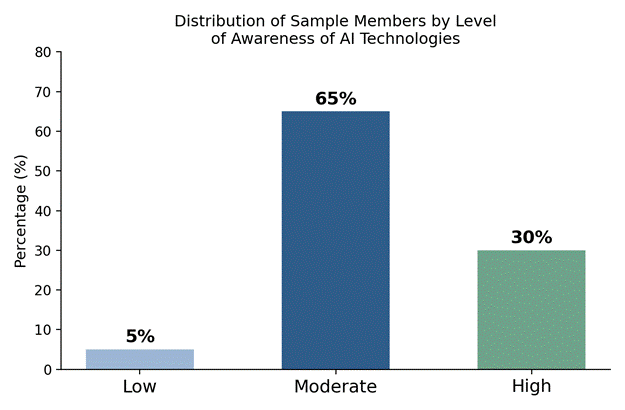
Table (2): Distribution of Sample Members by Level of Awareness of AI Technologies
| Level | Frequency | Percentage |
| Low | 6 | 5% |
| Moderate | 78 | 65% |
| High | 36 | 30% |
| Total | 120 | 100% |
Table (3): Arithmetic Mean and Standard Deviation of the Total Score
| Arithmetic Mean | Standard Deviation | Evaluation |
| 40.2 | 3.45 | Moderate |
Figure (1): Distribution of Sample Members by Level of Awareness
Analysis
Tables (2) and (3) show that 65% of the sample members (78 male and female students) have a moderate awareness of AI technologies, that 30% (36 students) have a high awareness, while the proportion of those with low awareness was only 5% (6 students). The arithmetic mean of the total score was 40.2 out of 60, which falls within the moderate range (33.34 – 46.66). The standard deviation (3.45) is relatively low compared with the mean (coefficient of variation ≈ 8.6%), which indicates relative homogeneity in students’ responses about their level of awareness.
To test the hypothesis, a one-sample t-test was conducted, comparing the sample mean (40.2) with the theoretical mean of the scale (40 points). The t value was ≈ 0.64 at 119 degrees of freedom, with a p-value ≈ 0.53, which is greater than 0.05. That is, there is no statistically significant difference between the sample mean and the theoretical mean, and therefore the hypothesis that the level of awareness is moderate is supported.
Eleventh: Discussion of the Results
The results of the study showed that the level of awareness of AI technologies among students of the Institute of Science and Techniques of Physical and Sports Activities was moderate, as the proportion of students with moderate awareness reached 65% and the overall arithmetic mean was 40.2 out of 60.
This result agrees with the study by Al-Turkawi and Ali at the University of Zawia, which showed that postgraduate students’ level of awareness and skills was moderate. It is also consistent with the study by Zaqqawa and Al-Massous at the University of Relizane, which found that students’ knowledge was moderate at 68%, a figure close to the 65% in our study, with the reservation that the instruments, samples, and specializations differ. It also converges with the study by Bushra Hassan and Jaafar Al-Abbas (2025), which found a generally moderate degree of employment among first-cycle teachers, noting that the sample in that study comes from a different group; the comparison is therefore only a general indication and nothing more.
This convergence at the moderate level may be due to the fact that AI technologies have become a tangible reality driven by technological development, which generates among students of various specializations a general knowledge of their basics. The shortage of specialized training programs and the absence of university courses related to integrating AI into the sports and educational fields may also have played a role in preventing awareness from reaching high levels; however, these interpretations remain hypotheses that the present study did not test, since it did not measure these factors directly.
Despite this moderate level, there remains a need to raise awareness of the conscious and responsible use of these tools, especially with regard to verifying outputs, academic integrity, and privacy, in order to avoid haphazard use. This level also represents a suitable starting point for preparing students for the requirements of their professional future.
Twelfth: Conclusion and Recommendations
The study concluded that the level of awareness of AI technologies among students of the Faculty of Physical Education and Sports is moderate, as most of them have a general knowledge of these technologies, while the proportion with a high level of awareness reached 30% and the proportion with a low level of awareness reached 5%. In light of this, we propose the following:
First: Applied Recommendations
- Establishing university digital clubs: Creating an “Artificial Intelligence and Digital Innovation Club” within the institute, supervised by specialized professors, to serve as an open space for exchanging experiences and for students’ self-training.
- Reviewing assessment methods in light of AI: Reconsidering student assessment methods by focusing on oral examinations, field application, and live project discussions, in order to reduce excessive reliance on ready-made texts.
- Supporting open and blended learning platforms: Providing students with free subscriptions to platforms that offer courses on “AI in Education and Sports,” and directing them to complete these courses as a complementary requirement.
- Forming committees to monitor AI-generated plagiarism: Equipping the institute with modern software capable of detecting texts generated by AI, and training graduation-thesis committees to use it to ensure academic integrity, while noting that such software is not entirely accurate.
- Linking training to the requirements of the new labor market: Raising students’ awareness of newly emerging jobs in the sports field that depend on data analysis.
Second: Proposed Future Studies
- A study of differences in the level of awareness according to gender, specialization, and academic level.
- An experimental study of the effect of a training program on raising students’ awareness of the responsible use of AI.
- A comparative study among physical education and sports institutes at several universities using a random sample.
- A qualitative study (interviews) on students’ actual practices in using AI tools.
References:
1. Al-Ayyadi, Fatiha, & Ghanem, Jouida. (2024). Artificial intelligence from the perspective of John Searle [in Arabic]. Journal of Wisdom for Philosophical Studies, Vol. 12, No. 03, pp. 792–1804.
2. Rizk, Mohamed Hanaa. (2021). Artificial intelligence systems and the future of education [in Arabic]. Journal of Studies in University Education, No. (52), pp. 573–587.
3. Belassel Bent Nabi, Yasmine, & Al-Hussein, Amrouche. (2022). Artificial intelligence and its role in achieving sustainable development [in Arabic]. Journal of Legal and Economic Studies, Vol. 05, No. (01), pp. 1153–1177.
4. Bidi, Ahmed Ibrahim Hussein. (2026). Artificial intelligence and the coming economic revolution [in Arabic]. Scientific Journal of Economic Dialogue, Vol. 05, No. 205, pp. 19–38.
5. Al-Kharusi, Hussein bin Ali, Al-Aghbariyah, Nasiba bint Ibrahim, & Al-Qalhatiyah, Amina bint Salem. (2025). Building a tool to measure teachers’ attitudes toward the use of artificial intelligence in educational assessment in the Sultanate of Oman [in Arabic]. Journal of Educational and Teaching Research, Vol. 14, No. 02, pp. 211–240.
Websites: