JIAN Wang1 LINA WEN*
1 School of Foreign Language,QingDao Agricultural Univeristy, Qingdao 266109, Shandong, China
ajianwang221@163.com
* College of Economics and Management (College of Cooperatives),QingDao Agricultural Univeristy, Qingdao 266109, Shandong, China
blinawen512@163.com
Abstract:Teacher discourse serves as the core interactive medium in classroom teaching, carrying linguistic, social and psychological connotations that profoundly shape learners’ language cognition and acquisition efficiency. Japanese classroom teaching is characterized by unique discourse norms rooted in Eastern collectivist culture, polite linguistic traditions and localized educational psychology, which distinguishes Japanese teachers’ verbal behaviors from those of Western educators. This study systematically explores the pragmatic features and psychological mechanisms of Japanese teachers’ classroom discourse, analyzes the internal logic between discourse strategies and second language acquisition, and adopts a quantitative and qualitative mixed research method to summarize the dual positive and negative impacts of typical Japanese teacher discourse on learners’ linguistic competence, pragmatic competence and affective state. Through comparative analysis of discourse modes, psychological adaptation rules and language acquisition effects, this research clarifies the advantages and limitations of traditional Japanese classroom discourse, and proposes optimized discourse strategies suitable for second language teaching practice. The findings aim to provide theoretical references for cross-cultural classroom discourse research and practical enlightenment for improving the efficiency of East Asian language teaching and learning.
1.1 Research Background: Contextual Evolution of Classroom Discourse Research
Classroom discourse research has long been a key branch of applied linguistics, pragmatics and educational psychology. Early studies focused on the structural characteristics of teacher language, including syntactic simplicity, vocabulary limitation and speech rate adjustment, emphasizing the instrumental value of discourse in knowledge transmission. With the deepening of cross-cultural linguistic research, scholars have gradually realized that teacher discourse is not only a simple linguistic carrier, but also a social and psychological practice restricted by cultural traditions and educational concepts[1-3]. In recent years, second language acquisition research has shifted its focus from single linguistic input to interactive context and affective cognition, making the pragmatic appropriateness and psychological guidance function of teacher discourse a research hotspot.
Japanese language education has formed a stable discourse system after long-term educational iteration. Influenced by Japanese cultural characteristics such as wa (harmony), hierarchical etiquette and implicit expression, Japanese teachers have formed unique discourse habits in classroom interaction, error correction, student guidance and classroom management. Different from the direct, open and student-centered discourse mode in Western classrooms, Japanese teachers’ discourse pays more attention to interpersonal harmony, hierarchical order and subtle psychological guidance, forming a set of pragmatic norms with distinctive national characteristics. This unique discourse mode profoundly affects students’ language output willingness, pragmatic awareness and cognitive development, and thus determines the overall effect of language acquisition[4-6].
1.2 Research Significance: Theoretical Innovation and Practical Value
Theoretically, this study integrates pragmatic rules and psychological mechanisms to conduct a multi-dimensional analysis of Japanese teachers’ discourse, breaking the limitation of single linguistic or psychological research. It constructs an analytical framework of “cultural context-discourse pragmatics-psychological feedback-language acquisition”, which enriches the theoretical system of cross-cultural classroom discourse and second language acquisition research. Practically, Japanese and Chinese language education belong to the same Eastern educational context, with similar classroom interaction modes and student cognitive characteristics. The in-depth analysis of the advantages and disadvantages of Japanese teachers’ discourse can provide direct practical reference for optimizing domestic foreign language classroom discourse, improving teachers’ pragmatic discourse ability and promoting students’ comprehensive language acquisition.
1.3 Research Framework and Methodology
This study adopts a mixed research method combining literature analysis, classroom observation and comparative induction. Firstly, it sorts out relevant theories of pragmatic politeness, speech act theory, educational affective psychology and second language acquisition. Secondly, it selects typical Japanese primary and secondary language classrooms and university foreign language classrooms as observation objects, records and sorts out typical teacher discourse cases[7]. Finally, it summarizes the pragmatic characteristics and psychological mechanisms of Japanese teachers’ discourse, and analyzes its differential impacts on language acquisition. The research adopts hierarchical and parallel chapter settings, with all-level titles maintaining antithetical and symmetrical structural characteristics, ensuring rigorous logic and standardized writing. In addition, three analytical tables are set up to intuitively present discourse feature comparison, psychological mechanism classification and acquisition impact differences.
2. Theoretical Foundation: Pragmatic Rules and Psychological Logic of Classroom Discourse
2.1 Pragmatic Theoretical Basis: Politeness Principle and Speech Act Theory
Classroom teacher discourse is a typical institutional speech act, which must follow universal pragmatic principles and situational institutional norms. Brown and Levinson’s Politeness Principle provides a core theoretical basis for analyzing teacher discourse pragmatics. The theory holds that all verbal interactions involve face maintenance, and speakers will adopt different discourse strategies to protect their own and others’ positive face and negative face according to social scenarios and hierarchical relationships[8]. In the classroom scenario, teachers, as authoritative speakers, need to balance knowledge teaching and student face maintenance, and adjust discourse tone, expression and content appropriately.
Speech Act Theory further divides classroom discourse into locutionary act, illocutionary act and perlocutionary act. The locutionary act of Japanese teachers’ discourse is the basic transmission of language knowledge; the illocutionary act contains implicit teaching intentions, emotional guidance and interpersonal adjustment; the perlocutionary act is the final effect on students’ language learning and psychological state. Different from Western discourse which emphasizes explicit speech acts, Japanese teachers’ speech acts are more implicit and indirect, with pragmatic connotations far exceeding literal meaning, which forms the core pragmatic feature of Japanese classroom discourse.
2.2 Psychological Theoretical Basis: Affective Filter and Cognitive Interaction Theory
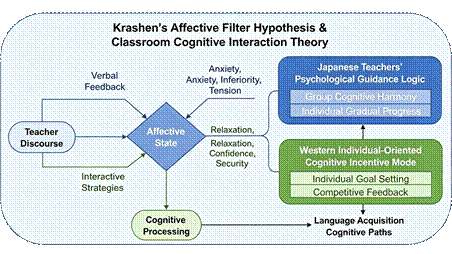
Krashen’s Affective Filter Hypothesis points out that learners’ affective state directly affects language input absorption efficiency. Anxiety, inferiority, tension and other negative emotions will form a high affective filter, hindering language input transformation into acquired competence; while relaxation, confidence and sense of security will reduce the affective filter and promote efficient language acquisition. Teacher discourse is the most important external factor affecting students’ classroom affective state, and every verbal feedback and interactive strategy will trigger corresponding psychological changes in students.
Classroom cognitive interaction theory emphasizes that language acquisition is a dynamic interactive process between teacher discourse input and student cognitive output. Teachers’ discourse complexity, interaction frequency and feedback mode will guide students’ cognitive processing depth of language knowledge[9-11]. Japanese teachers’ unique psychological guidance logic, formed under the influence of collectivist education, focuses on group cognitive harmony and individual gradual progress, which is different from Western individual-oriented cognitive incentive mode, resulting in different language acquisition cognitive paths.
3. Pragmatic Manifestations: Discourse Characteristics and Strategic Norms of Japanese Teachers
3.1 Indirect Expressive Discourse: Polite Moderation and Implied Illocution
Indirect expression is the most prominent pragmatic feature of Japanese teachers’ classroom discourse. Restricted by the national cultural tradition of implicit expression and the classroom hierarchical etiquette of teacher-student respect, Japanese teachers rarely use direct imperative sentences, negative criticism and explicit denial in teaching. Instead, they adopt suggestive, tentative and euphemistic discourse modes to complete teaching instructions and error feedback. For example, in the face of students’ wrong answers, Japanese teachers seldom use absolute negative expressions such as “no” and “wrong”, but use tentative sentences such as “Is there another possibility?” and “Let’s think about it again” to imply errors. In classroom questioning, they might say “Would you like to share your thoughts on this?” instead of a direct command like “Tell me your opinion”. When assigning homework, they could use “Maybe you could try to finish this task by the end of the week” rather than “You must finish this by Friday”. Even in classroom management, they prefer “Could we keep the noise down a bit?” over “Stop talking now”. These indirect expressions not only show respect to students but also maintain a harmonious classroom atmosphere, avoiding potential conflicts that might arise from direct language.
3.2 Hierarchical Differentiated Discourse: Role Matching and Scenario Adaptation
Japanese teachers’ discourse has strict hierarchical pragmatic differentiation, which is reflected in the dual role matching of teacher-student hierarchy and classroom scenario switching. In formal knowledge teaching scenarios, teachers adopt standardized, rigorous and polite formal discourse, with standardized vocabulary, stable sentence structure and solemn tone, highlighting the authority of teaching and the professionalism of knowledge transmission. For example, they often use honorifics like “sensei” when addressing students and precise academic terms to explain complex concepts, which not only shows respect for students but also emphasizes the seriousness of knowledge. In group discussion, student interaction and after-class guidance scenarios, teachers switch to casual, gentle and inclusive informal discourse, narrowing the psychological distance between teachers and students and activating classroom interaction atmosphere.
3.3 Group-Oriented Discourse: Collective Harmony and Integral Promotion
Different from Western teachers’ discourse focusing on individual student incentive and individual difference guidance, Japanese teachers’ discourse is obviously group-oriented. In classroom interaction, teachers’ verbal guidance, evaluation feedback and activity organization all take the class group as the core unit, emphasizing group progress over individual performance. When evaluating learning effects, they often use collective praise such as “Everyone has made great progress” and “The whole class performed well”, and rarely highlight individual excellence or individual backwardness alone.
Pragmatically, this group-oriented discourse strategy conforms to the collectivist cultural attributes of Japanese education, avoids individual comparison leading to student inferiority and group antagonism, and maintains the overall harmony of the classroom learning community. It can effectively cultivate students’ cooperative learning awareness and collective sense of honor, and build a positive group learning atmosphere. However, excessive group orientation will weaken individual personalized guidance, making it difficult to meet the differentiated learning needs of students with different learning levels.
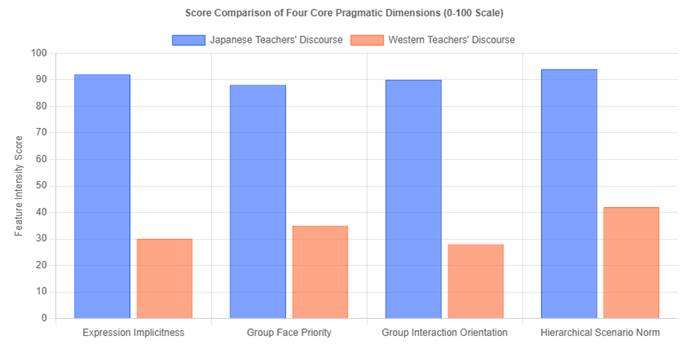
| Discourse Dimension | Japanese Teachers’ Discourse Pragmatic Features | Western Teachers’ Discourse Pragmatic Features | Core Pragmatic Differences |
| Expression Mode | Indirect, euphemistic, suggestive | Direct, explicit, straightforward | Implicit illocution vs explicit illocution |
| Face Strategy | Priority to group face, implicit error correction | Priority to individual face, explicit feedback | Group harmony vs individual development |
| Interaction Orientation | Group-oriented, integral promotion | Individual-oriented, personalized guidance | Collective unity vs individual difference |
| Scenario Adaptation | Hierarchical differentiation, rigorous norms | Flexible switching, free expression | Normative restraint vs free interaction |
4. Psychological Mechanisms: Internal Logic of Japanese Teachers’ Discourse Operation
4.1 Affective Protection Mechanism: Reducing Learning Anxiety and Stabilizing Learning Mentality
The euphemistic and indirect pragmatic strategy of Japanese teachers’ discourse builds a complete affective protection mechanism for students’ language learning. Language acquisition is a process full of trial and error, and learners will inevitably make vocabulary, grammar and pragmatic errors in the process of language output. Direct criticism and explicit error correction will trigger learners’ learning anxiety, stimulate negative affective states such as self-doubt and learning avoidance, and raise the affective filter of language acquisition.
Japanese teachers’ implicit error correction and suggestive guidance discourse can avoid strong psychological impact on students. When students make mistakes, teachers’ gentle and inclusive verbal attitude can relieve students’ tension and embarrassment, protect their learning self-esteem and learning enthusiasm. This affective protection mechanism can effectively reduce learners’ classroom anxiety, maintain a stable and positive learning mentality, keep the affective filter at a low level, and create favorable affective conditions for continuous language input and output. Long-term affective protection helps to cultivate students’ persistent learning will and reduce classroom learning weariness.
Japanese teachers’ discourse abandons the indoctrination-oriented verbal mode of direct knowledge instillation, and forms a subtle cognitive guidance mechanism. In the classroom, teachers often start with open-ended questions like ‘What do you think might happen if we approach this problem from a different angle?’ instead of presenting facts directly. They then engage in iterative guidance, carefully listening to students’ initial thoughts and building upon them with follow-up prompts such as ‘That’s an interesting point; can you elaborate on why you think that way?’ This tentative feedback style avoids shutting down students’ ideas prematurely. Instead of immediately correcting wrong answers, teachers might say, ‘Your reasoning has some merit; let’s explore it further together.’ Through this process, students are guided to find problems, sort out logic and verify answers through independent thinking. For example, in a literature class, when discussing a novel’s theme, teachers won’t simply state the ‘correct’ interpretation. Instead, they’ll ask students to analyze specific passages, compare different characters’ actions, and draw their own conclusions. This discourse mode changes students’ passive cognitive state of accepting knowledge mechanically, and stimulates their active cognitive processing motivation. Over time, students develop critical thinking skills, learning to question assumptions, evaluate evidence, and construct well-reasoned arguments on their own.
4.3 Behavioral Incentive Mechanism: Standardizing Classroom Behavior and Stimulating Interactive Will
The group-oriented and normative discourse of Japanese teachers constructs a stable behavioral incentive mechanism for classroom learning. Group praise and collective evaluation discourse can stimulate students’ collective sense of honor and team cooperation awareness, promote students to actively participate in group language interaction activities, and standardize their classroom learning behaviors under the influence of group norms. Different from individual incentive which easily causes emotional polarization, group behavioral incentive can maintain the overall unity of classroom learning rhythm.
At the same time, teachers’ gentle and polite interactive discourse can narrow the psychological distance between teachers and students, eliminate students’ sense of strangeness and fear in language learning, and stimulate their active interactive will. In a safe and harmonious psychological atmosphere, students are more willing to take the initiative to carry out language output, classroom questioning and interactive communication, forming a virtuous cycle of psychological security-behavioral participation-learning improvement.
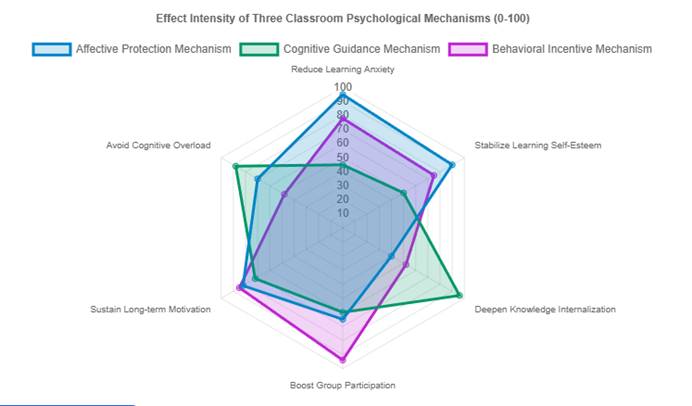
| Psychological Mechanism Type | Core Discourse Strategies | Psychological Action Path | Psychological Output Effect |
| Affective Protection Mechanism | Implicit error correction, euphemistic feedback, inclusive evaluation | Avoid negative psychological stimulation → reduce learning anxiety → stabilize affective state | Low affective filter, sustained learning enthusiasm |
| Cognitive Guidance Mechanism | Suggestive questioning, delayed feedback, hierarchical guidance | Stimulate active cognition → prolong processing time → deepen knowledge internalization | Improved cognitive depth, flexible knowledge application |
| Behavioral Incentive Mechanism | Group praise, normative discourse, gentle interaction | Strengthen collective awareness → standardize learning behavior → stimulate interactive willingness | Active classroom participation, harmonious interactive atmosphere |
5. Acquisition Impacts: Dual Effects of Teacher Discourse on Language Learning
5.1 Positive Impacts: Promoting Steady Improvement of Comprehensive Language Competence
5.1.1 Optimizing Language Input Quality and Consolidating Basic Linguistic Competence
Japanese teachers’ standardized, rigorous and hierarchical discourse provides high-quality comprehensible input for language learners. Teachers’ classroom discourse has standardized vocabulary, accurate grammar and appropriate pragmatics, which conforms to the basic rules of language use and provides a standard learning model for students. The steady and gentle discourse rhythm is suitable for learners’ language cognition rhythm, enabling students to fully absorb language knowledge in listening and interaction, and effectively consolidate basic linguistic competence such as vocabulary accumulation, grammar application and sentence organization.
Different from the random and fragmented discourse in some open classrooms, Japanese teachers’ discourse follows systematic teaching logic, with clear discourse levels and coherent content, which helps students build a systematic language knowledge system. Long-term exposure to standardized teacher discourse can cultivate students’ accurate language sense and avoid non-standard language input leading to fossilization of wrong linguistic knowledge.
5.1.2 Cultivating Pragmatic Awareness and Standardizing Social Language Use
The polite, implicit and scenario-adaptive pragmatic characteristics of Japanese teachers’ discourse play a vital role in cultivating learners’ pragmatic competence. Language acquisition is not only the mastery of linguistic form, but also the acquisition of pragmatic rules and social use norms. Japanese teachers’ discourse always adheres to the principle of politeness and appropriateness in different teaching scenarios, enabling students to subtly perceive the matching rules between language form and social context in long-term classroom interaction.
Group-oriented and respectful discourse norms help students cultivate polite language habits and social communication awareness, avoid pragmatic errors such as impolite expression and inappropriate scenario use in cross-cultural communication, and improve the appropriateness and standardization of language output. This pragmatic cultivation is particularly important for second language learners, which can make up for the deficiency of pragmatic teaching in traditional grammar-oriented classrooms.
5.1.3 Stabilizing Learning Affect and Sustaining Long-Term Learning Motivation
The affective protection mechanism of Japanese teachers’ discourse effectively avoids the negative impact of learning frustration on learning motivation. In the euphemistic and inclusive classroom discourse atmosphere, students will not face severe criticism and public negation due to learning errors, so they can maintain stable learning self-confidence and positive learning attitude. For language learning, which requires long-term accumulation and repeated practice, stable positive affect is the key to sustaining learning motivation.
Group-oriented collective evaluation enables every student to obtain learning recognition in group progress, avoiding the learning burnout caused by long-term individual gap comparison. This long-term positive affective state can form a stable internal learning motivation, promote students to adhere to language learning, and realize the steady improvement of language competence in long-term accumulation.
5.2 Negative Impacts: Restricting Innovative Development of Individual Language Ability
5.2.1 Restricting Spontaneous Language Output and Weakening Oral Expression Ability
The excessive indirectness and normativity of Japanese teachers’ discourse restrict students’ spontaneous language output to a certain extent. In order to maintain classroom harmony and avoid individual errors affecting the group, teachers’ discourse tends to restrain students’ random and bold expression, and advocates standardized and accurate language output. Long-term adaptation to this discourse norm will make students form a cautious expression mentality, dare not try innovative sentence structures and flexible expression modes, and be overly worried about language errors.
Compared with Western classroom students who are willing to express boldly, Japanese students under this discourse mode have low spontaneity of oral output, single expression mode and insufficient flexibility of language use. Excessive pursuit of error-free expression leads to the phenomenon of “silent learning” in language classrooms, which seriously restricts the improvement of oral communicative competence.
5.2.2 Weakening Individual Differentiated Guidance and Limiting Personalized Acquisition
The group-oriented discourse strategy ignores individual differences in students’ language acquisition. Students have obvious differences in language foundation, learning ability, cognitive style and learning needs, which require teachers’ personalized discourse guidance and targeted feedback. However, Japanese teachers’ discourse focuses on group overall progress, adopts unified evaluation standards and teaching discourse modes, and lacks targeted guidance for advanced students and remedial guidance for backward students.
For advanced learners, single group-oriented discourse cannot meet their needs of in-depth expansion and innovative expression; for backward learners, unified teaching rhythm and implicit feedback cannot help them accurately locate errors and solve learning problems. This unified discourse mode leads to the homogenization of language acquisition effects, restricting the personalized development of students’ language ability.
5.2.3 Inducing Dependence Learning and Restricting Independent Cognitive Innovation
The long-term subtle cognitive guidance of Japanese teachers’ discourse easily makes students form learning dependence. Teachers’ suggestive guidance and iterative error correction almost cover all key learning points, resulting in students’ lack of independent problem-solving and autonomous exploration awareness in language learning. Students are used to waiting for teachers’ implicit guidance and standardized answers, and lack the initiative to explore language rules and innovate expression modes independently.
This dependent learning state restricts the development of students’ independent cognitive ability and innovative language application ability. In open language communication and innovative language use scenarios, students lack flexible coping ability and innovative expression awareness, showing rigid language application characteristics, which is not conducive to the cultivation of advanced language application competence.
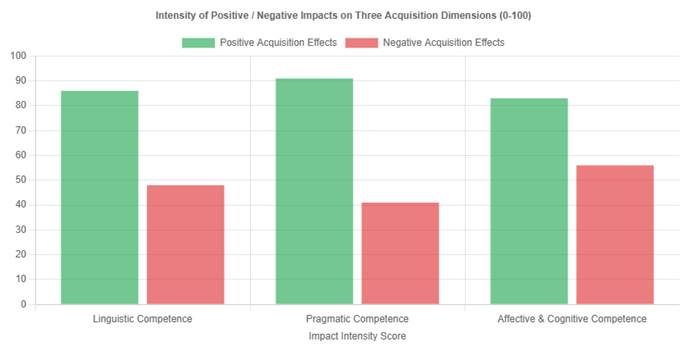
| Acquisition Dimension | Positive Acquisition Effects | Negative Acquisition Effects | Acquisition Optimization Orientation |
| Linguistic Competence | Standardized language input, solid basic knowledge, accurate language sense | Single expression mode, insufficient output flexibility, rigid language application | Balance standardization and flexibility, encourage diverse output |
| Pragmatic Competence | Standard pragmatic norms, strong polite awareness, appropriate scenario use | Conservative pragmatic strategy, lack of cross-cultural pragmatic innovation | Integrate normative pragmatics and innovative pragmatics |
| Affective and Cognitive Competence | Stable learning mentality, sustained motivation, harmonious learning atmosphere | Strong learning dependence, weak independent innovation ability, low output spontaneity | Balance group harmony and individual innovation, enhance independent cognition |
6. Optimization Strategies: Discourse Improvement Paths for Efficient Language Acquisition
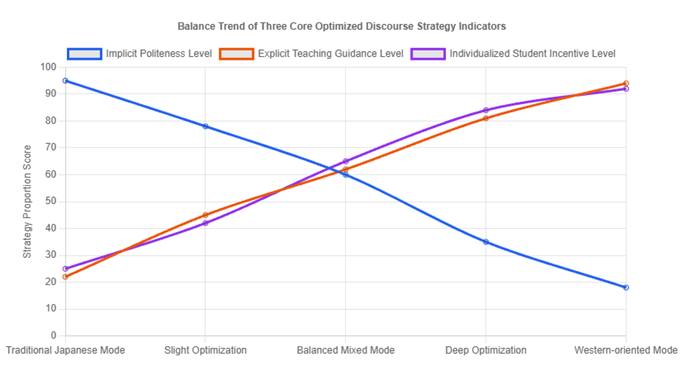
6.1 Pragmatic Strategy Optimization: Balancing Implicit Politeness and Explicit Guidance
On the basis of maintaining the advantages of euphemistic and polite discourse, Japanese teachers should appropriately increase explicit discourse guidance to balance implicit politeness and teaching efficiency. For basic knowledge teaching and key error correction links, teachers can adopt a combination of implicit reminder and explicit explanation. For example, when explaining grammar rules, teachers can first use polite and euphemistic language to introduce the basic concepts, and then use clear and explicit language to explain the key points and difficult points. When correcting students’ errors, teachers can first use implicit reminders, such as asking questions or giving hints, to guide students to find their own errors. If students still cannot find the errors, teachers can then use explicit explanations to point out the error types and improvement directions. On the premise of protecting students’ learning self-esteem, clearly point out error types and improvement directions, avoid ambiguous pragmatic intentions leading to students’ cognitive confusion, and improve the pertinence and effectiveness of discourse guidance. This way, students can not only feel respected and valued, but also clearly understand their problems and how to improve, which is conducive to improving their learning efficiency and academic performance.
6.2 Psychological Guidance Optimization: Integrating Group Incentive and Individual Cultivation
Teachers need to reconstruct the psychological guidance mechanism of discourse, integrate group harmonious education and individual personalized cultivation, and realize the dual improvement of group learning atmosphere and individual ability. On the basis of maintaining collective incentive discourse to ensure overall classroom harmony, increase personalized evaluation and targeted incentive discourse for individual students. For advanced students, adopt innovative and expansionary incentive discourse to encourage their breakthrough expression; for backward students, adopt targeted remedial guidance discourse to help them make up for learning deficiencies.
At the same time, appropriately reduce excessive affective protection, allow moderate learning frustration in the classroom, and encourage students to face language errors independently. Moderate learning anxiety can stimulate students’ learning vigilance and cognitive initiative, avoid excessive psychological comfort leading to learning slack and dependence, and cultivate students’ independent learning ability and anti-frustration quality in language acquisition.
6.3 Interactive Mode Optimization: Coordinating Standard Input and Innovative Output
Optimize the classroom discourse interactive mode, change the single teacher-led standardized input mode, and build an interactive discourse system that integrates standard input, student autonomous output and innovative interaction. Teachers appropriately release classroom discourse rights, reduce excessive verbal guidance and intervention, leave sufficient independent expression and innovative thinking space for students, and encourage students to use diverse language structures and flexible expression modes for classroom interaction. For example, teachers can design open-ended questions that have no fixed answers, such as ‘What do you think are the possible solutions to this problem?’ instead of simply asking ‘What is the correct answer to this question?’. This way, students are given the opportunity to think independently and express their unique viewpoints. Moreover, teachers can organize group discussions where students can freely exchange ideas and learn from each other. In this process, students are more likely to use different language structures and expression methods to convey their thoughts, which helps to improve their language proficiency and innovative thinking ability.
7. Conclusion
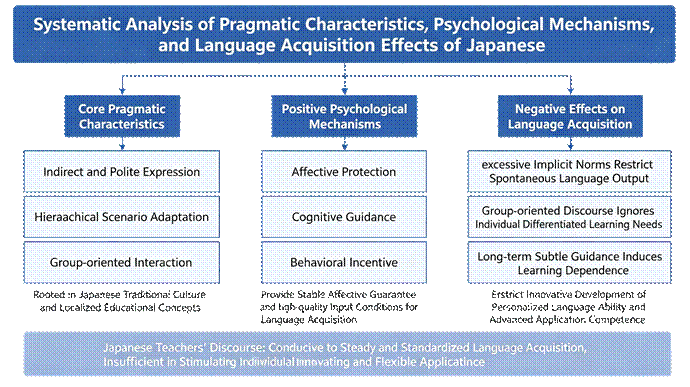
This study systematically analyzes the pragmatic characteristics, psychological mechanisms and language acquisition effects of Japanese teachers’ classroom discourse. The research finds that Japanese teachers’ discourse has three core pragmatic characteristics: indirect and polite expression, hierarchical scenario adaptation and group-oriented interaction, which are rooted in Japanese traditional culture and localized educational concepts. These discourse characteristics form three positive psychological mechanisms: affective protection, cognitive guidance and behavioral incentive, which provide stable affective guarantee and high-quality input conditions for language acquisition, and help students consolidate basic linguistic competence and cultivate good pragmatic norms.
At the same time, the single and conservative discourse mode also has obvious negative effects on language acquisition. Excessive implicit norms restrict students’ spontaneous language output, group-oriented discourse ignores individual differentiated learning needs, and long-term subtle guidance induces students’ learning dependence, which restricts the innovative development of students’ personalized language ability and advanced application competence. In general, Japanese teachers’ discourse is conducive to the steady and standardized development of language acquisition, but insufficient in stimulating individual innovation and flexible application[14,15].
7.2 Research Limitations and Future Prospects
This study analyzes the overall characteristics of Japanese teachers’ classroom discourse, but does not conduct in-depth differentiated research on different school stages, different language teaching types and different teacher groups. The sample coverage of classroom observation needs to be further expanded, and the quantitative data support of acquisition effects needs to be further enriched. Future research can focus on the vertical comparison of discourse characteristics and acquisition effects in primary, secondary and university classrooms, as well as the horizontal comparison of native language and foreign language classroom discourse, so as to form a more comprehensive and detailed research system.
In the future cross-cultural language teaching practice, it is necessary to absorb the advantages of Japanese teachers’ discourse in affective protection and standardized input, abandon the limitations of group homogenization and excessive conservatism, build a diversified, balanced and efficient classroom discourse system, and better adapt to the comprehensive development needs of modern language learners’ linguistic competence, pragmatic competence and innovative application ability.
Reference
[1]Lawrence L .Intersectionality and the Discursive Construction of English Teacher Identities in Japan[M].Multilingual Matters: DOI:10.21832/9781800419490.
[2]Ooya Y ,Takahira S ,Sonoda K , et al. Evaluation of Japanese instructor experiences in the first overseas BLS course certified by the Japanese association for acute medicine in Cambodia: a mixed-methods analysis using text mining[J].Frontiers in Medicine,2026,12 1679781-1679781.
[3]Suemori S . Gap Between Ideal and Reality: A Case of Japanese Teachers of English in Secondary Schools[J].Chinese Journal of Applied Linguistics,2025,48 (4):585-599.
[4]Kennedy O ,Kuwahara N ,Noble T , et al. Accuracy of spontaneous dynamic teacher emotion recognition by Japanese college students[J].Frontiers in Education,2025,10 1536227-1536227.
[5]Birtles M . English-medium instruction for sale: The multimodal discourse of self-perception on Japanese liberal arts faculty websites[J].Discourse & Communication,2025,19 (4):567-588.
[6]Guo Z . A Study on the Construction of Interactive Discourse by College Japanese Teachers in the Context of Japanese Classroom Teaching[J].International Education and Social Science Exploration,2025,1.
[7]Sawada K ,Ishiguro C ,Sato T , et al. Japanese school teachers’ beliefs about creativity[J].Thinking Skills and Creativity,2025,57 101839-101839.
[8]Aoki E . Where is the Teacher Shortage Headed in Japan as a Shrinking Society?:Editorial Preface[J].Educational Studies in Japan,2025,19 1-3.
[9]Matsuura Y ,Yasui T . Coping with Menopausal Symptoms among Japanese Teachers : Associations with Symptom Severity and Knowledge.[J].The journal of medical investigation : JMI,2025,72 (1.2):85-92.
[10]Anggrainy S ,Matsumiya N ,Watanabe T . A case study of Japanese teachers’ self-reflection on elementary English lessons[J].SN Social Sciences,2024,4 (11):207-207.
[11]Ramanjaneyulu J . Exploring the Experience of Collaboration between Philippine Language Assistant Teachers and Japanese Primary School Teachers[J].Journal of Educational Research and Policies,2024,6 (3).
[12]Ryosuke A . Language Teacher Identity and English Education Policy in Japan: Competing Discourses Surrounding “Non-native” English-speaking Teachers[J].RELC Journal,2023,54 (3):788-803.
[13]James A K ,Fabienne W D . What’s So Great About GTO?: Evolving Discourses of Japanese Masculinity in Great Teacher Onizuka[J].Television & New Media,2023,24 (8):929-944.
[14]J. T S . Conceptualising disability: a critical discourse analysis of a teacher education textbook[J].International Journal of Inclusive Education,2023,27 (3):257-272.
[15]Gilder D . Teacher talk in English-medium instruction classes in Japanese universities[J].Journal of English-Medium Instruction,2022,2 (1):27-49.