Xuan Wang1,2,a
1Zhengzhou University of Aeronautics, Zhengzhou 450046, Henan ,China
2Faculty of Education , Henan Normal University, Xinxiang 453000, Henan ,China
aE-mail:wxtg35@126.com
Abstract:With the comprehensive penetration of digital technologies into the field of education, educational digitization has become an inevitable trend of global educational reform and educational modernization. Teachers, as the core implementers of educational digitization transformation, their digital literacy level directly determines the implementation quality of digital teaching, the innovation of educational modes and the cultivation effect of students’ digital competencies. In order to systematically clarify the connotation, dimensional structure and influencing factors of teachers’ digital literacy in the digital education era, this study constructs a scientific and standardized multidimensional measurement framework for teachers’ digital literacy based on literature sorting, theoretical deduction and expert consultation. This research adopts a quantitative research method, takes primary and secondary school teachers and university teachers as research objects, designs a standardized measurement questionnaire, and collects valid research data through large-scale sample investigation. On this basis, it systematically explores the hierarchical influence mechanism of individual factors, institutional factors and environmental factors on teachers’ digital literacy, and verifies the structural relationship between different variables. The research results show that teachers’ digital literacy presents a four-dimensional hierarchical structure including digital technical literacy, digital teaching literacy, digital professional literacy and digital ethical literacy. Individual learning initiative, school institutional support and social digital environment construction have significant positive hierarchical effects on teachers’ digital literacy, while digital anxiety and resource mismatch have negative inhibitory effects. This study improves the theoretical system of teachers’ digital literacy research, provides a reliable measurement tool for subsequent empirical research, and offers targeted practical references for schools and educational administrative departments to carry out teachers’ digital literacy training and promote high-quality development of educational digitization.
Keywords: Educational Digitization; Teachers’ Digital Literacy; Multidimensional Framework; Capability Measurement; Influence Mechanism
1.1 Background of The Times: Digital Transformation Reshapes Educational Ecology
The rapid iteration of emerging digital technologies represented by big data, artificial intelligence, cloud computing and virtual reality has completely overturned the traditional educational teaching mode and educational management mode, and promoted the global education field to enter a new stage of comprehensive digital transformation[1-3]. Educational digitization has broken the time and space limitations of traditional classroom teaching, realized the sharing of high-quality educational resources, personalized teaching implementation and intelligent educational evaluation, and become a core driving force for promoting educational equity, improving educational quality and optimizing educational structure. Governments and educational institutions around the world have successively issued digital education development strategies, taking teachers’ digital capability construction as a key task of educational modernization construction[4]. The global educational reform practice fully shows that the digital transformation of education is not only the superposition of digital technologies and educational scenes, but also the comprehensive reconstruction of educational concepts, teaching modes and teachers’ professional capabilities[5].
In the wave of educational digitization, the professional literacy structure of teachers has undergone fundamental changes. Traditional teaching literacy centered on classroom teaching experience and subject professional knowledge can no longer adapt to the needs of intelligent digital teaching. Teachers need to master professional digital application capabilities, innovative digital teaching capabilities and standardized digital behavioral literacy to adapt to the new educational ecology. As the key subject of educational digital transformation, teachers’ digital literacy level has become a core index to measure the level of school digital education construction and an essential professional quality for modern teachers’ career development. Therefore, accurately defining the connotation of teachers’ digital literacy, constructing a scientific capability measurement system, and clarifying its internal influence mechanism are important theoretical and practical topics to promote the in-depth development of educational digitization.
1.2 Research Gaps: Deficiencies in Framework Construction and Mechanism Exploration
In recent years, domestic and foreign academic circles have carried out extensive research on teachers’ digital literacy, and have formed a series of theoretical frameworks and measurement tools represented by DigCompEdu framework, TPACK model and UNESCO teacher digital literacy standards. Existing studies have basically clarified the basic connotation and core dimensions of teachers’ digital literacy, and verified the positive role of digital literacy in improving teaching efficiency and promoting educational innovation. However, through systematic literature sorting, it is found that the current research still has obvious deficiencies in two core aspects.
On the one hand, the dimensional division of teachers’ digital literacy measurement framework is inconsistent and lacks systematic hierarchical logic. Most existing frameworks focus on digital technical operation capabilities and digital teaching application capabilities, but ignore the important position of digital professional development literacy and digital ethical normative literacy, resulting in a single measurement dimension and incomplete coverage of literacy connotation. At the same time, many measurement frameworks lack targeted adaptation to the actual teaching scenes of basic education and higher education, and the universality and pertinence of measurement indicators are insufficient[6,7].
On the other hand, the exploration of the influence mechanism of teachers’ digital literacy is relatively superficial and lacks hierarchical and systematic analysis. Most existing studies only discuss the single influence of individual factors or environmental factors on digital literacy, and fail to construct a multi-level influence system covering individual, institutional and social environmental dimensions. The interaction mechanism between different influencing variables is not clear, and the differential influence effect of different factors on different dimensions of digital literacy is not verified, which leads to the lack of targeted basis for practical training and policy formulation.
This research has important theoretical innovation value. Firstly, it expands the connotation boundary of teachers’ digital literacy, constructs a four-dimensional integrated measurement framework covering technology, teaching, profession and ethics, which makes up for the deficiency of incomplete dimensional coverage of existing research frameworks. Secondly, it clarifies the multi-level hierarchical influence mechanism of teachers’ digital literacy, reveals the action path and interaction relationship of different influencing factors, and enriches the theoretical system of teachers’ professional literacy development in the digital era. Thirdly, it forms a standardized and reliable digital literacy measurement scale through empirical verification, which provides a unified measurement tool for subsequent related research[8].
This research also has prominent practical application value. For educational management departments, the research results can provide scientific decision-making basis for formulating teachers’ digital literacy training policies and educational digital development plans. For school institutions, it can guide schools to build targeted digital teacher training systems and optimize digital teaching support environments. For teachers’ personal development, it can help teachers accurately recognize their own digital literacy deficiencies, clarify the direction of professional digital development, and realize the continuous improvement of comprehensive digital teaching capabilities.
1.4 Research Ideas and Methods: Systematic Design and Standardized Verification
This research adopts the research logic of “theoretical construction – framework design – empirical measurement – mechanism analysis – conclusion and suggestion”. Firstly, through literature research, it sorts out the relevant theories and research status of teachers’ digital literacy, defines the core connotation and dimensional structure of digital literacy in the context of educational digitization. Secondly, combined with expert interview results and actual teaching scenes, it constructs a multidimensional measurement framework of teachers’ digital literacy and designs standardized measurement indicators. Thirdly, it collects sample data through questionnaire survey, tests the reliability and validity of the measurement framework, and analyzes the current situation and characteristics of teachers’ digital literacy level[9]. Finally, it constructs an influence mechanism model, uses structural equation model to verify the hierarchical influence effect of different factors, and puts forward targeted optimization strategies.
The main research methods adopted in this study include literature research method, expert consultation method, questionnaire survey method and structural equation model analysis method. Literature research method is used to sort out theoretical basis and research progress; expert consultation method is used to optimize the dimensional framework and indicator system; questionnaire survey method is used to obtain empirical research data; structural equation model analysis method is used to test the influence mechanism and structural relationship of variables.
2. Literature Review and Theoretical Basis
2.1 Literature Review of Teachers’ Digital Literacy Research
2.1.1 Foreign Research Progress
Foreign research on teachers’ digital literacy started early and has formed a relatively perfect theoretical system and standard system. The European DigCompEdu framework, as the most authoritative teacher digital competence framework in the world, divides teachers’ digital competence into six core dimensions: professional engagement, digital resource application, teaching and learning implementation, teaching assessment, student empowerment and student digital competence cultivation, covering the whole process of teachers’ digital teaching practice and professional development. The TPACK theoretical model proposed by American scholars focuses on the integration of technical knowledge, pedagogical knowledge and subject knowledge, emphasizing that teachers’ digital literacy is essentially the comprehensive capability of realizing the deep integration of digital technology and subject teaching. UNESCO has issued a global teacher digital literacy standard, which takes teacher professional development as the core, and constructs a multi-level literacy system including basic technology application, teaching innovation application and educational leadership development. In addition, many foreign scholars have carried out empirical research on the measurement of teachers’ digital literacy, developed a variety of standardized measurement scales, and verified the positive impact of school support, social environment and individual learning motivation on teachers’ digital capability improvement.
2.1.2 Domestic Research Progress
Domestic research on teachers’ digital literacy has developed rapidly in recent years with the promotion of educational digitization policies. Domestic scholars have carried out in-depth research on the connotation definition, dimensional division, current situation investigation and promotion strategies of teachers’ digital literacy. Most domestic studies believe that teachers’ digital literacy in the digital era is a comprehensive professional quality including digital technology operation, digital teaching design, digital resource development and digital teaching evaluation. In terms of empirical research, existing studies have investigated the digital literacy level of teachers in different regions and different educational stages, and found that there are regional differences and stage differences in teachers’ digital literacy in China. In terms of influence factors, domestic research mainly focuses on the influence of individual age, educational background, teaching experience and school digital resource conditions on digital literacy, but there is a lack of systematic hierarchical analysis of multi-dimensional influencing factors, and the research on the internal action mechanism of influencing factors is not in-depth enough.
2.1.3 Research Review and Prospect
To sum up, domestic and foreign existing studies have laid a solid theoretical and empirical foundation for this research, but there are still two key problems to be solved. First, the existing measurement frameworks are mostly transplanted from foreign mature models, lacking localized optimization combined with China’s educational digitization practice and teachers’ actual teaching scenarios, and the dimensional pertinence is insufficient. Second, the research on the influence mechanism is relatively fragmented, failing to construct a multi-level and systematic influence system, and the differential influence of different factors on different literacy dimensions is unclear. On the basis of inheriting existing research results, this study optimizes the multidimensional measurement framework suitable for Chinese teachers’ digital literacy, and systematically explores the hierarchical influence mechanism of multi-level factors, so as to make up for the deficiencies of existing research.
2.2 Theoretical Basis of The Research
2.2.1 Professional Competence Theory
Professional competence theory holds that the professional literacy of professional practitioners is a multi-dimensional and hierarchical organic whole, including technical operation literacy, professional application literacy, professional development literacy and ethical normative literacy, which jointly determine the professional practice level of practitioners. Teachers’ digital literacy is a new form of teachers’ professional competence in the digital era, which conforms to the multi-dimensional hierarchical characteristics of professional competence. Based on professional competence theory, this study divides teachers’ digital literacy into four progressive dimensions, which ensures the systematicness and comprehensiveness of the framework construction.
2.2.2 Environmental Behavior Theory
Environmental behavior theory emphasizes that individual professional behavior and capability development are affected by the joint action of individual internal factors and external environmental factors. Internal factors such as individual learning motivation, cognitive level and professional awareness determine the initiative of individual capability improvement, while external factors such as institutional environment, resource environment and social environment restrict and guide the direction and efficiency of individual capability development. This theory provides a core theoretical basis for the construction of the multi-level influence mechanism model of teachers’ digital literacy, and supports the hierarchical analysis of individual, institutional and social environmental influencing factors.
2.2.3 Educational Technology Integration Theory
Educational technology integration theory points out that the core of educational digitization is to realize the deep integration of digital technology and teaching practice, and teachers’ digital literacy is the key to realize effective integration. The improvement of teachers’ digital literacy is not only the improvement of simple technical operation ability, but also the comprehensive improvement of teaching design, teaching innovation, resource integration and educational evaluation based on digital technology. This theory clarifies the core connotation of teachers’ digital literacy, and guides the setting of teaching-oriented and practice-oriented measurement indicators in the framework.
3. Construction of Multidimensional Measurement Framework for Teachers’ Digital Literacy
3.1 Construction Principles of The Framework
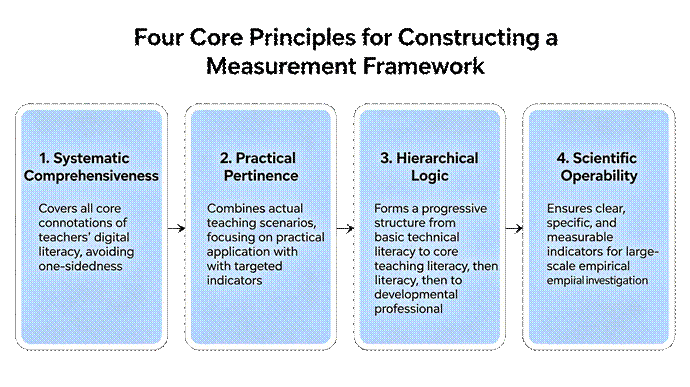
In order to ensure the scientificity, systematicness, pertinence and operability of the measurement framework, this study adheres to four core principles in the process of framework construction. First, the principle of systematic comprehensiveness, which covers all core connotations of teachers’ digital literacy in the digital era, avoids the one-sidedness of single-dimensional measurement, and realizes the full coverage of technical application, teaching practice, professional development and ethical norms. Second, the principle of practical pertinence, which combines the actual teaching scenarios of basic education and higher education, focuses on the practical application of digital literacy in teaching work, and sets targeted measurable indicators. Third, the principle of hierarchical logic, which forms a progressive and organic hierarchical structure from basic technical literacy to core teaching literacy, then to developmental professional literacy and normative ethical literacy. Fourth, the principle of scientific operability, which ensures that each measurement indicator is clear and specific, easy to observe and measure, and can be applied to large-scale empirical investigation and practical evaluation[10].
3.2 Dimensional Division and Connotation Definition of The Framework
Combined with theoretical deduction, literature analysis and expert consultation results, this study constructs a four-dimensional integrated measurement framework of teachers’ digital literacy, including digital technical literacy, digital teaching literacy, digital professional literacy and digital ethical literacy. Each primary dimension includes several secondary indicators, forming a complete hierarchical indicator system. The specific dimensional connotation and indicator composition are shown in Table 1.
| Primary Dimension | Secondary Indicators | Dimension Connotation Definition |
| Digital Technical Literacy (Basic Layer) | Digital tool operation, multimedia resource production, platform system management, data basic processing | The basic technical capability of teachers to proficiently apply various digital teaching tools, produce digital teaching resources, manage online teaching platforms and process teaching data, which is the basic premise of digital teaching practice |
| Digital Teaching Literacy (Core Layer) | Digital teaching design, interactive teaching innovation, digital teaching evaluation, personalized teaching support | The core teaching capability of teachers to carry out innovative teaching design, build interactive teaching scenes, implement intelligent teaching evaluation and provide personalized teaching guidance based on digital technology |
| Digital Professional Literacy (Development Layer) | Digital learning awareness, online academic communication, teaching research innovation, sustainable capability improvement | The developmental professional capability of teachers to take the initiative to carry out digital learning, participate in online academic exchanges, carry out digital teaching research and realize continuous professional growth |
| Digital Ethical Literacy (Normative Layer) | Digital information identification, student privacy protection, network behavior norms, educational data security | The normative literacy of teachers to abide by digital educational ethics, accurately identify network information, protect student privacy, standardize network teaching behavior and ensure educational data security in digital teaching |
Table 1. Multidimensional Measurement Framework and Connotation of Teachers’ Digital Literacy
3.3 Standard Setting of Measurement Indicators
On the basis of determining the dimensional framework, this study sets standardized measurement standards for each secondary indicator, and adopts a five-point Likert scoring method for quantitative measurement, with 1 representing “very inconsistent” and 5 representing “very consistent”. In order to ensure the accuracy of indicator measurement, this study refines the observation items of each secondary indicator, forming a total of 24 standardized observation items. Among them, digital technical literacy includes 6 observation items, focusing on the proficiency of teachers’ basic digital technology operation; digital teaching literacy includes 8 observation items, focusing on the practical application effect of digital technology in teaching innovation; digital professional literacy includes 5 observation items, focusing on teachers’ active development ability in the digital environment; digital ethical literacy includes 5 observation items, focusing on teachers’ normative awareness and behavioral norms in digital teaching. The refined indicator system fully covers the whole process of teachers’ digital teaching practice and professional development, and has good measurement comprehensiveness and accuracy.
3.4 Reliability and Validity Test of The Framework
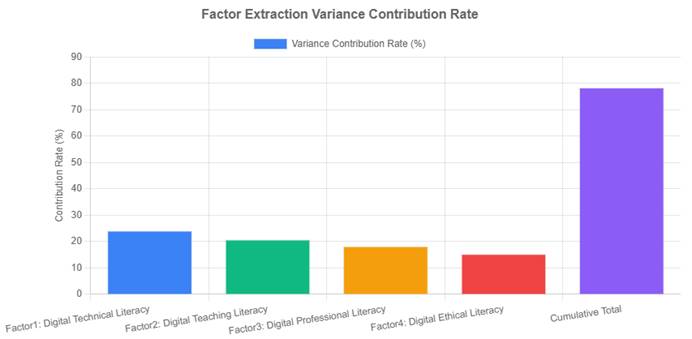
In order to verify the scientificity and stability of the constructed measurement framework, this study carries out reliability and validity test through empirical data. The research randomly selects 320 teachers from primary schools, middle schools and universities in different regions as pre-investigation samples, recovers 308 valid questionnaires, with an effective recovery rate of 96.25%. The reliability test results show that the Cronbach’s α coefficient of the total scale is 0.926, and the α coefficients of the four sub-dimensions are all higher than 0.85, indicating that the scale has good internal consistency and reliability. The validity test results show that the KMO value of the scale is 0.892, and the Bartlett spherical test significance is less than 0.001, which is suitable for factor analysis. The exploratory factor analysis extracts four common factors consistent with the framework dimension, and the cumulative variance contribution rate reaches 78.36%, indicating that the framework has good structural validity. The above test results fully prove that the constructed multidimensional measurement framework of teachers’ digital literacy has good scientificity and applicability.
4. Research Design and Empirical Analysis
4.1 Research Hypothesis and Model Construction
Based on environmental behavior theory and existing research results, this study divides the influencing factors of teachers’ digital literacy into three levels: individual internal factors, school institutional factors and social environmental factors, and constructs a hierarchical influence mechanism model. Individual factors include individual learning initiative and digital cognitive level; school institutional factors include school digital resource support, digital training system and teaching incentive mechanism; social environmental factors include social digital education atmosphere and policy system guarantee. Combined with theoretical analysis, the research puts forward the following research hypotheses[11].
H1: Individual internal factors have a significant positive impact on teachers’ overall digital literacy and each sub-dimension.
H2: School institutional factors have a significant positive impact on teachers’ overall digital literacy and each sub-dimension, and play a partial mediating role between individual factors and digital literacy.
H3: Social environmental factors have a significant positive regulatory effect on the relationship between school institutional factors and teachers’ digital literacy.
H4: The influence intensity of different influencing factors on different sub-dimensions of digital literacy has significant differences.
4.2 Sample Selection and Data Collection
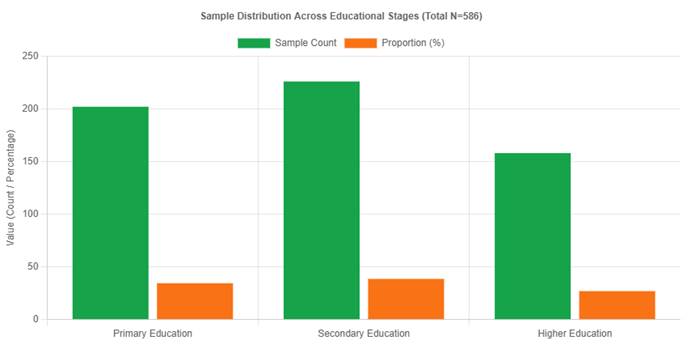
This study adopts the stratified random sampling method, selecting teachers from different educational stages, different school types and different regional levels as formal research samples. The survey objects cover primary school teachers, middle school teachers and university teachers, covering urban and rural areas, eastern, central and western regions of China. The formal survey was carried out from March to April 2026, and a total of 650 questionnaires were distributed, and 612 questionnaires were recovered. After eliminating invalid questionnaires with regular answers and missing key data, 586 valid questionnaires were finally obtained, with an effective recovery rate of 90.15%. The basic demographic characteristics of the samples are shown in Table 2.
| Sample Characteristics | Classification Standard | Sample Number | Proportion (%) |
| Educational Stage | Primary Education | 202 | 34.47 |
| Secondary Education | 226 | 38.57 | |
| Higher Education | 158 | 26.96 | |
| Teaching Experience | 1-5 years | 168 | 28.67 |
| 6-15 years | 245 | 41.81 | |
| More than 15 years | 173 | 29.52 | |
| Regional Distribution | Eastern Region | 215 | 36.69 |
| Central Region | 208 | 35.49 | |
| Western Region | 163 | 27.81 |
Table 2. Basic Demographic Characteristics of Research Samples (N=586)
4.3 Current Situation Analysis of Teachers’ Digital Literacy
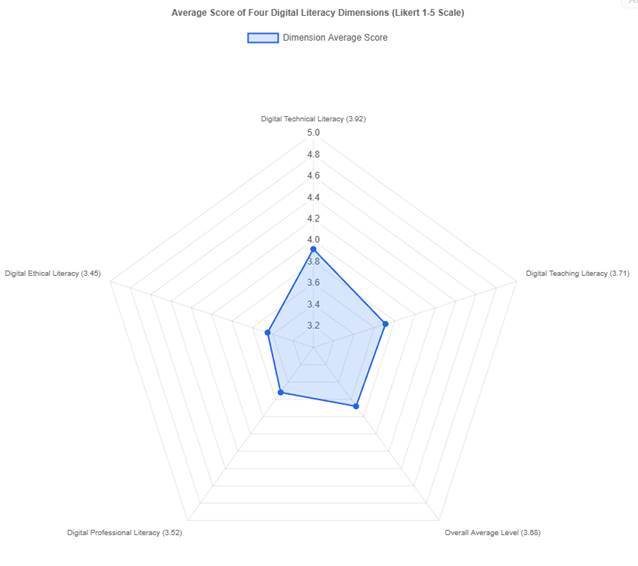
Based on the constructed multidimensional measurement framework, this study conducts statistical analysis on the overall level and dimensional differences of teachers’ digital literacy. The overall average score of teachers’ digital literacy in the sample is 3.68 (full score 5), indicating that the overall digital literacy level of teachers in China is at the medium level, and there is still a large space for improvement. From the perspective of each sub-dimension, the average score of digital technical literacy is 3.92, which is the highest among all dimensions, indicating that most teachers have mastered basic digital operation skills and can proficiently use conventional digital teaching tools. The average score of digital teaching literacy is 3.71, which is slightly higher than the overall average, reflecting that teachers have initially formed the ability of digital teaching innovation, but the depth of personalized teaching and intelligent evaluation needs to be improved.
The average score of digital professional literacy is 3.52, which is lower than the overall average, indicating that teachers’ active digital learning awareness and digital teaching research ability are insufficient, and the sustainable development ability of digital literacy needs to be strengthened. The average score of digital ethical literacy is 3.45, which is the lowest among all dimensions, reflecting that teachers’ attention to digital educational ethics, data security and student privacy protection is insufficient, and the normative awareness of digital teaching behavior needs to be further improved. The dimensional difference data fully shows that the development of teachers’ digital literacy is unbalanced, the basic technical ability is relatively mature, while the developmental and normative literacy is relatively weak, which is the key direction of subsequent training and improvement.
4.4 Empirical Test of Influence Mechanism
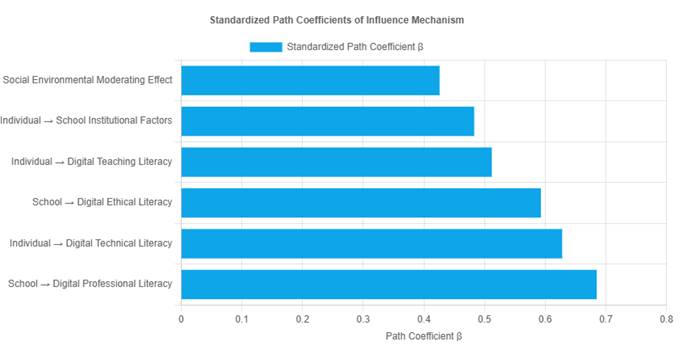
This study uses AMOS26.0 software to construct a structural equation model, test the research hypotheses, and analyze the hierarchical influence mechanism of different factors on teachers’ digital literacy. The overall fitting effect of the model is good: χ²/df=1.826, RMSEA=0.042, CFI=0.938, TLI=0.925, SRMR=0.036, all fitting indexes meet the standard requirements, indicating that the model is stable and effective. The specific path coefficient test results are shown in Table 3.
| Influence Path | Path Coefficient (β) | P Value | Significance | Influence Intensity |
| Individual Factors → Digital Technical Literacy | 0.628 | <0.001 | *** | Strong Positive |
| Individual Factors → Digital Teaching Literacy | 0.512 | <0.001 | *** | Medium Positive |
| School Institutional Factors → Digital Professional Literacy | 0.685 | <0.001 | *** | Strong Positive |
| School Institutional Factors → Digital Ethical Literacy | 0.593 | <0.001 | *** | Medium Positive |
| Social Environmental Factors → Regulatory Effect | 0.426 | <0.01 | ** | Weak Positive |
| Individual Factors → School Institutional Factors | 0.483 | <0.001 | *** | Medium Positive |
Table 3. Path Coefficient and Influence Effect Test Results of Influence Mechanism
According to the model test results, all the research hypotheses are verified. First, individual internal factors have the strongest positive impact on digital technical literacy, which indicates that teachers’ personal learning initiative and digital cognitive level are the core internal driving force for the improvement of basic digital operation ability. Second, school institutional factors have the most significant impact on digital professional literacy, which shows that school training systems, resource support and incentive mechanisms are key external guarantees for teachers’ sustainable digital professional development[12,13]. Third, social environmental factors play a significant positive regulatory role in the whole influence process, which can amplify the positive effect of school institutional support on teachers’ digital literacy. Fourth, there are significant differences in the influence intensity of different factors on different literacy dimensions, which verifies the hierarchical and differential characteristics of the influence mechanism of teachers’ digital literacy.
5. Discussion of Research Results
5.1 Discussion on Multidimensional Measurement Framework Results
The four-dimensional measurement framework of teachers’ digital literacy constructed in this study breaks through the limitation of the single technical and teaching dimension of traditional research, and incorporates digital professional literacy and digital ethical literacy into the measurement system, realizing the full coverage of basic operation, core application, sustainable development and behavioral norms. The empirical test results show that the four-dimensional structure has good structural stability and practical applicability, which is more in line with the actual needs of teachers’ digital development in the new era. The unbalanced development of each dimension of teachers’ digital literacy reflects the current development status of educational digitization in China[14]. At this stage, the popularization of digital teaching equipment and basic technical training has been basically completed, so teachers’ basic digital technical literacy is relatively mature. However, the high-level digital teaching innovation ability, independent digital research ability and digital ethical normative awareness have not been fully cultivated, which is the key bottleneck restricting the high-quality development of teachers’ digital literacy.
5.2 Discussion on Hierarchical Influence Mechanism Results
The influence mechanism analysis verifies the multi-level progressive influence law of “individual internal drive – school institutional support – social environmental regulation” on teachers’ digital literacy. Individual factors are the fundamental internal motivation for the improvement of teachers’ digital literacy. Only when teachers have active digital learning awareness and good digital cognitive ability, can they take the initiative to learn digital technologies, apply digital teaching modes and carry out digital teaching innovation. School institutional factors are the core external driving force. Perfect digital resource support and professional training systems can effectively make up for the deficiencies of individual ability and accelerate the improvement of teachers’ digital teaching and professional development capabilities. Social environmental factors play a macroscopic regulatory role. A good social digital education atmosphere and perfect policy guarantee system can optimize the overall development environment of teachers’ digital literacy and amplify the effect of individual and institutional influencing factors.
The differential influence effect of different factors on different literacy dimensions explains the structural imbalance of teachers’ digital literacy development. Individual factors mainly affect basic technical literacy, resulting in the overall high level of teachers’ technical operation ability; school institutional factors have a weak driving effect on digital ethical literacy, leading to the prominent deficiency of teachers’ digital ethical normative awareness. This differential influence mechanism provides a targeted theoretical basis for the subsequent formulation of differentiated training strategies.
5.3 Comparative Analysis with Existing Research Results
Compared with the existing DigCompEdu framework and TPACK model research results, the framework constructed in this study has obvious localized optimization and dimensional innovation. Foreign frameworks focus on the practical application of digital teaching, but lack attention to teachers’ digital professional sustainable development and digital ethical norms, which cannot fully adapt to the high-quality development requirements of educational digitization in China. This study adds professional development and ethical normative dimensions on the basis of traditional technical and teaching dimensions, which enriches the connotation of teachers’ digital literacy in the new era. In terms of influence mechanism research, most existing studies focus on single-factor linear influence, while this study constructs a multi-level hierarchical influence model, clarifying the internal driving, external supporting and macroscopic regulatory effects of different factors, and revealing the interactive mechanism between variables, which makes up for the fragmentation deficiency of existing mechanism research[15].
6. Optimization Strategies for Teachers’ Digital Literacy Improvement
6.1 Activate Individual Internal Drive to Lay a Foundation for Independent Digital Development
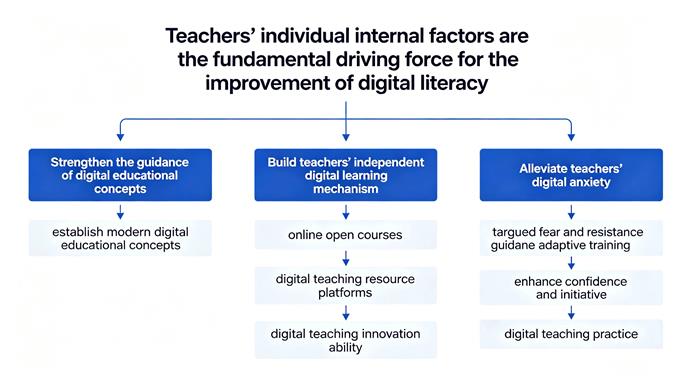
Teachers’ individual internal factors are the fundamental driving force for the improvement of digital literacy. It is necessary to focus on stimulating teachers’ active digital learning awareness and improving digital cognitive level. First, strengthen the guidance of digital educational concepts, help teachers establish modern digital educational concepts, abandon traditional teaching stereotypes, and fully recognize the important value of digital technology for teaching innovation and professional development. Second, build teachers’ independent digital learning mechanism, encourage teachers to make full use of online open courses, digital teaching resource platforms for autonomous learning, and continuously improve the proficiency of digital tool operation and the ability of digital teaching innovation. Third, alleviate teachers’ digital anxiety, carry out targeted psychological guidance and adaptive training, reduce teachers’ fear and resistance to new digital technologies, and enhance teachers’ confidence and initiative in digital teaching practice.
6.2 Improve School Institutional Support to Build a Professional Training System
Schools should take institutional construction as the core to build a full-process and multi-dimensional digital literacy training and support system. First, optimize the allocation of school digital teaching resources, update digital teaching equipment in a timely manner, build high-quality school-based digital teaching resource libraries, and break the resource mismatch barrier restricting teachers’ digital teaching practice. Second, improve the hierarchical digital training system, design differentiated training courses for teachers of different teaching ages and different literacy levels, focus on strengthening training in digital teaching innovation, digital teaching research and digital educational ethics, and make up for the short board of high-level literacy capability. Third, establish a perfect digital teaching incentive mechanism, incorporate teachers’ digital teaching practice and digital literacy improvement into professional assessment and evaluation, and fully mobilize teachers’ enthusiasm for digital teaching innovation and capability improvement.
6.3 Optimize Social Environmental Guarantee to Strengthen Macro Regulatory Effect
Educational administrative departments and social institutions should jointly optimize the external environment for teachers’ digital literacy development. First, improve the policy guarantee system of educational digitization, issue targeted teachers’ digital literacy improvement plans and implementation standards, and provide institutional guidance for school training and teachers’ personal development. Second, build a regional high-quality digital education resource sharing platform, realize the balanced allocation of digital educational resources in different regions, and narrow the regional gap of teachers’ digital literacy development. Third, create a good social digital education atmosphere, carry out digital teaching innovation competitions and excellent case promotion activities, strengthen academic exchanges and experience sharing among teachers, and promote the overall improvement of teachers’ digital literacy level in the whole society.
7. Research Conclusion and Prospect
This study takes teachers’ digital literacy in the era of educational digitization as the research object, constructs a four-dimensional multidimensional measurement framework including digital technical literacy, digital teaching literacy, digital professional literacy and digital ethical literacy, and systematically explores the hierarchical influence mechanism of individual, institutional and social environmental factors on teachers’ digital literacy through empirical research. The main research conclusions are as follows.
First, teachers’ digital literacy in the digital era presents a hierarchical and progressive four-dimensional structure, including basic technical layer, core teaching layer, developmental professional layer and normative ethical layer. The overall level of teachers’ digital literacy in China is medium, and the development of each dimension is unbalanced. The basic digital technical literacy is relatively mature, while the digital professional literacy and digital ethical literacy are relatively weak, which are the key improvement directions.
Second, teachers’ digital literacy is affected by the joint action of multi-level factors, forming a hierarchical influence mechanism of “individual internal drive – school institutional support – social environmental regulation”. Individual factors have a strong positive impact on basic digital technical literacy, school institutional factors have a significant driving effect on digital professional literacy and digital teaching literacy, and social environmental factors play a positive regulatory role in the overall influence process.
Third, there are significant differential influence effects of different influencing factors on different sub-dimensions of digital literacy. The insufficient institutional training of digital ethics and the lack of individual active research awareness are the main reasons for the structural imbalance of teachers’ digital literacy development.
The research innovations of this study are mainly reflected in two aspects. On the one hand, it realizes the dimensional innovation of teachers’ digital literacy measurement framework. On the basis of inheriting traditional technical and teaching dimensions, it adds professional development and ethical normative dimensions, constructs a more systematic and comprehensive four-dimensional measurement system, which makes up for the deficiency of incomplete dimensional coverage of existing research frameworks, and realizes the localized optimization of teachers’ digital literacy framework suitable for China’s educational digitization practice.
On the other hand, it realizes the systematic innovation of influence mechanism research. This study breaks through the limitation of single-factor linear analysis in existing research, constructs a multi-level hierarchical influence model covering individual, institutional and social environmental factors, clarifies the internal action path, variable interaction relationship and differential influence effect of different factors, and systematically reveals the formation mechanism and development law of teachers’ digital literacy.
7.3 Research Limitations and Future Prospects
This study also has some research limitations. Firstly, the research sample is mainly concentrated in domestic conventional schools, and the coverage of special education schools and vocational education schools is insufficient, which needs to be further expanded in subsequent research. Secondly, this study adopts a cross-sectional survey method to analyze the current situation and influence mechanism of digital literacy, and fails to explore the dynamic development law of teachers’ digital literacy in the long term. Thirdly, this study only verifies the overall influence mechanism, and does not further explore the moderating effect of demographic variables such as age and teaching age.
On the basis of this research, future research can be carried out from three aspects. First, expand the research sample coverage, include vocational education and special education teachers in the research scope, and analyze the differential characteristics of digital literacy of different types of teachers. Second, carry out longitudinal tracking research, explore the dynamic evolution process and long-term development law of teachers’ digital literacy with the help of panel data. Third, further expand the influence mechanism model, introduce demographic regulatory variables, and refine the heterogeneous influence mechanism of teachers’ digital literacy.
Reference
[1]Aliyyah R R ,Prasetyo T ,Widyasari W . Perspectives of Teachers on Digital Literacy Implementation Curriculum in Elementary Schools[J].F1000Research,2026,14 DOI:10.12688/F1000RESEARCH.172273.2.
[2]Acosta S J H ,Ricaforte M R . Perceived Digital Literacy and Technology Integration as Predictors of Teacher Innovative Work Behavior[J].Asian Journal of Education and Social Studies,2026,52 (6):497-510.DOI:10.9734/AJESS/2026/V52I63111.
[3]Liu M . A Study on the Value and Pathways for Enhancing the Digital Literacy of Ideological and Political Education Teachers in the New Era[J].Journal of Higher Education Research,2026,7 (2):DOI:10.32629/JHER.V7I2.5158.
[4]Camanse D G V E ,Cabaluna M E ,Ydimne J L , et al. Digital Literacy and Readiness among Primary Grade Teachers in the Implementation of Matatag Curriculum[J].Asian Journal of Education and Social Studies,2026,52 (6):355-367.DOI:10.9734/AJESS/2026/V52I63100.
[5]Xiaona H . Investigating the Structural Relationships of Vocational Teachers’ Digital Literacy for Blended Learning[J].International Journal of Mobile and Blended Learning (IJMBL),2026,18 (1):1-18.DOI:10.4018/IJMBL.410609.
[6]Gulen N H ,Kucuk S . Integrating artificial intelligence into preservice teacher education: enhancing AI literacy and digital material design competency[J].Education and Information Technologies,2026, (prepublish):1-26.DOI:10.1007/S10639-026-14020-1.
[7]Gui Q ,Omar K M ,Harithuddin M S A . An empirical study on teachers’ attitudes and digital competencies in Jiangxi, China: gender as a moderating factor.[J].Scientific reports,2026, DOI:10.1038/S41598-026-51428-8.
[8]Chen W ,Liu R ,Li X . Motivation stimulation and continuous learning behavior in teacher digital literacy cultivation: a self-determination theory perspective.[J].BMC psychology,2026, DOI:10.1186/S40359-026-04592-5.
[9]Li P ,Liu C ,Qi W , et al. Correlation between Digital Literacy and Teaching Efficacy among Teachers in Private Medical Colleges in Shandong Province[J].Education Insights,2026,3 (4):322-329.DOI:10.70088/JD6SE140.
[10]Ma Y ,Zhang X . Research on the Improvement Path of Foreign Language Teachers’ Digital Literacy in the Digital Intelligence Era[J].Journal of Humanities, Arts and Social Science,2026,10 (4):DOI:10.26855/JHASS.2026.04.017.
[11]Yang Y ,Shi W . Digital health literacy framework for PE teachers: a grounded theory study[J].Frontiers in Public Health,2026,14 1771020-1771020.DOI:10.3389/FPUBH.2026.1771020.
[12]Chen Y . Developmental Paths of Digital Literacy among Pre-service English Teachers in Human–AI Collaborative Contexts[J].English Language Teaching and Linguistics Studies,2026,8 (2):DOI:10.22158/ELTLS.V8N2P229.
[13]Du Y . How teachers’ digital literacy influences the intention to use AI teaching tools: an empirical study based on an integrated model[J].Interactive Learning Environments,2026,34 (4):2020-2042.DOI:10.1080/10494820.2025.2538746.
[14]Chen H . The Real Gap and Improvement Path of Rural Teachers’ Digital Literacy in the Era of Intelligence[J].New Explorations in Education and Teaching,2026,4 (4):DOI:10.70711/NEET.V4I4.9124.
[15]Sun P . Exploring the Pathways for Cultivating Teachers’ Digital Literacy through Educational Technology in the Era of Intelligence[J].Education Reform and Development,2026,8 (3):49-55.DOI:10.26689/ERD.V8I3.14493.