DOI:https://doi-0004.org/6812/17919584219976
bentoumi Ahmed1, bentoumi miloud2, Ahmed bendib3, Abdelaziz Rabehi4
1 Signal and Systems Analysis Laboratory, Department of Electronics, University of M’sila, M’sila 28000, Algeria, E-mail: ahmed.bentoumi@ univ_msila.dz
2 Signal and Systems Analysis Laboratory, Department of Electronics, University of M’sila, M’sila 28000, Algeria, E-mail: miloud.bentoumi@univ_msila.dz
3 SET Laboratory, Electronics Department Blida, University Blida, Algeria, E-mail: ahmedib28@gmail.com
4Laboratory of Telecommunication and Smart Systems (LTSS), Faculty of Science and Technology, University of Djelfa, E-mail: Abdelaziz.rabehi@univ.djelfa.dz
Received: 29/08/2026 ; Published: 14/10/2026
Abstract
The generalized Rayleigh–Gamma mixture model (R-GG), characterized by the scale parameter, the power parameter, and the shape parameter, for radar clutter modelling, is investigated in this paper. Expressions of integer order moments, non-integer order moments and logarithmic moments are presented in such a way that the scale parameter of the R-GG probability density function (PDF) is eliminated, and two-dimensional estimators labelled HOME, NIOME, and [zlog(z)] methods are obtained. Due to the presence of the gamma function with fractional variables, these estimators cannot be given in closed form. The fitness function for each estimator is given as a sum of squared errors of nonlinear equations.
A numerical approach based on the Birds of Prey-Based Optimisation (BPBO) algorithm, in its updated 2025 version, is adopted to solve the corresponding optimization problems. The performance of the different estimation methods is first evaluated using artificially generated synthetic data. Then, the ability of the R-GG model to represent the tail behaviour of radar clutter is compared with that of the standard K-distribution, considered a particular case of the R-GG model, using real radar measurements. The statistical metric is performed using the Kolmogorov–Smirnov (KS) test.
The obtained results show that the studied estimation methods provide satisfactory statistical accuracy. However, the estimator based on the Fractional-Order Moment Estimator (FOME), when optimized using the BPBO technique, demonstrates the best performance in terms of parameter estimation accuracy and model fitting quality, particularly in the high-amplitude regions of radar clutter.
Keywords: radar clutter, parameter estimation, compound-gaussian, generalized gamma, HOME, NIOME, [zlog(z)]; R-GG model, BPBO, KS.
1. Introduction
Radar clutter is defined as the unwanted reflective waves from irrelevant targets. Modelling of high-resolution radar echoes is a key problem of target detection processors. These returns deteriorate detection performance and therefore require an accurate statistical description (Diao et al., 2022). Classical amplitude models such as Rayleigh, log-normal, Weibull, and K–distribution have been widely used to characterize clutter under different conditions (Mahapatra et al., 2024). Over the last few decades, compound distributions in which a random texture modulates a speckle process have gained considerable attention for representing complex land and sea clutter returns. This interest stems from their ability to capture both small-scale fluctuations and large-scale variability in clutter statistics (Castilho et al., 2023). Modelling sea clutter is particularly challenging because its distribution is affected by environmental dynamics (for example, wind speed, surface roughness, and wave motion) as well as radar system characteristics, including operating frequency, resolution cell size, and polarisation (Bounaceur et al., 2022). Furthermore, since sea states and surface conditions evolve, clutter statistics are inherently non-stationary. These factors motivate the search for more flexible models that can adapt to varying scattering behaviours encountered in real environments (Jabeen et al., 2025).
Generalized compound models extend the classical compound-Gaussian framework by allowing the texture and speckle components to follow flexible distributions such as generalized gamma laws. Under specific parameter selections, popular distributions like the K–distribution emerge as special cases. The K–distribution has been extensively employed in clutter analysis and detector design due to its ability to accommodate heavy tails commonly observed in high-resolution scenarios (Li et al., 2025). However, other texture laws, such as inverse Gaussian, inverse gamma, and log-normal, have also demonstrated improved fitting to measured data in many situations. Additionally, mixture models that combine multiple statistical forms have shown enhanced adaptability in representing heterogeneous clutter regimes, particularly in mixed background environments (Chalabi, 2023).
Accurate estimation of clutter distribution parameters is essential for adaptive signal processing, especially in constant false alarm rate (CFAR) detection, where threshold calculations depend directly on estimated statistical parameters derived from the clutter range profile (CRP). A wide range of estimation techniques has been explored in the literature, from the method of moments and higher-order moment matching to maximum likelihood and Bayesian approaches (Rafiq & Bazaz, 2022). However, radar clutter modelling requires alternative approaches. Anastassopoulos proposed generalized compound (GC) clutter using generalized gamma-distributed speckle and texture. The K-distribution, introduced by Bocquet, is a GC special case used in CFAR target detection. Other compound Gaussian models apply inverse gamma, inverse Gaussian, or log-normal modulation, including Rayleigh–K mixtures with EM-based parameter estimation (Cheng et al., 2024). Although integer-order moment methods provide straightforward computations, they often lack robustness in heavy-tailed environments (Cheng et al., 2024). To mitigate this, fractional moments, logarithmic moments, and hybrid strategies have been proposed, offering closed-form or numerically stable estimators with improved performance. Such developments underline the importance of choosing estimation techniques that align with the underlying clutter model, particularly when using flexible distributions like the Rayleigh–Generalized Gamma model that can represent both moderate and extreme scattering behaviours (Mahapatra et al., 2024).
Parameter estimation of radar clutter plays a fundamental role in modern radar signal processing. Accurate control of the false alarm rate and reliable target detection both rely on adaptive thresholding techniques, which require precise estimates of the statistical parameters derived from the CRP (Diao et al., 2022). Since clutter statistics vary depending on the operating environment, different probabilistic models are adopted to describe sea, land, or heterogeneous backgrounds. As a consequence, parameter estimation procedures must be tailored to the assumed distribution (He et al., 2024). Several methodologies have been proposed, including least-squares fitting techniques, higher-order moment estimation (HOME), maximum likelihood estimation (MLE), and related approaches. The use of integer-order moments is common due to its simplicity; however, this method does not always provide optimal performance (Hualde & Nielsen, 2022). In the particular case of K-distributed clutter, it has been shown that fractional-order moments and logarithmic-moment-based techniques allow the derivation of closed-form estimators, known respectively as FOME and the [zlog(z)] method (Medeiros et al., 2023). These estimators generally offer improved accuracy compared to conventional integer-moment techniques. Moreover, when the texture component is assumed to follow a log-normal distribution, analytical closed-form expressions for both the FOME and [zlog(z)] estimators have recently been derived. These approaches demonstrate superior estimation performance relative to the traditional HOME method (Douiou et al., 2024).
This study investigates the parameter estimation of the Rayleigh–Generalized Gamma mixture (R–GG) model for radar clutter characterization. Closed-form expressions of integer-order moments, fractional-order moments, and logarithmic moments are derived in such a way that the scale parameter is removed, resulting in two-dimensional estimators known as HOME, FOME, and the [zlog(z)] method. Because the resulting formulations involve Gamma functions with non-integer arguments, closed-form analytical solutions cannot be obtained. The proposed estimation techniques are first validated using simulated data. Then, the tail behaviour of the R–GG distribution and the conventional K-distribution (considered as a particular case of the R–GG model) is evaluated and compared with real radar measurements. It was found that the R–GG distribution provides satisfactory modelling capability across all estimation schemes, with the FOME method, optimized using the BPBO technique, achieving the highest estimation accuracy. The statistical metric is performed using the KS test (Bonnard et al., 2025).
This paper is organized as follows. Section 2 introduces the R–GG radar clutter model, including its moment expressions and the associated probability distribution function. Section 3 details the treatment of integer-order, fractional-order, and logarithmic moments in order to simplify the estimation procedure by reducing the problem to a two-dimensional framework. Section 4 provides a comprehensive assessment of the estimation performance of the proposed methods. Section 5 introduces the BPBO algorithm, which leverages natural hunting strategies to enhance the search for optimal solutions in complex solution spaces. Section 6 statistically evaluates the proposed estimators using the KS test, which measures the agreement between the theoretical R–GG model and the observed data by comparing the cumulative distribution functions, thereby enabling accurate detection of discrepancies, including in rare high-amplitude events. In Section 7, we discuss the radar characteristics and apply the R–GG estimator to IPIX data from Grimsby, Ontario. In Section 8, we discuss the experimental results obtained by applying the proposed R–GG estimators to both simulated and real IPIX radar data. Finally, the paper concludes with remarks emphasizing the effectiveness and flexibility of the R–GG model, its practical applicability to real radar data, and the potential for future research in improving radar clutter modelling and detection performance.
2– Rayleigh–Generalized Gamma (R–GG) Distribution for Radar Clutter Modelling
Statistical modelling of radar echoes is a fundamental aspect for the detection and interpretation of signals in complex environments, such as maritime areas or regions with heterogeneous clutter. Among the existing models, the R-GG model stands out for its ability to represent both low-intensity returns and extreme events (heavy-tail) through an adjustable shape parameter, denoted by ν (Qin et al., 2024).
The figure illustrates the probability density function (PDF) of the R-GG model for different values of ν, compared with a standard Rayleigh distribution. It highlights the influence of ν\nuν on the distribution shape: low values lead to sharp peaks and long tails, representing rare but significant intensities, whereas high values smooth the distribution, approaching the classical Rayleigh behaviour typical of more homogeneous environments. This analysis demonstrates that the R-GG model provides significant flexibility to represent various types of radar clutter, making it a valuable tool for optimizing detection techniques and characterizing signals under diverse conditions.
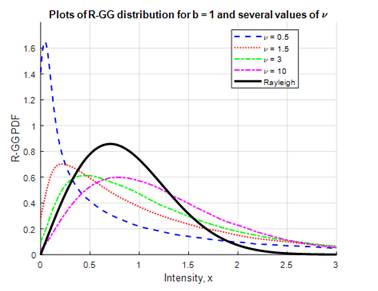
Figure 2. Probability density function (PDF) of the R-GG distribution with b=1 for different values of ν
The Rayleigh–Generalized Gamma model belongs to the class of compound statistical distributions widely used to characterize heterogeneous radar clutter. It is constructed by combining a Rayleigh-distributed speckle component with a Generalized Gamma-distributed texture component (Yao et al., 2026). This compound formulation enables accurate modelling of non-Gaussian and heavy-tailed behaviours frequently observed in high-resolution radar returns. The PDFs given by (Chalabi, 2023);
(1)
The CG clutter model with generalized gamma texture law is obtained from (1)
(2)
The complementary distribution function (CCDF) is given by
(3)
The K-distribution can be regarded as a special case of the R-GG distribution. Specifically, by setting the parameter b=2, the general expression of the R-GG distribution given in equation (2) simplifies and can be reformulated in the form of the K-distribution. This allows modelling clutter with heavier tails while maintaining the overall statistical structure of the R-GG distribution.
(4)
where K(⋅) denotes the modified Bessel function of the second kind of order ν (Christensen et al., 2024). The corresponding complementary cumulative distribution function (CCDF) of equation (4) can then be expressed as
(5)
3. Parameter Estimation Approaches for the R-GG Distribution
In the following, we develop the expressions under the assumption that the samples x1,x2,…,xM are independent and identically distributed (i.i.d.), representing M independent measurements of radar clutter amplitudes. The combination of the third- and fourth-order moments, denoted by and
, leads to the following expression.
(6)
3.1 Estimator Based on Higher-Order Moments
To estimate the unknown parameters of the R-GG distribution, we employ the Higher-Order Moments Estimator (HOME). This approach relies on matching theoretical higher-order moments with their empirical counterparts derived from the observed radar clutter samples. By exploiting the statistical information contained in higher-order moments, the estimator provides improved robustness and sensitivity to distribution shape characteristics (Akemann et al., 2023).
This method is referred to as HOME.
(7)
3.2 Parameter Estimation via Fractional-Order Moments
The main idea is to extend the usual definition of statistical moments to non-integer orders. This allows a more precise description of the tail behaviour of the distribution. Unlike integer-order moments, fractional moments can be chosen to control the influence of large amplitude values while keeping good numerical stability. This is especially useful for compound models such as the Rayleigh–Generalized Gamma distribution, which must represent both moderate variations and heavy tails accurately.
By matching the theoretical fractional moments of the model with the empirical moments computed from the clutter range profile, we obtain a system of nonlinear equations. Solving these equations provides reliable and efficient estimates of the unknown model parameters. Therefore, the fractional-order moment method offers a robust and practical estimation approach for adaptive radar signal processing, particularly in CFAR detection systems.
(8)
3.3 Logarithmic Moments-Based Estimator
The logarithmic moments-based estimator, commonly referred to as the [z log(z)] method, is a widely used technique for parameter estimation in radar clutter modelling. This method relies on the statistical properties of the logarithm of the observed data, allowing for robust estimation even in the presence of heavy-tailed or non-Gaussian clutter distributions. By transforming the measurements through the logarithmic function, the [z log(z)] estimator effectively reduces sensitivity to extreme outliers and emphasizes the central tendencies of the data, providing improved accuracy compared to traditional moment-based approaches. Its simplicity and effectiveness make it particularly suitable for real-time radar applications and for modelling compound clutter environments.
(9)
where
Following the calculation of and using (7), (8), or (9), the parameter 𝑎 is determined directly from the first integer-order moment.
(10)
4. Assessment of Estimation Performance
The next step is to evaluate the performance of the newly proposed estimators defined by (7) and (10). This evaluation is carried out by generating synthetic R- G G distributed clutter, with the shape parameter taking discrete values ranging from 0.1 to 1.5. For selected values of b=0.5 and 3, the clutter power is normalized to unity to ensure consistency. These choices are intended to represent both very spiky and moderately spiky clutter scenarios. Solving the nonlinear equation systems introduced in Section 3 requires numerical techniques. Accordingly, a belief (or fitness) function is defined as the sum of squared errors corresponding to each equation. Specifically, the belief function for the HOME method is expressed as:
(11)
Similarly, the belief function of the FOME method is
(12)
Finally, the belief function for the case of mixture zlog(z) and the first two integer moments based methods yields
(13)
To solve (11)–(13), we employed the BPBO algorithm [published in July 2025] to find the minimum with two variables, starting from an initial estimate. This approach falls under unconstrained nonlinear optimization. BPBO is a direct search technique that does not rely on numerical or analytical gradients. Similar to the simplex search, BPBO iteratively explores the search space to converge toward the optimal solution. The algorithm initializes a set of candidate solutions around the initial guess x0, generating perturbations for each component of x0 to form the initial population. For any component x0(i)=0, a small value of 0.00025 is used. The population is then updated iteratively according to the BPBO procedure described in the original publication, gradually improving the solution until convergence.
4.1 Estimation of Parameters Based on Simulated Data
The following MATLAB function is employed to generate M independent samples following an R-GG distribution.
(14)
Here, and denote the inverse incomplete gamma and Rayleigh functions, respectively. For consistency, the size of the CRP, M, is fixed at 10,000 throughout the simulations.
5. Birds of prey-based optimization technique
The BPBO algorithm is a metaheuristic method inspired by the cooperative and adaptive hunting strategies of birds of prey. It integrates global exploration, local exploitation, and dynamic diversity-preservation mechanisms to ensure robust convergence toward the global optimum.
5.1 Exploration Phase (Global Search)
The main objective of this phase is to avoid getting trapped in local optima by broadly exploring the search space. The reconnaissance flight of birds of prey inspires this strategy.
The position update is expressed as:
(15)
is the position of the i-th bird at iteration t,
is the current best solution (temporary global optimum),
is a random number,
denotes a Lévy flight, used to enhance global exploration.
5.2. Transition and Cooperative Hunting (Exploitation)
When promising regions are detected, the algorithm gradually shifts to a local exploitation phase. The birds adjust their positions based on the global best solution and the population mean:
(16)
(17)
It’s the population’s centre of mass,
is a random coefficient,
is a decreasing adaptive weight.
(18)
This mechanism ensures a gradual transition from exploration to exploitation, thereby improving convergence.
5.3 Weak-Prey Targeting Strategy
To accelerate convergence and avoid stagnation, the algorithm identifies the worst-performing individual , and repositions it relative to the best solution:
(19)
This strategy eliminates low-quality solutions and increases selective pressure toward optimal regions.
5.4 Dynamic Migration Mechanism
When population diversity decreases (stagnation), a random relocation is triggered:
(20)
where LB and UB are the lower and upper bounds of the search space, respectively.
This mechanism restores diversity and prevents premature convergence.
6. Statistical Evaluation Using the Kolmogorov–Smirnov Test
To quantitatively assess the goodness-of-fit of the considered statistical models to the experimental radar clutter data, the KS test is employed. This non-parametric test measures the maximum absolute difference between the empirical cumulative distribution function and the theoretical cumulative distribution function of a model, as defined in Equation 21. Smaller KS values indicate a closer agreement between the model and the observed data, providing a clear metric to evaluate the accuracy of each statistical representation. The KS test is particularly useful for highlighting discrepancies in both the central region and the tail of the distribution, which is critical for modelling rare high-amplitude events in radar clutter.
The Kolmogorov–Smirnov statistic is defined by:
(21)
Where:
is the CCDF obtained from the measured data,
is the theoretical CCDF,
The smaller the is, the better the fit.
7. Estimation using real data
In this subsection, the newly proposed estimator defined by (13) is applied to fit the R-GG model to real IPIX data. For comparison, the K distribution is also considered, using the z log(z) estimator. The lake-clutter measurements analyzed were collected at Grimsby, Ontario, with the experimental IPIX radar from McMaster University. The IPIX radar operates in the X-band and is capable of dual-polarisation and frequency-agile modes. Our analysis focuses on datasets 84, 85, and 86, corresponding to range resolutions of 3 m, 15 m, and 30 m, respectively. Key specifications and characteristics of the IPIX radar are detailed in [13]. The radar site was positioned east of “Place Polonaise” in Grimsby, Ontario (Latitude 43.2114° N, Longitude 79.5985° W), observing Lake Ontario from a height of 20 m, with the nearest far shore located over 20 km away. The Grimsby database consists of 222 files, with the measurements stored as 10-bit integers.
The sea-clutter data exhibit heavy-tailed behaviour, which makes accurate modelling crucial for reliable detection. The R-GG estimator is applied to capture both the central tendency and the extreme values of the clutter distribution. Fitting is performed by minimizing the difference between the theoretical and empirical moments, allowing the R-GG model to match the observed amplitude distributions across all range resolutions closely. The comparison with the K distribution highlights the improved flexibility of the R-GG model in representing highly spiky and heavy-tailed clutter scenarios.
8.Experimental results and discussions
Figures 2 to 11 present the probability density function and complementary cumulative distribution function comparisons for various radar clutter datasets. The KS statistics are reported for each case. Overall, both the R-GG and K-distribution models generally follow the trend of the experimental data. However, the R-GG model consistently demonstrates superior capability in capturing extreme amplitudes (heavy-tail behaviour) and accurately reproducing the central peak, particularly in high-amplitude regions that are critical for radar detection.
Figure 2 illustrates that both models broadly track the empirical data; however, the R-GG model better captures the distribution tails and the extreme amplitudes. Agreement with the empirical PDF shows more precise estimation of the central peak and high-amplitude values, while the K-distribution slightly underestimates the probability of extreme events. The CCDF highlights the R-GG model’s advantage in representing rare events. A KS analysis within the restricted interval confirms a slightly better local fit for R-GG (KS = 0.001363) compared to the K-distribution (KS = 0.003133).
Figure 3 confirms these observations across the R-GG FOME-BPBO and K models, showing that the R-GG model better captures both the central peak and the heavy-tail region. The KS values, 0.987024 for R-GG versus 0.994670 for K, indicate excellent overall fits, with the R-GG model slightly outperforming the K-distribution in the high-amplitude regions critical for detecting rare clutter events.
Figure 4 (VV polarisation, 15 m resolution, range cell 10) shows the R-GG model with a KS statistic of 0.102552, compared to 0.329725 for the K-distribution. The central region of the PDF is accurately reproduced, and the heavy-tail behaviour is substantially better captured by the R-GG model, which also maintains close agreement in the high-threshold region of the CCDF. The KS difference highlights the superior overall performance of R-GG in modelling the full dynamic range of the clutter.
Figure 5 demonstrates a contrasting scenario, where KS values are 0.999981 for R-GG and 0.028462 for K. Despite the R-GG model following the PDF trend visually, significant deviations occur in the CCDF, particularly in the transition and tail regions. Consequently, the K-distribution provides a highly accurate fit, while R-GG does not adequately represent the empirical distribution for this dataset.
Figure 6 (same configuration) shows KS statistics of 0.115948 for R-GG and 0.046980 for K. Both models provide acceptable fits. Still, the K-distribution achieves superior agreement, particularly in the tail region, where precise modelling of high-amplitude events is essential for radar detection performance.
Figures 7–9 (VV polarisation, 15 m resolution, range cells 15–30) illustrate that the R-GG model consistently outperforms the K-distribution, with KS values of 0.047742, 0.037271, and 0.035401, respectively. These results emphasize the model’s ability to represent extreme-amplitude events and rare occurrences, ensuring reliable detection performance across multiple range cells.
Figures 10 and 11 focus on HH polarisation at high resolution (3 m, range cell 30). Here, the K-distribution achieves lower KS values (0.031263 and 0.052111) compared to R-GG (0.056269 and 0.088809), indicating that under these conditions, the K-distribution provides a more faithful representation of the clutter, particularly in high-amplitude regions.
In summary, the R-GG FOME-BPBO model generally offers greater flexibility and higher accuracy for modelling radar clutter, especially for extreme amplitudes and critical range cells in VV polarisation. However, the K-distribution remains highly effective for specific datasets, particularly under HH polarisation and high-resolution configurations, where it provides the most accurate statistical representation. These findings demonstrate the importance of selecting the appropriate statistical model based on polarisation, resolution, and range cell characteristics (Gogineni et al., 2024).
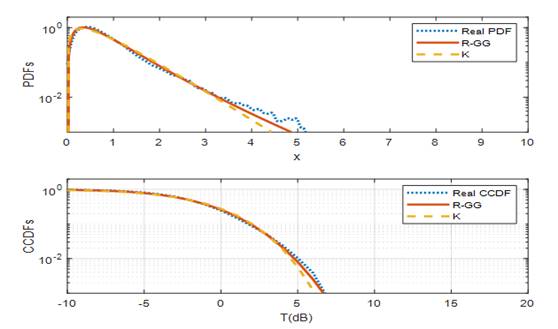
Figure 2. Fit of the R-GG and K distributions to empirical VV-polarised data at 15 m resolution for the 19th range cell, using BPBO with parameters: N = 40, MaxIter = 200, LB = [0.01, 0.01], UB = [6.2, 20].
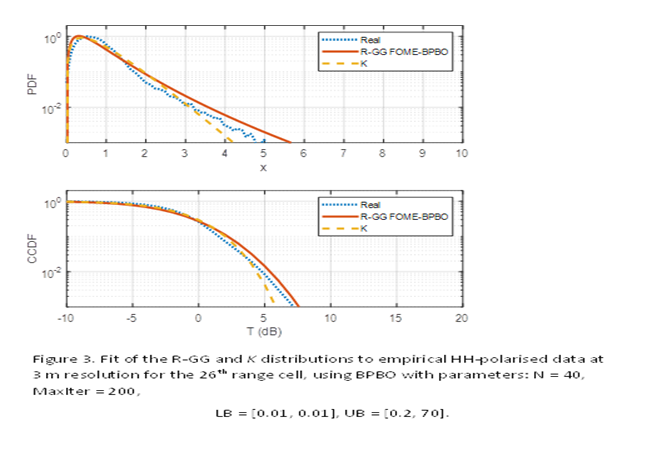
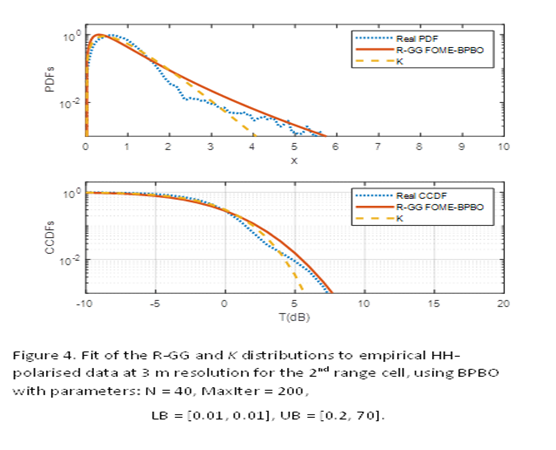
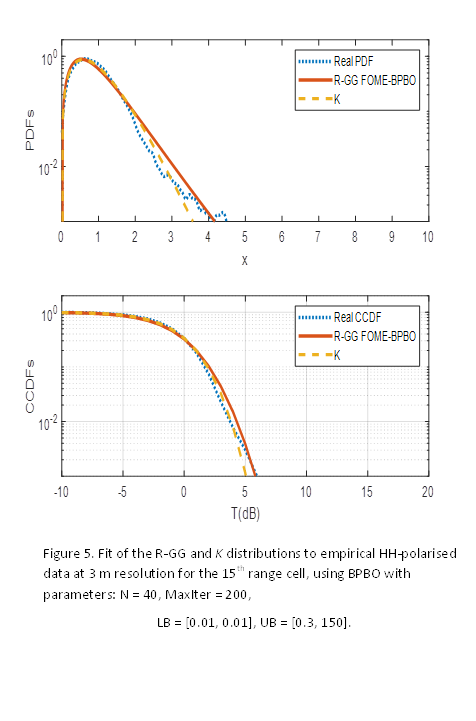
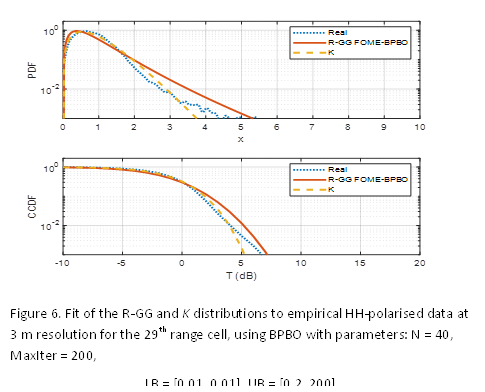
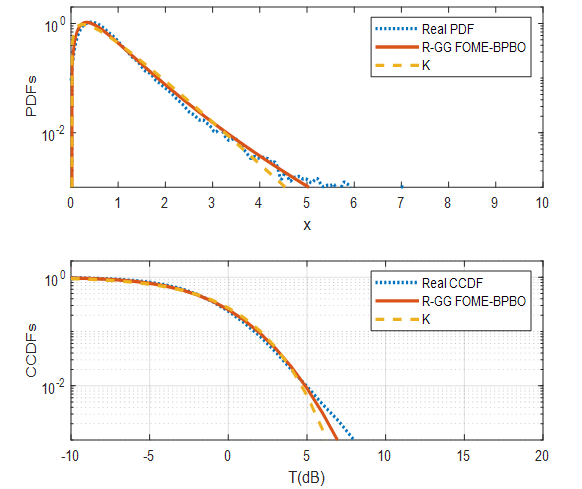
Figure 7. Fit of the R-GG and K distributions to empirical VV-polarised data at 15 m resolution for the 7th range cell, using BPBO with parameters: N = 40, MaxIter = 200,
LB = [0.01, 0.01], UB = [0.2, 150].
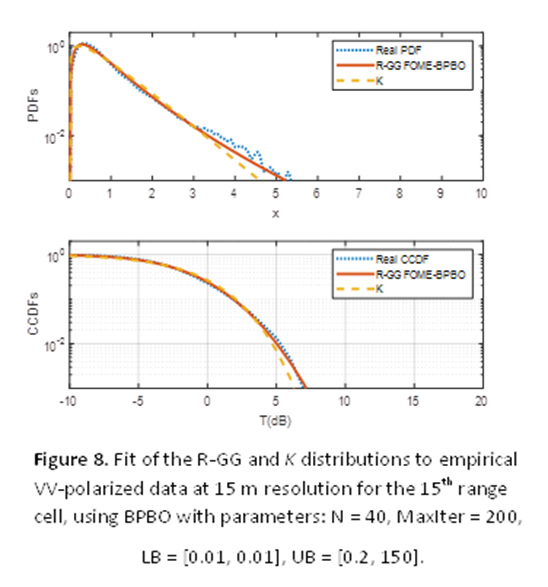
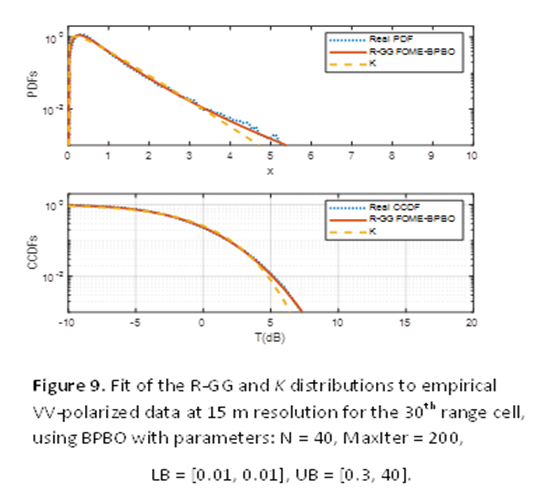
Figure 9 illustrates the fitting performance of the R‑GG distribution and K‑distribution to empirical VV-polarised sea-clutter data at 15 m resolution for the 30th range cell. The parameter estimation is performed using the Birds Prey Based Optimisation (BPBO) algorithm with N = 40, MaxIter = 200, LB = [0.01, 0.01], and UB = [0.3, 40]. The plotted PDF and CCDF curves show that both theoretical models closely follow the empirical distribution, indicating strong agreement and suggesting that either distribution can effectively represent the clutter statistics in this scenario.
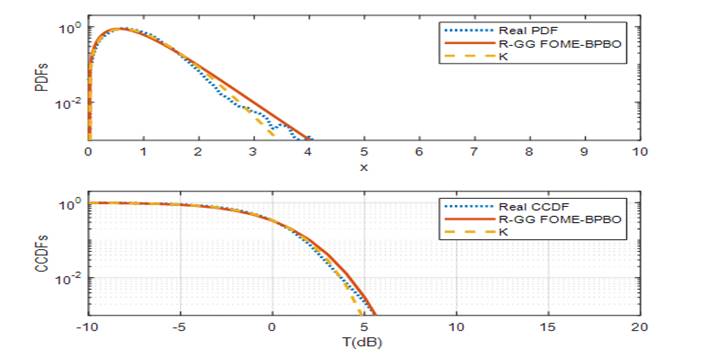
Figure 10. Fit of the R-GG and K distributions to empirical HH-polarised data at 3 m resolution for the 14th range cell, using BPBO with parameters: N = 40, MaxIter = 200,
LB = [0.01, 0.01], UB = [0.45, 50].
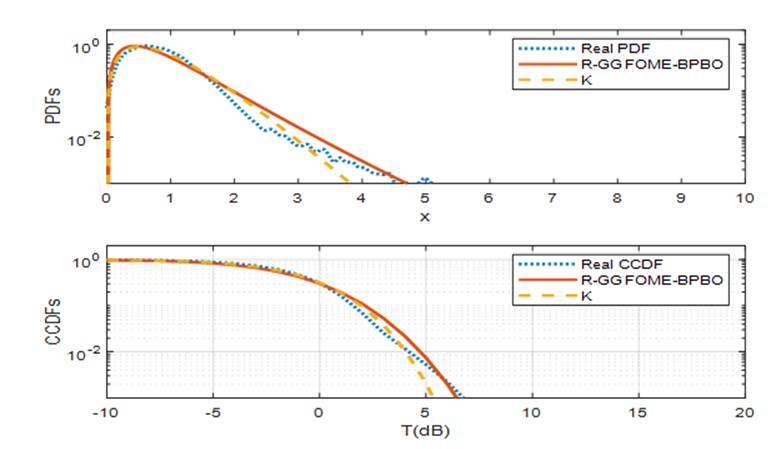
Figure 11. Fit of the R-GG and K distributions to empirical HH-polarised data at 3 m resolution for the 30th range cell, using BPBO with parameters: N = 40, MaxIter = 200,
LB = [0.01, 0.01], UB = [0.2, 20].
9. conclusion
This study investigated the generalized Rayleigh–Gamma (R-GG) mixture model for radar clutter modelling, focusing on parameter estimation using the HOME, FOME, and ZlogZ methods, optimized via the Birds of Prey-Based Optimisation (BPBO) algorithm. Experimental results, obtained from both real and synthetic radar data, confirm that the R-GG model provides superior flexibility in representing both the central region and the extremes of clutter amplitude. Statistical analysis based on the Kolmogorov–Smirnov (KS) test demonstrates that the R-GG model more reliably captures rare events and heavy-tail behaviour, particularly for VV polarisation and critical range cells, which are essential for radar detection. However, for certain configurations, notably HH polarisation at high resolution, the K-distribution remains competitive, offering more accurate fits in high-amplitude regions. These findings highlight the importance of selecting the appropriate statistical model according to polarisation, resolution, and range cell characteristics. Overall, the R-GG model represents a robust and accurate tool for radar clutter modelling, providing an optimal balance between overall fitting accuracy and the ability to capture extreme events crucial for enhancing the performance of modern radar systems. Hence, it was shown that parameters of R-GΓ distributed radar clutter can converge to their real values using some combinations of integer order moments, non-integer order moments and logarithmic moments. Specifically, estimates of underlying parameters could be approximated by the application of methods based on HOME, NIOME and [zlog(z)] involving numerical solutions of nonlinear systems. In most cases, this work has been confirmed by means of simulated and real data, showing that it is possible to obtain the best fit to real data if the R-GΓ model with [zlog(z)] estimator is taken into account.
REFERENCES
Akemann, G., Byun, S. S., Ebke, M., & Schehr, G. (2023). Universality in the number variance and counting statistics of the real and symplectic Ginibre ensemble. Journal of Physics A: Mathematical and Theoretical, 56(49), 495202.
Bonnard, L., Delaby, L., Murphy, M., & Ruelle, E. (2025). Optimizing the MoSt GG model, a sensitivity-driven calibration for better grass growth forecasting. Computers and Electronics in Agriculture, 235, 110288.
Bounaceur, H., Khenchaf, A., & Le Caillec, J. M. (2022). Analysis of small sea-surface targets detection performance according to airborne radar parameters in abnormal weather environments. Sensors, 22(9), 3263.
Castilho, V. M., Balthazar, W. F., da Silva, L., Penna, T. J. P., & Huguenin, J. A. O. (2023). Machine learning classification of speckle patterns for roughness measurements. Physics Letters A, 468, 128736.
Chalabi, I. (2023). High-resolution sea clutter modelling using compound inverted exponentiated Rayleigh distribution. Remote Sensing Letters, 14(5), 433-441.
Chalabi, I. (2023). High-resolution sea clutter modelling using compound inverted exponentiated Rayleigh distribution. Remote Sensing Letters, 14(5), 433-441.
Cheng, Y., Kexin, L. I., Chunbo, X. I. U., & Jiaxin, L. I. U. (2024). Improved Generalized Compound Distributed Clutter Simulation Method. Radioengineering, 33(4).
Cheng, Y., Kexin, L. I., Chunbo, X. I. U., & Jiaxin, L. I. U. (2024). Improved Generalized Compound Distributed Clutter Simulation Method. Radioengineering, 33(4).
Christensen, A. M., Rosado-Mendez, I. M., & Hall, T. J. (2024). A systematized review of quantitative ultrasound based on first-order speckle statistics. IEEE transactions on ultrasonics, ferroelectrics, and frequency control, 71(7), 872-886.
Diao, P. S., Alves, T., Poussot, B., & Azarian, S. (2022). A review of radar detection fundamentals. IEEE Aerospace and Electronic Systems Magazine, 39(9), 4-24.
Diao, P. S., Alves, T., Poussot, B., & Azarian, S. (2022). A review of radar detection fundamentals. IEEE Aerospace and Electronic Systems Magazine, 39(9), 4-24.
Douiou, Z., Chalabi, I., & Djerad, A. (2024). Fractional negative order moment parameter estimator of compound-gaussian clutter with lognormal texture. Przegląd Elektrotechniczny, 100.
Gogineni, S., Guerci, J. R., Nguyen, H. K., Bergin, J. S., Kirk, D. R., Watson, B. C., & Rangaswamy, M. (2022). High fidelity RF clutter modeling and simulation. IEEE Aerospace and Electronic Systems Magazine, 37(11), 24-43.
He, H., Li, Z., Zhang, X., Jia, J., He, Y., & You, Y. (2024). Characteristic description and statistical model-based method for sea clutter modeling. Remote Sensing, 16(23), 4429.
Hualde, J., & Nielsen, M. Ø. (2022). Fractional integration and cointegration. arXiv preprint arXiv:2211.10235.
Jabeen, N., Lei, H., Muhammad, A., Ali, A., Khan, Z. U., & Pan, G. (2025). Localization in ISAC: A review. IEEE Internet of Things Journal.
Li, D., Zhao, X., Xu, W., Ge, C., & Li, C. (2025). A novel renewable energy scenario generation method based on multi-resolution denoising diffusion probabilistic models. Energies, 18(14), 3781.
Mahapatra, D. K., Frery, A. C., Pradhan, B. B., & Roy, L. P. (2024). A review on parametric and semiparametric distributions in characterizing synthetic aperture radar clutter data. IEEE Access, 12, 83340-83362.
Mahapatra, D. K., Frery, A. C., Pradhan, B. B., & Roy, L. P. (2024). A review on parametric and semiparametric distributions in characterizing synthetic aperture radar clutter data. IEEE Access, 12, 83340-83362.
Medeiros, D. S., García, F. D. A., Machado, R., Santos Filho, J. C. S., & Saotome, O. (2023). CA-CFAR performance in K-distributed sea clutter with fully correlated texture. IEEE Geoscience and Remote Sensing Letters, 20, 1-5.
Qin, X., Zao, Z., & Xie, L. (2024, November). An In-Depth Analysis of the Recent Progress and Remaining Obstacles in Radar Signal Processing: A Holistic Evaluation. In International Conference on Information Processing and Network Provisioning (pp. 37-47). Singapore: Springer Nature Singapore.
Rafiq, D., & Bazaz, M. A. (2022). Model order reduction via moment-matching: a state of the art review. Archives of Computational Methods in Engineering, 29(3), 1463-1483.
Yao, S., Frery, A. C., & Balz, T. (2026). Angular Consistency Adaptive Filtering and Complex Generalized Gaussian-Based Phase Linking for DS-InSAR. IEEE Transactions on Geoscience and Remote Sensing.