Lulu Yang
Beijing Language and Culture University, Beijing, China
Renmin University of China, Beijing, China
Email:lly2025066@163.com
Beijing Language and Culture University, No. 15 Xueyuan Road, Haidian District,
Beijing 100083, P.R. China
Abstract
Background Information: Digital diplomacy has become a key component of international relations, particularly for countries in Asia, leveraging social media to shape global perceptions and foster diplomatic engagement. Nations like China, India, and Japan utilize digital platforms to project their image, communicate policies, and engage in cross-cultural dialogue.
Objectives: This study aims to explore how Asian countries employ digital diplomacy through strategic social media themes to influence international narratives and public perception, focusing on the thematic content and tone of their digital communication.
Proposed Work: The research applies a combination of thematic analysis, discourse analysis, and intercultural communication theory to analyze diplomatic posts from official government social media accounts. It examines how themes like economic diplomacy, cooperation, and cultural pride are framed and interpreted by global audiences.
Results: The study finds that China focuses on economic cooperation and cultural diplomacy, with “TAX_FNCACT” and “EPU_POLICY” as dominant themes, totaling over 15,000 mentions. India emphasizes governance and public policy, with “EPU_POLICY” and “GENERAL GOVERNMENT” making up 25% of their posts. Japan highlights economic growth and international collaboration, with “EPU_ECONOMY” leading. The Goldstein Scale shows China and Russia have negative values, around -2 and -3, reflecting conflict-driven diplomacy, while Israel and the USA show more cooperative stances, with values around +2.5 and 0, respectively.
- Introduction
Digital diplomacy is being placed as a necessity by governments at both global level and especially in Asia, which has seen countries such as China, India and Japan empowered through the social media platforms to reach out to international communities[1]. These social media like twitter, Facebook, Instagram and Youtube have transformed how governments share their policies, values and cultural identities [2]. Digital technologies have provided an opportunity for countries to stream their stories and interact with regular citizens as well as foreign governments [3]. The very ability of digital diplomacy to crowd-in awareness, goodwill, and relationship-building between nations is what gives it worth [4]. Social media platforms have offered governments an unprecedented opening to shape their image on the world stage, standing for national pride, economic agendas, and major diplomatic achievements-all critical matters in the area of contemporary statecraft [5].
Several reasons have attributed this growing importance of social media in diplomacy. The great degree of globalization of information seems to persuade governments that they must strongly assert themselves within the digital platforms in order to mold their international images [6]. Social media is also a tool for live communication, thus dismantling what has become the monopolistic barrier to all conventional diplomacy that had, till now, depended on inter-state intercourse [7].
As the issue of misinformation and the necessity to employ soft power have emerged, the governments are forced to actively control their narratives to affect the perceptions of other countries[8]. Moreover, the advent of high-speed digital connectivity in Asia has offered a ready channel through which governments can easily connect with the rest of the world[9]. This has brought about the idea of abandoning the conventional approach to diplomacy to a more casual and interactive one that can increase the international influence of a nation and solve the problem of digital communication[10].
As a traditional approach to researching digital diplomacy, quantitative content analysis or survey-based research tend to concentrate on the analysis of the mass of content or audience feedback [11]. Thematic analysis is common to locate repeated diplomatic forms of messages; discourse analysis is applied to know how language and rhetoric strategies affect the interpretation of the audience[12]. These approaches however have the disadvantage of not recognizing the dynamism of the social media where interaction and engagement are central to the development of diplomatic results[13]. Although they are capable of unearthing generalized narratives, in most occasions, they fail to discuss how the same messages are construed within various cultures and across geographical locations[14]. Also, the current literature is inclined to focus on the state-to-state diplomacy and overlooks the role of the non-state actors, including citizens and media, in the process of cross-cultural perceptions[15]. Because of this, a disconnect exists in comprehensibly grasping how digital diplomacy is executed within the framework of global and intercultural communication[16].
Current research gives a different model that integrates thematic analysis, discourse analysis and intercultural communication theory to give deeper insight into digital diplomacy in Asia. It is taking the model beyond the traditional one because it would include the cross-cultural communication lenses within which those diplomatic messages are taken on and perceived by different cultural entities. This way, one could study how Asian governments frame their messages on social media and how these perspectives resonate with disparate audiences globally. Newness in this study lies in the comprehensive perspective of identifying central themes-the malleable perceptions within the diplomatic narrative-but also giving insight into cultural reception of these narratives. It thus provides an umbrella that fills an existing gap in the literature, placing a richer intellectual level over the debate on digital diplomacy and of how digital strategies change the perception and contribution to cross-cultural awareness. The key contribution of this paper is:
- Analyzing how Asian countries utilize social media to shape international political narratives and cross-cultural perceptions, with the GDELT 2.0 Event Database as the primary dataset for examining geopolitical events and media coverage tied to digital diplomacy.
- This is undertaking thematic analysis in order to find or categorize the common diplomat themes, which also include economic cooperation, cultural pride, and technological advancement, by coding social media postings and gathering them into classes that correspond with the national priorities of Asian governments.
- Examining how Asian governments employ language, metaphors, and visual symbols through discourse analysis to influence international audiences, interpreting rhetorical devices like slogans, imagery, and tone to understand the framing of digital narratives.
- Investigating cross-cultural perceptions using intercultural communication theory, exploring how social media content is interpreted across different cultural contexts, providing a deeper understanding of how diplomatic messages are received internationally.
- Synthesizing findings from both thematic and discourse analysis to offer insights into how digital diplomacy in Asia shapes international relations and providing recommendations for governments to improve their strategies based on content, tone, and cultural reception.
The paper is structured as follows: Section 2 provides an in-depth review of the literature examining main theories and research on digital diplomacy, with a special emphasis on the Asian context. Section 3 lays out the methodology, from design to data collection techniques and methods of analysis. Section 4 is about the results together with their presentation and interpretation. The discussion in Section 5 reflects on the significance of these findings in terms of the existing literature. Finally, Section 6 ends the paper by summarizing essential takeaways and suggesting avenues for further research.
- Literature Survey
Whyke et al. [17] discusses the practically international mega influencer who creates cultural soft power from China through vlogging on YouTube. These vlogs show the rural Chinese way of life and instill in international audiences an image of an ideal form of traditional Chinese rural culture. Content analysis and discourse analysis are applied to look at Li’s visual and narrative representations and their effects on the social media users’ view of Chinese culture. The study’s findings stress a double-image of China on the national front and one of Li on the personal scale-an empowered yet soft rural Chinese woman-who bottom-up helped in building. Ng & Carley., [18] digital diplomacy through social media bots aids in building the national image, and the diplomatic balloon incident between China and the U.S. is thus very timely for this case study. There is a description of the three kinds of bots-Type General Bots, News Bots, and Bridging Bots-that from their stance can complement the diffusion of information and the building up of public opinion. Being more computational, essentially the study articulates the various kinds of narrative maneuvers that bots would engage in on behalf of one or the other country with wider implications on the concrete policy level and how automatic agents move political discourse on social media.
Xu et al. [19] is an analysis of Chinese digital diplomacy strategies vis-à-vis African countries, based on 1,681 tweets posted by the African Department of the Chinese Foreign Ministry. A mixed-methods approach was used in this research endeavor to categorize these tweets according to their themes, including foreign relations, economic partnership, and COVID-19 aid. The findings emphasized China’s digital diplomacy working for a benign image for China while respecting African sovereignty. This study deepens understanding of interaction patterns mainly in trade, education, and state visits and realizes the growing discourse around the Chinese way of conducting diplomacy in social media. Garcia [20] technology as such is a social construction; nevertheless, the third-world countries pose colossal challenges for it. Hence, there should be a development tech diplomacy scaling over areas like innovation, access, inclusion, and fair distribution of benefits. For Garcia, multi-stakeholder co-governance facilities for technology to serve mankind and human purposes to demonstrate either the realization of an eradication of poverty or achievement of the SDGs by leveling off structural power disadvantages which would otherwise create further inequalities.
Sullivan & Wang [21] view the rise of foreign wanghong media in China and the complexity of marketing under state-nurtured constraints. Media creators search foreignness and acculturation toward a modern version of cultural nationalism as the process of building a foreign image in the negotiation with the Chinese public in light of unfolding geopolitical currents. Mixed-method content analysis of Douyin videos of foreign wanghong offers insight into how these creators strategize their self-presentation and cross-cultural communication in negotiating foreignness toward social, cultural, and economic capital in the highly competitive world of Internet celebrity culture in China. Meng Yao [22] describes a particularly worthy intersection between usages of digital media and the construction of cultural identity, considering technological affordances as mediators with symbolic representations and social engagements. Previous literature provides a further backbone to the supposition that digital platforms appear to affect culture identity inasmuch as some scholars postulate that media use can at times modify how a person considers or expresses particular cultural affiliations to another. On the contrary, studies contrast the varied patterns of their consumption of different media and the different impacts those have in bolstering identity, hence introducing relevant intervening variables into intercultural communication.
B. K. et al., [23] analyze VR projects for decolonizing processes via a case study on Shenyou Dunhuang, a Chinese museum project toward the digital reconstruction of Cave 61 of the Dunhuang Mogao Caves. The study showed that this kind of virtual system could prepare the collective memories of the caves to shift from an artistic view upon cultural and spiritual values involved rather than a view held in historical trauma. Further, it examines whether VR could provide digital repatriation as a tool for changing cultural narratives against commodification and for fostering intercultural dialogue. Yuan [24] considers the growing importance of video games in soft power, asking how China is utilizing the gaming industry to gain cultural-political influence on the world stage. The emphasis laid on the leader of the gaming industry, Tencent, researches how some cultural elements and narratives enter games and thus become domains of cultural interchange and soft power projection. The paper marshals support behind the pairings of these gaming activities with China’s bigger soft power objectives by way of the Digital Silk Road initiative, which conceptualizes digital entertainment as diplomatic material.
Choi & Kessler, [25] investigate whether K-dramas fuel American intentions to visit South Korea, relative to sustainability messaging conveyed by the media. Applying the theory of planned behavior (TPB) and uses and gratifications theory (UGT), the study assumes career or competition related perceptions to be a factor in engagement with Korean culture and attitudes toward sustainable tourism. The results of a survey conducted among 554 U.S. participants show that stronger positive cultural perceptions and sustainability messaging in K-dramas promoted environmentally conscious travel behaviors, hence bolstering Korea’s soft power and giving directions to tourism marketing strategies. Xiang & Yuan contend that China is strategically pursuing eSports and gaming and using games, such as Honor of Kings and Black Myth: Wukong, to assert and amplify global leverage instead of using the standard soft power approach. By embedding some Chinese history and culture in these games, with tacit approval from the government, they can certainly be considered as cultural diplomacy. The article illustrates three significant qualities: allure, perseverance, and extensiveness, that make video games successful in cultivating interest in the global audience, implanting culture, and situating China as a global cultural influence, as showcased in the 2023 World Champion Cup of “Honor of Kings.
Bentum-Micah et al., [27] consider some issues and risks arising in the business operations between China and West Africa, especially with regard to China’s Digital Silk Road. In examining these risks, politics, regulations, and culture were studied by way of a mixed research methodology on digital partnering between Chinese companies and West African stakeholders. It is found to refer to issues hindering the establishment of low-level e-business instances with regulatory fragmentation, operational inefficiency, and conflicting perceptions of digital trust. The study also explores possible solutions to these risks, including regulatory and partnership model harmonization adapted for culture, thus setting the stage for sustainable digital cooperation. Li & Li [28] looks into the Russia-Ukraine war narrative competition on Chinese social media while concentrating on their strategies on the Weibo platform. Topic modeling, social network, and sentiment analyses were applied to investigate the formation, projection, and reception of strategic narratives. It was found that both countries did narrative crafting aimed at the public perception; however, narratives that appeal to shared values were more successful in creating an emotional connection to the audience. The study draws a conclusion about the effectiveness of prompt narratives based on shared values, even in a controlled media environment, as opposed to those based on national interests.
2.1 Problem Statement
The problem addressed in this body of research is the role played by virtual platforms, including social media and videogaming, towards the construction of national identities, cultural diplomacy, and soft power[18]. This includes the manner in which various actors, including influencers, international internet celebrities, and state-affiliated institutions, utilize digital media to produce and disseminate particular cultural narratives around the globe[21]. On the one side, China applies the new media strategically, involving YouTube, Douyin, and Weibo in the spheres of influence, but there are difficulties in the manipulation of public opinion-so much so through social bot technologies, gaming, and virtual reality. Attention is given to perspectives on some opportunities and challenges in cross-cultural digital diplomacy, having, on their plate, media framing of cultural identity, public diplomacy, as well as international relations. The considered research turns to those very issues found and implicated in the growing concern for digital media engagement in the international cultural reach of statecraft, along with the creation of international public opinion [25].
- Theoretical Framework
Theoretical framework stage is essentially where the research writer explains about the concepts and theories that form the guiding principles for the study. Consequently, this framework forms the basis of reasoning which attempts to relate the problem of study with perspectives taken from established academic views. In defining the main theories involved, it sets out both their pertinence and their use in interpreting the data. The framework places the study in the spectrum of current scholarship so as to illustrate the manner in which the present investigation adds to, or extends, present knowledge. In short, the framework provides the perspective from which the researcher will analyze the topic, ensuring a clear conceptual footing for the study.
3.1 Soft Power Theory
Developed by Joseph Nye, a Soft Power Theory relates to a nation being able to impact others not through coercion or monetary incentives, but rather through attraction, persuasion, and culture. The traditional or hard power is perceived to be military or economic; instead, soft power tries to shape preferences and attitudes by projecting a happy image of the country, its values, policies, and culture. Asia saw the great importance of soft power being exercised because countries such as China, Japan, India, and South Korea were more and more into maintaining their good image while strengthening regional and global influence through cultural exports, international media, and diplomatic messaging. Social media, being an international, interactive platform, is now one of the vital channels for the exercise of soft power. Governments may publicize their cultural heritage, landmarks in their policy achievements, technological developments, and social initiatives to the entire panantry; in so doing, they can create narratives that carry beyond all borders. In fact, this may afford countries the ability to influence perceptions in subtle ways while building goodwill and establishing diplomatic advantages, side by side with the older form of statecraft.
Within digital diplomacy, the Soft Power Theory clarifies the Asian government rationales for the selective use of social media producing media narratives designed for specific international audience rewards. This theory revolves around data, specifically that messages have been purposely designed to apply a person’s interest-often via an alluring point of interest from which national identity, political values, and societal ideals that are best represented. One could examine the ideas propagated through the various colloquial spheres of use on social media which as he/she observes the acceptors encapsulating the narrative into cross-cultural perceptions and international opinion. Soft power theory articulates its essence with regard to effectiveness, legitimacy, and appeal-the more such traits can be associated with the words of the individual, the better one gets the message. Thus, the Soft Power Theory does bring the theoretical basis of extremely comprehensive accounts of the ways through which Asian governments lead and work within the digital sphere to produce political discourses, exude influence, and secure a good reputation on the global scale.
3.2 Public Diplomacy Framework
The Public Diplomacy Framework is the strategic approach whereby governments can communicate and directly deal with foreign publics in an attempt to sway opinion, develop a mutual understanding and long-term relationships. In contrast to conventional diplomacy where the interactions between the state authorities are mostly among each other, public diplomacy is focused on communication with citizens of the non-state actor, media, and civil society in order to impact the current image of the country in the terms of its policies, culture, and values. The Asian approach has public diplomacy as the most important issue; it has therefore turned into a situation of nations struggling to negotiate regional issues, control international actions and image displaying soft power. The governments rely on the social media platforms to the final details in order to project their political messages and stories of culture and politics. By targeting foreign people instead of simply targeting state-to-state interactions, public diplomacy aims at producing positive impressions, correcting misconceptions and advancing the benefits of the nation through the channels that are not aggressive.
The frame of public diplomacy in digital diplomacy will be worried with how the Asian governments use the social media in narratives management and cross-cultural facilitation. On the contrary, this direction means that there are government messages and dialogues between the government and the citizen; where the government has means to measure and project moods not only for itself but for the entire international civic community. Hence, the entire concept offers very fertile grounds for investigating how official accounts act on social media towards creating a political narrative, addressing issues of concern for the international audience and cultivating an understanding of the culture. It further represents the revelation that diplomacy cannot succeed without cultural consciousness and the active deployment of strategic communication and is therefore an essential theoretical foundation that connects the effects of social media with Asian cross-cultural attitudes.
3.3 Framing Theory
True to the media and communication tradition, framing theorists attempt to observe the manner in which information is framed invoking an interpretation, on behalf of the audience. When structured in a particular manner and possessing a set of linguistic characteristics, imagery and tone, an issue, an incident or a message can shape the way people look at and respond to it. When supplementing digital diplomacy with the Asian context, to possess the frame-theoretical perspective. According to social media posts, videos, or campaigns there is never any equilibrium complementary to one another, but consciously accentuating some dimension of a given political story and pushing all others to the periphery. In examining governmental communication through a frame, researchers single out the frames as themes, metaphors and even repeated narrative structures frequently manipulated to express concepts of national identity, as policy intent, or cultural values. The theory assists understand why the same message can be interpreted differently by audiences in various countries: it all depends on who the message is transmitted by and in the light of what kind of cultural or political prism the message is perceived.
The framing theory offers a suitable and analytical theoretical instrument through which one can probe at the strategic formulation of the digital narrative modes by Asian governments in the context of social media diplomacy. The essence of the debate is that any specific message is framed and planned with the intentional purpose of shaping the opinions of the masses to change the frame of reference and consequently create an international discourse that fulfils the interest of individual nations. To illustrate, a foreign government would desire foreign trade negotiations to be seen externally as mechanisms of mutual growth as opposed to acrimony or to make regional security arrangements be viewed as cooperative as opposed to coercive. With thematic analysis and discourse analysis as the shelter of this theoretical covering, the investigators can observe how international attention is turned away, how the required emotional reactions are brought out, and how a positive national image is raised. Framing Theory, therefore, is a critical point of departure in understanding the politics of social media whereby social media is treated as a locus where political discourses are constructed, struggled over, and construed across the cultural frontiers in Asia.
3.4 Intercultural Communication Theory
Even the mere name Intercultural Communication Theory falls within the ethnographic tradition-how a person or a group of people with different cultural backgrounds are constructing, misperceiving, sharing meaning, or construing a meaning in a particular interaction. Culture and norms, values and languages, and their specific ways of communicating are actually permeated. That is, these would be bound to all the processes of making understanding or the contrary-misunderstanding. The theory through which prism of digital diplomacy examines how messages hack across the social media can be hacked into so many different senses by the global popularization with each of these being viewed from the cultural frame of reference. A diplomatic message emphasizing collectivism or harmony can have far greater influence in some of the Asian societies but can be viewed quite differently in societies that look at individualism or directness. In this regard, one can very easily perceive them through Intercultural Communication Theory, that is, understanding complex mechanisms through which diplomatic discourses can be passed back and forth across, as well how disagreements over interpretation might establish or destroy relationships.
Intercultural Theory of Communication states that governments develop specific stories or narratives to attract a variety of audiences abroad without losing its cultural identity. This theory is aimed at alleviating the cultural barriers through symbolic gestures, respect of culture, and the use of a language that inclusively seeks to understand each other. As an example, when in social media, where messages are transmitted by virtually instantaneous transmission methods and extensive reception across cultural boundaries, minor cultural indications, such as an image, metaphor, or idiomaticism can all coincide to find the commercial acceptability of a message. By studying communications that utilize this theoretical approach, researchers will have the capability to look at the messages through the lens of how they are meant, delivered, and decoded along cultural lines and in between cultures. Therefore, Intercultural Communication Theory can help in the study of cross-cultural perception because it describes the role of digital diplomacy as an information exchange and the negotiating nature of culture, as well as the creation of meanings in the global arena.
- Research Methodology
The entire architecture diagram displays the research workflow in analyzing Asia’s digital diplomacy on social media. The workflow starts with the Research Design, where lexical and discourse analysis are utilized to examine how narratives, framing, and communication strategies influence geopolitical perceptions. Data Sources are then determined, such as social media sites, official government pages, chosen posts, and media articles. A Purposive Sampling Strategy is employed in order to sift only pertinent diplomatic content in a manner that maintains concentration on influential narratives. Under the Data Collection stage, prominent diplomatic cases are determined, suitable platforms and authentic accounts are chosen, and posts are sampled according to international incidents, cooperation, and cultural events. The data is analyzed through an Analytics Method that crosses thematic analysis to derive repeated themes such as peace, cooperation, and cultural pride with discourse analysis to analyze language, rhetoric, and visual framing. The findings derived through these analyses form the basis of the Results, which identify how Asian governments, institutions, and citizens construct, communicate, and shape digital diplomatic narratives. Figure 1 illustrates the overall proposed methodology.
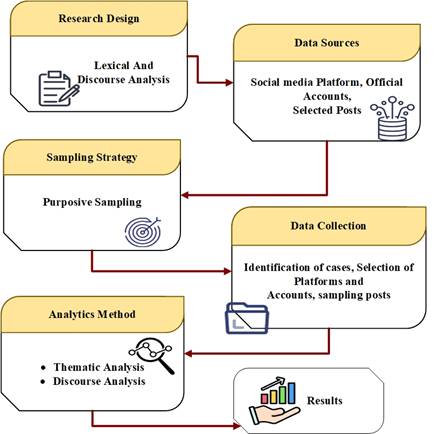
Figure 1: Overall proposed methodology
4.1 Research design
It is evident from the paper that the research is Lexical because it explores Asia’s diplomacy and the pertaining communication on social media, especially social media narratives, framing, and the meaning of communication in different cultures. Unlike social media where the primary goal is to quantify a diplomat’s influence, this approach enables a deeper, interpretative study of how geopolitical significance is created and transformed online by government bodies, institutions, and citizens. Within these annals are found topical instances and campaigns of social media diplomacy, with case studies shining bright under the spotlight. In this case, discourse- and frame-analysis fill the gap, as they study modern-day rhetoric and figures of thought on social media in the purview of diplomacy. In the Asian cultural context, it promotes a realization of taking the approach in the process of creating, contesting, and interpreting global political narratives.
4.2 Data sources
This step involves taking an account of the origin of the stories and messages of the digital diplomacy. For that, must look through social networks, accounts of government officials, some special posts devoted to the remarkable events, and media reporting reflecting these messages as well. The simultaneous inputting of information from all of these sources builds a complete picture of the cross-cultural political storytelling in Asia as a wholesome picture.
4.2.1 Social Media Platforms
The main sources of information will be major social media like Facebook, Instagram, YouTube, Twitter, and (X) that are basically the primary venues of the digital form of diplomacy in the Asian region. The legitimacy of using the platforms can be explained by the active activities of state authorities, diplomatic offices, and media houses of other countries in the platforms that they utilize to communicate with their citizens and foreign populations. Moreover, such platforms also enable working with the masses at a more intimate level, since stories are framed, contested and restructured with comments, resharing, hashtags and other multimedia tools.
4.2.3 Official Accounts
Authenticated and official social media profiles of the foreign Asian ministries, embassies, and government-owned media will be used to gather data. These social media pages act as the credible sources of diplomatic information and reflect the world events that the governments wish to convey. This analysis of these accounts can be systematically analyzed in the presentation of the political affairs of the state, image-building, and how they interact with the foreign audiences using the new media technologies.
4.2.3 Selected Posts
Based on the sample of accounts, purposive sampling will be used with regard to the international incidents, international cooperation and cultural occasions. The posts that are chosen will be multi-modal, that is, they will contain text, hashtags, images, and videos that will reveal the methods of framing and narrative. This will help in ensuring that this research focuses on content that is of importance to digital diplomacy and not spread on ordinary or routine content.
4.2.4 Media Content
In addition to checked accounts, we will also take into consideration the posts on social media of the state-owned and foreign news agencies. This material reflects how the governments conduct their diplomatic relationships in harmony with the general media discourse. It also reveals how the media take and enhance the government messages hence it offers the insight into the state communication and diplomacy machinery. The given kind of content can illuminate the dynamic of the public and state diplomacy in terms of international relations and cross-cultural international politics narratives.
4.3 Sampling Strategy: Purposive Sampling
This is done to block out irrelevant data and to take purposive sampling rather than random gathering of data. By use of purposive sampling, social posts, campaigns, or events that are not related to the theme of diplomacy, international relations, cross-cultural engagement are screened out. This blocks useless information and useless social media actions. This assists the research in getting profound into the digital diplomacy rather than quantifying the social media actions.
4.4 Data Collection Procedure
At this stage, the study gathers all materials that will be utilized in the process of the study. It does this by identifying key diplomatic cases, the social media sites of interest, and picking posts specifically related to the incidents. These materials are then archived and indexed with related metadata of the time of publication, degree of engagement and nature of media in order to facilitate validation. Concurrently further notes are gathered to connect the discourse to the larger context to the world and to politics to ensure that the method can be analyzed.
4.4.1 Identification of Cases
The first is to determine key diplomatic events, social media campaigns or other relevant international events in Asia where governments and institutional authorities have engaged in social media. These instances are chosen because they constitute examples of the enhanced communication with the aim of framing a political discourse and international perception control. In selecting such cases the study takes care of the cases that include digital diplomacy presence and significant influence.
4.4.2 Selection of Platforms and Accounts
After setting the cases, the cover of the large narratives on digital platforms follows. These are social networking sites, namely, Twitter/X, Facebook, Instagram, and YouTube. In addition, note the confirmed social media accounts of government officials, ministries, embassies and state media. These are the primary areas of interest since they are authoritative and officially institutional information.
4.4.3 Sampling of Posts
The selected posts belong to the selected accounts and platforms and are chosen with the help of purposive sampling. These posts comprise statements, hashtags, photos, videos and direct interaction with users all directly pertaining to the identified events. Only the material that has obvious diplomatic value can be analyzed using the sampling method, and the study can concentrate on the messages that actively attempt to construct the narratives and perceptions.
4.4.4Archiving and Documentation
The posts should be selected through metadata and data gritting is to be maintained; this will help in future analysis. Reckonable metadata is registered including posting date, the levels of engagement likes and shares and comments as well as type of media utilized. The need of archiving is that every item will be available to be used later even in the event that it has been deleted or altered and an index system is created that enables the systematic study of the themes and discussions.
4.4.5 Contextual Note-Taking
To facilitate analysis, it gives commentary on the archived materials. The commentary focuses on the most important political, cultural and international events of that period when the post was created, which allows to decipher the diplomatic texts of the real world under the social media posts. This makes sure that the analysis is not merely of the text or picture at the center but to clarify the relations hidden behind social media communications of diplomacy, politics and cultural relations.
4.5 Analytical methods
The data gathered should, therefore, be critically examined so as to notice the minor patterns that gained prominence everywhere in the field of diplomacy in social media. The discussion takes an interest in the manner in which language, tone, and framing operate to precondition the interpretation of the audience and the perception of the international audience. Therefore, an integrated strategy integrating thematic and discourse analysis is created in this work. Cooperation, cultural pride, or technological progress are dominant themes-abiding issues that the thematic analysis emphasizes, and rhetorical strategies, symbolic choices, and framing devices are illuminated by discourse analysis. The two complementary methodologies, therefore, give a better description of the operationalization of social media by Asian governments in relation to digital diplomatic goals.
4.5.1 Thematic Analysis
After that, they collected the posts coded to the pre-existing topics: hashtag, slogan, cultural reference, symbolic image, etc. Each of the codes represents, comparatively, a small unit of meaning in the large aggregate that is then grouped into categories that speak to larger communicative strategies: like regional cooperation, national identity, or cultural promotion. This systematic approach helps ensure that the analysis-the process of comparing content on certain dimensions across platforms and across countries-goes beyond mere description of content.
After the categories are created, they are further combined into a theme that reflects the dominant narratives pursued by governments in the realm of digital diplomacy. One could give an example of concentration: systematic repetition of posts mentioning peace summits, humanitarian aid, and sustainable development programs. Citations to cultural festivals, heritage, or national achievements in the category of cultural pride would also be an additional example of such consolidated reputations. Thus, thematic analysis helps to highlight not only government messaging priorities but also additional strategic intentions in narrative building. In this way, the study spells out how Asian states derive their voices both internally and externally in an effort to create credibility and might. Thematical Analysis demonstrates by Eq (1):
(1)
Where stands for code indexes in respect to posts,
stands for total codes,
is the interpretive process, and
for dominant themes extracted. This does not simply signify themes, which seem consistent, like peace diplomacy or humanitarian leadership, or even cultural pride; it is also useful for understanding the relationships between themes synergistic with larger country strategy in the region. Displaying multiple themes of several cases across several platforms, it displays the common strategies and the country priorities in Asian digital diplomacy.
4.5.2 Discourse Analysis
Thematic analysis determines the major narratives, and discourse analysis deals with the language and the rhetorical strategies, which construct the narratives. Not only the decision made by the governments, including mutual benefit, strategic partnerships, shared future, is included in it, but also the manner of its delivery (i.e., persuasive, celebratory, authoritative). The discourse analysis too takes into account the figures of speech that are employed such as slogans, metaphors and idiomatic phrases all forms of making a given complication political issue more relatable to different audiences. In this aspect, discourse analysis shows how language is a strategic tool that is applied to define reality and influence the way individuals consider such issues.
Besides text, the discourse analysis entails study of visual and semiotic communication. As an example, the pictures of leaders shaking hands, pictures of cultural icons, flags or places are examined, in the sense of their messages. Moreover, each of these elements is a strategy-driven discourse and uses authority, legitimacy and credibility to the international publics. Interrogating both of these rhetorical modes into analysis, the study will assist in the unpacking of the power relations, ideological framing, and cross-cultural strategies of digital diplomacy, and collectively, the study will be systematic, dual approach, in its ability to capture the meaning of not only what is communicated in the process of diplomacy, but also the meaning of how it is communicated, as well as, the strategy in the construction of the initial message. Eq (2) shows that Discourse Analysis is:
(2)
Where stands for lexical choices,
for rhetorical devices,
for visual discourse,
for silences or omissions, and
for the rest of the discourse pattern assigning diplomatic communication; the exercise of this framework shows how governments construe language and symbols to favorably frame political issues of interest. Examples of such language would be terms like “mutual growth” or “strategic partnerships,” which are used to frame diplomacy as cooperation instead of competition, while images of cultural festivals and heritage sites work to construct national identities. Discourse analysis thus exposes the politics of power, methods for constructing legitimacy, and cross-cultural framing tools within the specter of Asian digital diplomacy.
- Results
The findings of this study illustrate how strategically Asian nations use digital diplomacy focusing on economic progress, cooperation, and cultural pride. The thematic analysis of social media posts was able to reveal how governments, for example, China and India and Japan, create social media posts on unique themes to reflect national values through the development of shaped perceptions of their nation and social media used themes such as peace, technological strength, humanity, and sustainability to shape perceptions of their nation, build trust, and reliability with their viewers in order to make a strong diplomatic relationship. The nations did this by using the same theme consistently through their messages across each platform.
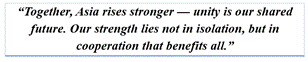
Figure 2: Identification of Core Narratives
This step focuses on exploring the dominant storylines that drive a country to present itself through digital diplomacy is figure 2. The official twitter accounts of different states should be analyzed thoroughly because they usually discuss their national pride, their power, their regional alliance, or even their worldwide leadership. Not only are they consistent but they also appear to be woven into their social media presence. The political messages must be interpreted in a tutored way. Social media serves the purpose of filtering the diplomatic messages to the appropriate degree. The words, Together, were move forward, used by numerous world leaders are a powerful story of development. These terms are used to build the international reputation of the country and also determine the global discourse about the role of the country.

Figure 3: Use of Storytelling Techniques
Storytelling, where a people-centered story is used to communicate a political or a diplomatic agenda, is figure 3 in the digital diplomacy domain. Governments prefer to publish a statistic or a formal statement and to stick to it. Nevertheless, they have a story of HIV success or a symbolic accomplishment that brings the emotions of people. The aspiration of diplomacy can be portrayed either individually, as personal achievements, as charitable work or civic pride, in the manner that is interesting and exciting to the imagination. The approach is valuable to blend in official messages in a more interesting light softens the impact and helps in the creation of a loyal audience that views the diplomacy to be effective and soft instead of bureaucratic and detached.

Figure 4: Emphasis on Strategic Themes
Digital Diplomacy relies on strategic themes, as they offer focus areas that enable the projection of a country’s image, along with the accomplishment of its foreign policy goals is figure 4. Such is the case of countries and their official diplomats, who by talking about peace, collective cooperation, sustainable development, or innovative technology, attempt to position their countries as innovative and trustworthy partners. The inclusion of such themes in their tweets helps counter any perceptions of their countries being involved in worldwide wars or being sidelined. Such strategic themes support consistent messaging from a country, aid in building credibility, and help sculpt a country’s image to meet long-term diplomatic goals.

Figure 5: Integration of Cultural Elements
Figure 5 is the image showing that the digital diplomacy uses strategic themes to place a country as a reliable and innovative partner in the world arena. Focusing on the major themes such as peace, cooperation, sustainable development, and innovative technology, the countries are striving to create a good global image in diplomacy. Such themes are echoed in the official social media content such as tweets, which can be used to combat negative associations, like a conflict or an international isolation. They protect the continuity of the message, enhance the credibility, and conform to the long-term diplomatic interests, eventually, forming the image of a country to meet its foreign policy objectives.
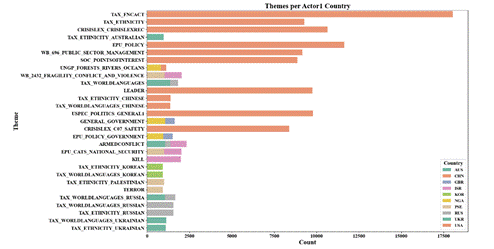
Figure 6: Themes per Actor1 Country
Figure 6 indicates that the themes per Actor1 Country” represents the distribution of the major diplomatic themes in different countries. The TAX_FNCACT and TAX_ETHNICITY themes prevail in the chart especially in the case of China (CHN) that indicates highest number of mentions with more than 15,000. The next important themes are EPU_POLICY, WB_696_PUBLIC_SEctor-management and SOC_POINTSOFINTEREST and China (CHN) and South Korea (KOR) are having significant mentions. Nations such as USA, Russia (RUS), and Israel (ISR) are more balanced in terms of theme distributions in such areas as GENERAL_GOVERNMENT and ARMEDCONFLICT. The graph shows the orientation of the social media communication towards the particular diplomatic concerns of the various countries and provides an idea of their online diplomacy policies and priorities.
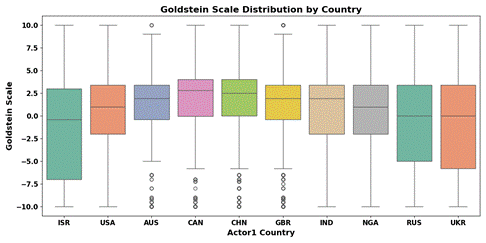
Figure 7: Goldstein Scale Distribution by Country
Figure 7 Goldstein Scale Distribution by Country illustrates the distribution of diplomatic actions (actual events) by country based on the Goldstein Scale where -10 is conflict and +10 is cooperation. Israel (ISR) and USA had higher positive values (meaning cooperation) and had median values about 2.5 (ISR) and near 0 (USA). China (CHN) and Russia (RUS) had power negative values (meaning conflict) at median values of about -2 and -3 respectively. India (IND) and United Kingdom (GBR) are closer to zero, meaning their diplomatic actions fall somewhere in between conflict and cooperation. The plot includes outliers for several countries and includes some extreme events in their diplomatic history.
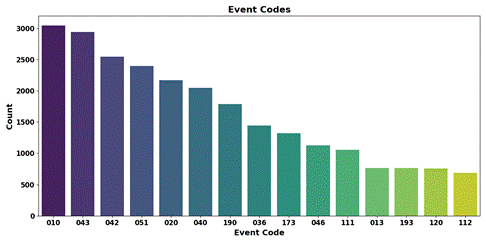
Figure 8: Event Codes
Figure 8 Event Codes shows the frequencies of various event incidents as based on diplomatic actions. The event code “010” registered the highest count, with over 3000 occurrences, implicating it to be the most frequent diplomatic event. After that comes event code 043 with roughly 2500 mentions, followed by 042 with just fewer than 2500 mentions. Then follow the other event codes like 051, 020 and 040 with additional smaller counts of 2000 to slightly over 2200 events. The numbers decrease progressively with further event codes with event like 111, 013, 193 and 120 about activities that do not even reach 600 mentions being least common. This form of distribution proceeds to emphasize the variation in frequency and significance of the diplomatic actions according to the coding of events.
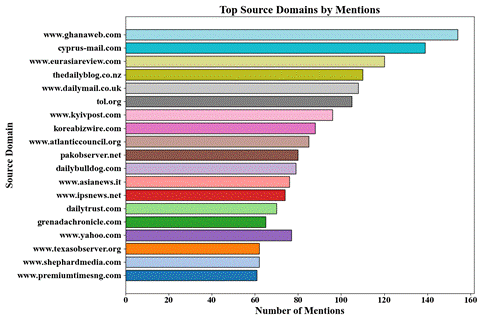
Figure 9: Top Source Domains by Mentions
Figure 9 presents the frequency of mentions of different domains of sources. Therefore, through example, the field has almost 140 mentions and occupies the very top, another with close runner-up 130 mentions. Others among the large names also have about 120 and 110 mentions. Some in the 90-100 range, some with nearly 100 references and some with a few less. The least-mentioned domains are found at the bottom of the chart-less than 40 mentions each. This setup brings out the difference in the manner in which these media houses are attended to and reported, thereby focusing on the contribution of the media houses in coverage of diplomatic events or issues.
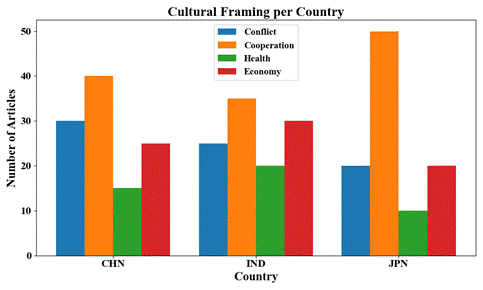
Figure 10: Cultural Framing per Country
Figure 10, presents a Cultural Framing per Country, provides information regarding the number of articles on different diplomatic themes of Conflict, Cooperation, Health, and Economy in the three countries, China (CHN), India (IND) and Japan (JPN). The most discussed theme with China is cooperation with approximately forty articles, then Conflict with approximately thirty articles and Health and Economy with approximately less than twenty articles respectively. India, however, displays somewhat balanced patterns of article distribution, with Cooperation having about thirty, followed by Conflict and Economy with twenty to twenty-five, and Health with about ten articles. In case of Japan, across the three discussed countries, Cooperation is given high priority with more than forty articles, whereas Conflict retains a substantial position too, coming just short of fifty. Health and Economy fall behind, with article counts of fewer than twenty each.