First Author : Qiang Lv 1
Affiliation: Changzhou University
No. 21, Gehu Middle Road
Wujin District, Changzhou City
Jiangsu Province, China
ORCID iD: 0009-0007-1246-4557
Corresponding Author : Yanyan Luan 2
Affiliation: Aba Teachers University
No. 588, Guanghua East Third Road
Qingyang District, Chengdu City
Sichuan Province, China
Shuimo Town, Wenchuan, Sichuan
Email: lvqiag@cczu.edu.cn 1 , 44618965@qq.com 2
Abstract
The increasing use of digital technologies in higher education has made blended learning, which combines online and in-person training, a popular teaching strategy. Because of this change, students must become increasingly self-reliant, which makes Self-Directed Learning (SDL) an essential academic ability. The direct and indirect relationships between SDL, motivation, and academic performance, however, have not been adequately captured by previous research, which has frequently relied on structural equation modeling techniques while ignoring more approachable and interpretable statistical techniques like Multiple Linear Regression (MLR). Furthermore, a number of earlier models have not adequately taken into account the actual constraints that students encounter while using SDL techniques in mixed contexts, nor have they adequately addressed the mediating roles of motivation and engagement. In order to fill these gaps, this study used a quantitative research design using MLR to investigate the effects of learner engagement, student motivation, and SDL on academic success among college students in a blended learning environment. 350 Peking University undergraduate students were given a structured survey via Google Forms, which was used to gather data. SDL, motivation, engagement, and academic accomplishment were the four primary dimensions that were examined in the study. Four hypotheses were examined in the investigation, one of which was the mediating function of engagement and motivation between SDL and academic results. The findings demonstrated the direct impact of autonomous learning practices by demonstrating a statistically significant positive correlation between SDL and academic attainment. However, the predicted mediating impact of motivation on academic achievement was minimal, and SDL did not significantly predict student motivation. Furthermore, learning engagement had little mediation effect, indicating that other factors could be more important in bridging the gap between SDL and accomplishment.
These results imply that although SDL is necessary for academic achievement in mixed learning environments, its full effectiveness requires the backing of more comprehensive instructional and motivational frameworks. For more in-depth understanding, future study should take into account more mediators and carry out longitudinal investigations.
Keywords: Self-Directed Learning, Student Motivation, Blended Learning, Academic Achievement, Learning Engagement, Multiple Linear Regression
1. Introduction
Within the last few years, the educational arena has undergone significant transformation largely as a result of incorporation of technology into the conventional educational framework. Blended learning, for instance, is one of the innovations that have probably impacted education the most [1]. In other words, blended learning is an educational model that combines two kinds of learning, namely, learning that takes place in a classroom, requiring a physical meeting with an instructor, and learning from what some termed as the flexibility that the Internet offers [2]. The model has steadily gained acceptance in institutions of higher learning where learners are offered a chance to study at varying times, sustain varied learning paces, and access greater numbers of instructional resources and tools. With this learning arrangement, it becomes less about creating avenues for delivering content to passive recipients and more about engaging learners in the active construction of their knowledge, thus granting them ownership of their learning experiences. In this context, self-direction in learning has come to be viewed as an essential task for students to acquire as they deal with learning in the increasingly hybrid environment [3], [4]. Education now is slowly moving towards a paradigm of learner-centered engagement, where SDL becomes an absolute must, especially in blended modes where less immediate teacher support is available, and students must exercise autonomy and sustained motivation to perform well academically [5].
In theory, blended learning could gain from SDL, but it is fraught with a host of unmet challenges. One major issue is that students often vary a lot in their readiness and ability to direct their own learning. Age, past experiences, self-efficacy, motivation, and digital literacy often determine whether or not a student will profit from self-directed learning [6], [7]. For many, the transition from a rigid classroom to a more autonomous learning atmosphere occurs in a very short period of time, becoming quite an uncertain and overwhelming event. Other students have limited metacognitive skills, which help them; such students often find themselves disengaged or not performing well [8]. Furthermore, several socio-cultural and institutional factors, including limited access to technology, non-individualized support, and lack of a coherent training program for teachers regarding blended pedagogy, further widen the gulf among students in terms of SDL readiness [9], [10]. These factors create heavy distortions to the actual learning outcomes, thus questioning the equity and efficacy of blended learning models onto different student populations.
In blending environments and mapping alternatives, the minimal theoretical understanding of self-service learning has been baked only into limitations of present-day instructional layout and tutoring methods. Many blended learning programs predominantly focus on content delivery and assessment while relegating to the sidelines the nurturing of SDL-related competencies, such as self-reflection, intrinsic motivation, and goal-setting. Instructors themselves may find it difficult to transition to a teaching model in which mentoring, facilitating, or differentiated support is offered to created autonomous learners [11], [12]. In balancing the benefits of a formal learning environment, existing learning management systems have emphasized task completion and content tracking, rather than meaningful engagement and personalized feedback. This invariably leads to learners negotiating through arduous online material with little guidance or structure, which may inhibit their motivation and confidence [13]. Despite increased rhetoric about student-centered learning, there remains a gap between the intended design of blended courses and the actual experience of students, with respect to fostering and sustaining self-directed learning in particular [14], [15]. These gaps signal the need for a deeper understanding of the workings of self-directed learning in blended contexts and how institutions can better assist students in acquiring these independent and self-motivated learning skills.
The proposed method explores the relationships between Self-Directed Learning, Student Motivation, Learning Engagement, and Academic Achievement of undergraduate students engaged in blended learning through Multiple Linear Regression. MLR was used since it allows us to describe the direct effect of many independent variables on one dependent outcome, providing information on how each component bears on the academic performance of students. Hence, the approach is such that it tests the hypothesized relations between constructs but also weighs the relative importance of cognitive (motivation), behavioral (engagement), and SDL aspects of learning outcomes. With this approach, it is hoped that the study may generate some evidence on how related autonomous behaviors and psychological drivers may support academic resilience in digitally blended settings.
Research Questions
- RQ1: What is the relationship between self-directed learning and academic achievement among university students in blended learning environments?
- RQ2: How does self-directed learning influence student motivation in blended learning environments?
- RQ3: Do students with higher levels of self-directed learning perform better academically than those with lower levels?
- RQ4: In a blended learning setting, does the link between SDL and academic accomplishment become mediated by student motivation?
Research Hypotheses
- RH1: There is a positive relationship between SDL and academic achievement among university students in blended learning environments.
- RH2: There is a positive relationship between SDL and student motivation in blended learning environments.
- RH3: Students with high levels of self-directed learning will report higher academic achievement compared to students with low SDL levels.
- RH4: In blended learning environments, the link between SDL and academic accomplishment is mediated by student motivation.
In this article, Section 2 presents a review of the related literature to establish the study’s theoretical foundation. Section 3 outlines the proposed research methodology. Section 4 discusses the results, and Section 5 concludes the paper with key findings and policy implications.
2. Related Works
Hua et al. [16] used questionnaires given to 939 first-year students and SEM analysis to investigate the relationships between university students’ learning experiences, training methods, and learning satisfaction in hybrid learning environments in China. While this approach may provide a detailed depiction of all interactions of the variables as a whole, the generalizability of the final study limitations may be restricted in that they depend completely on expressed data and take place in one cohort year. Adigun et al. [17] proposes a constructivist-based theoretical model of the three-ring-drag-in approach to promote self-directed learning within higher education students while providing blended learning as a facilitating environment. It is conceptual and theoretically rich but remains unverified in practical terms through empirical research or actual classroom implementation.
Nursing students were investigated by Govindan et al. [18] for their readiness for SDL by using a post-test design, where one group is taught fully directly and the other set is taught with a mixed-mode learning approach supported by e-books. Even though the method allowed for pragmatic comparison, a small sample size and a non-equivalent group design for two groups could limit the findings’ generalizability, as well as internal validity. Using paired sample t-tests and correlational analysis, Park and Shin [19] examined the effects of blended education on the confidence, independent learning capacity, and classroom engagement of 30 undergraduates from speech-language pathology. As important as it has been in providing relevant information, the approach’s major limitations pertain to its small number of participants and its restricted application to other subjects or organizations.
Mai et al. [20] did a study on the effects of various teaching styles in a mixed educational setting on the SDL competency of 485 undergraduates at Hanoi University of Sciences and Technologies by way of the quantitative approach. The whole procedure facilitated the conduct of wide-ranging analyses across scholastic groupings; conversely, their breadth and validity might suffer from an exclusive reliance on expressed data neglecting previous SDL training. Using different kinds of statistical methods, such as t-tests, ANOVA, correlation, and regression analysis, Kim et al. [21] tried to assess the effects of SDL and its application to research in those three colleges, however, the approach would have yielded much more insights. These aspects could have further curtailed the application of the study, especially given that it used reduced secondary data and a very short period of data collection.
Chaiyasit et al. [22] used a two-phase design, including survey analysis and small exploratory action, to understand the capacity for independent study of freshman year students and to test the efficacy of a hybrid, problem-oriented approach to pedagogy in improving those skills. The testing phase’s small sample size and its dependence on self-reporting could have implications for the general dependability and generalization of the findings, though the techniques supplied both universal and targeted information concerning these constructs. Wei et al. [23] deals with a survey-based study and hierarchical regression analysis that investigated the exclusive, social, and external variables in relation to academic self-efficacy among 366 undergraduates in a blended-education setting. While this approach could be useful to identify the significant determinants, the longitudinal methodology and single-university emphasis could further restrict the breadth and depth of findings.
Lu et al. [24] utilized a quasi-experimental design whereby a total sample of 239 respondents was divided into two groups: the experimental and control, to check on the learning capabilities of the medical learners taught through blended learning vs those taught through conventional lectures. These results could be limited by the short intervention period and the restriction to a particular institution’s student population, even if the methodology provided an unparalleled opportunity to investigate two competing philosophies of instruction in great detail. Tong et al. [25] examined the effectiveness of flexible coordination of teaching in the geometry field with study groups being given both pre-and post-tests, observations, and surveys, comparing them to a conventional teaching grouping of control groups. The study had a limited sample size and time constraints, which could have limited the possibilities for wider applicability of the results, despite rendering some qualitative and quantitative insights.
Shurygin et al. [26] investigated the Self-regulation in science among 3rd year college learners. There may have been contextual factors such as the number of learners involved and the context of the study, which may constrain how widely these findings could be generalised, but the design allowed for some measure of comparison to be made in numbers of academic scores between the experimental and control group. Shoukat et al. [27] utilized an organized Likert-scale questionnaire and an ensemble of 400 learners, this correlational investigation examined the effects of blended learning on academic enthusiasm and achievement between Bachelor of Science pupils. Even though the methodology allowed broad statistical analysis by authentic instruments, the focus on self-reported data and local sampling to some extent may affect to which generalization their findings can be attributed to larger sets of students or DL variables.
Research Gap
- While there is a good amount of research into blended learning or self-directed learning independently, only a handful of studies researched SDL specifically in blended learning situations [28].
- Previous studies primarily employed basic forms of analysis that fail to examine deeper relationships among SDL, motivation and academic success [29].
- Most research has a tendency to examine the nature of the teaching strategy or the technology used, while disregarding more student-related personal skills (motivational concepts and self-control) [30].
- Previous studies are typically based in particular countries or subjects, therefore it is difficult to know what implications, if any, those studies have on different cultures or educational systems [31].
3. Proposed MLR Framework
The research methodology framework adopted in this study is depicted in Figure 1, starting from sampling and data collection of 350 undergraduate students at Peking University, China, via Google Forms. The independent variables are SDL, Student Motivation, Learning Engagement, and Academic Achievement, as hypothesized to relate to each other (H1-H4) and which form the structural equation model subjected to MLR analysis. The flow chart depicts an established network of orderly stacking of data collection parameters, theoretical notions, and statistical rigor to validate the conceptual framework.
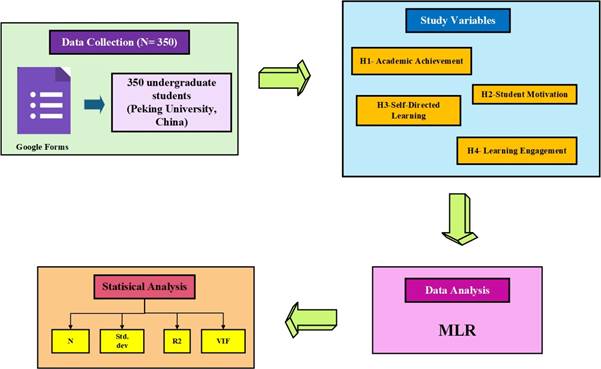
Figure 1: Proposed MLR Framework
3.1 Methods
Study Design
This study considers a quantitative, cross-sectional survey approach to building the relationship between SDL, academic achievement, and motivation among undergraduate students in a blended environment. Such design is fit to capture patterns, trends, and association among variables at a single point in time. Structured questions allow the extent of SDL, motivation, and academic performance to be measured quantitatively, thus allowing statistical analysis of the data and generalization of the results to the larger student populations within the university context.
Data Source
This study used structured self-report questionnaires that were disseminated among undergraduate students at Peking University in Beijing. The survey used Ford’s validated constructs from prior literature and administered through Google Forms, providing greater accessibility and faster distribution. The data collection was direct from the participants themselves, thereby eliminating any intermediary steps that could falsify the reporting accuracy.
Data Collection and Participant Selection
Data were collected from a sample of 350 undergraduate students from various academic courses at Peking University. Convenience sampling was utilized by selecting those students who were active in blended learning courses during the academic term. The survey link was dispersed among university communication platforms and emails. Participation was voluntary and anonymous, with the students giving informed consent before completing the questionnaire. By working this way, the collected sample size was adequate in number and relevance for statistical analysis.
Questionnaire Elements
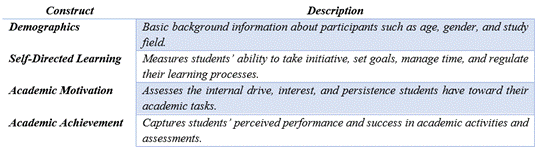
The constructs included in the questionnaire, each being intended to capture important facets of the study is given in Table 1. The demographic items provide background context, while the main constructs, that is, self-directed learning, academic motivation, and academic achievement, were purposely chosen to tie in with the objectives of the study. Hence, the study was interested in how students learn independently, what sorts of drives students possess in the academic settings, and how students rate themselves in terms of their academic accomplishment in blended learning setup.
Table 1: Questionnaire Elements
- Study Variables
Working around four main variables- self-directed learning, student motivation, academic achievement, and learning engagement-are considered. Self-directed learning is positioned as the independent variable, and academic achievement is considered a dependent variable. Student motivation and learning engagement stand as mediators to help explain the influences exerted by self-directed learning on academic achievement within a blended learning environment.
H1® Academic Achievement
Academic achievement denotes the level to which the student has reached his or her short- or long-term educational goals, generally shown in terms of grades, marks, and general performance in academic pursuits. Within the context of blended learning, therefore, academic achievement represents one critical way of gauging how students acquire and apply knowledge through both online and face-to-face instructions. Other factors that influence it are the teaching methods, the level of engagement of the learners, their motivation, and particularly the learner’s ability to self-direct their own learning. The measurement of academic achievement is, in turn, to enable the researchers to see how students perform under a blended learning setting and to weigh the influence of self-directed learning and motivation on their achievement.
H2® Student Motivation
Student motivation is the driving force, whether internal or external, that makes a student step into the learning process, attain goals on the road to academic success, or allow him or her to go through all the obstacles. In any blended learning context, motivation primarily determines to what extent and how effectively the students will be working on both online and face-to-face components. Considerations of motivation here will include both internal motivation initialization, such as curiosity or wanting to master something, and external motivation installation, such as getting grades or approval from somebody else. When motivation is high, engagement goes up, self-regulation goes up, and academic outcomes go up.
H3® SDL
SDL is a self-management approach to studying whereby the learner puts forth learning goals, collects resources, chooses methods, and assesses the results. It is employed to designate the autonomy, upright orientation, and activeness of a learner in situations especially in the blended format where the instructor is much relegated. Learners develop different heart approaches through SDL, accommodate computer discipline processes, and stay motivated with fewer instances of supervision. This research presupposes SDL as a strong determining factor of motivation and academic achievement because it equips learners with a set of skills for succeeding in a flexible system of technology-based education.
H4® Learning Engagement
Learning engagement is the interest, participation, and emotional involvement of learners in their learning process. It has three dimensions: behavioral (such as attending class or completing assignments), emotional (interest, enthusiasm), and cognitive. In blended learning contexts, since students learn online and offline content more independently, engagement indicates the level at which the learner actively interacts with learning materials, peers, and instructors. Usually, learning engagement means comprehension and retention of information and ultimately academic performances. Thus, it acts as a dynamic actor between self-directed long study efforts and purposeful outcomes of education.
3.3 MLR Data Analysis
This study employed MLR to interrogate the relationships that exist among the focal subjects. The MLR works to determine which individual elements, SDL, M, and LE, influence academic achievement significantly. The very first step of the analysis involved assumption checking of normality of residuals, linearity of fit, multicollinearity, and homoscedasticity, as it adds uniqueness to the proposed model. After performing the assumption check across all the variables, standardized regression coefficients (β), statistical significance, and coefficient of determination (R) were calculated to signify the strength and effect of the relationship within the variables.
The techniques of using MLR shed light on the direct effect of each predictor on academic performance of students in a blended-learning environment, especially regarding the variance explained by SDL, M and LE. Further, mediation and moderation testing were meltingly undertaken by bootstrapping from the hierarchical regression method or Sobel tests when it made sense. Again, this was hoped to be a simple, least statistically strongest, and direct method of checking the research hypotheses along with unveiling the involvement of cognitions or behavior interactions in shaping students’ academic outcomes.
4. Results and Discussion
The findings built from applying the MLR analysis, which tested all the four hypotheses of the study. The results show both the direct and indirect effects these variables have, indicating the degree to which each factor relates to students’ academic performance.
RH1: There is a positive relationship between SDL and academic achievement among university students in blended learning environments.
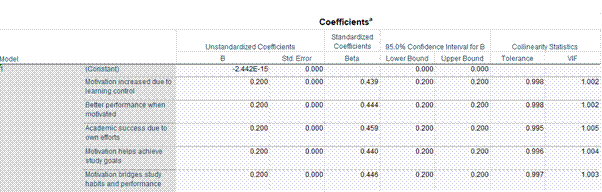
The tables give results of the regression analysis implemented for H1. From Table 2, the model attains perfect fit with an R-square value 1.000. The ANOVA in Table 3 indicates a statistically significant model (large sum of squares regression, 90.437; residual sum of squares, 0.000), supporting the validity of the model. Lastly, Table 4 outlines the regression coefficients where the independent variables. The model variables, such as motivation and academic achievement, are heavily correlated to performance, hence indicating how motivation affects a student’s academic performance. Additionally, the low variance inflation factor (VIF) values in the last column imply that there are no multicollinearity issues between the predictors, thus the robustness of the model.
Table 2: Model Summary of H1

Table 3: ANOVA Table of H1
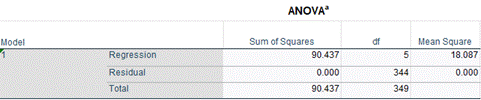
Table 4: Model Coefficients of H1
RH2: There is a positive relationship between SDL and student motivation in blended learning environments.
These tables provided represent the results for H2, investigating motivation and SDL Scores. Table 5 depicts the mean motivation score as 2.7777, with pretty much a small standard deviation (0.38847). In contradistinction from that, the SDL score has a mean of 2.8791 with a standard deviation of 0.29033. Table 6 reports a very weak negative correlation (-0.067) between motivation and SDL. The model summary in Table 7 indicates that the value of R-squared is 0.005, signifying that only a very small fraction on one thousand is explained by variance in motivation scores towards SDL scores. Table 8 validates the above statement further; it exhibits ANOVA with high residual sums of squares (52.429) and a p-value of 0.210. At last, Table 9 depicts the regression coefficient table, where the coefficient of SDL scores is -0.090 and statistically insignificant (p-value > 0.05) to support that motivation, in this case, is not a significant predictor of SDL scores.
Table 5: Descriptive Statistics of H2

Table 6: Correlation Analysis of H2
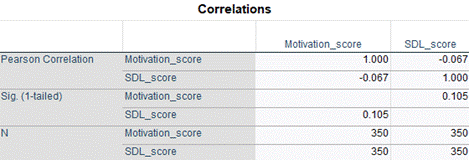
Table 7: Model Summary of H2

Table 8: ANOVA Table of H2

Table 9: Model Coefficients of H2

RH3: Students with high levels of self-directed learning will report higher academic achievement compared to students with low SDL levels.
The tables show an analysis of whether Achievement Score and High SDL (Self-Directed Learning) are associated. The descriptive statistics is given in Table 10 The correlation analysis (Table 11) indicates that these two variables are correlated to a slight extent (0.022), implying that there is are almost no correlation. The model summary (Table 12) further emphasizes this thesis with an R-square value of 0.0000, which means that the regression model failed to explain any variation in the achievement scores. The ANOVA (Table 13) further states the null hypothesis is valid with a significance level of 0.678. Finally, from the source of the variation (Table 14), the coefficient for the high SDL is extremely small (0.034), confirming that SDL affects achievement scores negligibly. Thus, from the set of analyses, it is argued there is no significant relationship between high SDL and achievement scores in this dataset.
Table 10: Descriptive Statistics of H3

Table 11: Correlation Analysis of H3
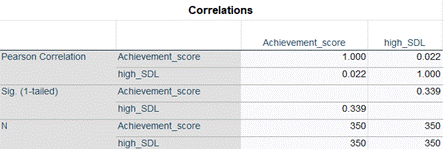
Table 12: Model Summary of H3

Table 13: ANOVA Table of H3

Table 14: Model Coefficients of H3

RH4: In blended learning environments, the link between SDL and academic accomplishment is mediated by student motivation.
The data represents the outcome of statistical analyses that were performed on three variables: mediator score, SDL score, and Achievement score. The descriptive statistics in Table 15 show mean values of all the variables with numbers relatively close to each other: mean SDL score having the maximum value of 2.8791, followed by Achievement score at 2.7023 and mediator score at 2.5229, respectively. The given standard deviations emphasize how the data varies; here again, mediator score exhibited the biggest variance among the data points (0.50905). Table 16 reveals the correlation analysis where the greatest correlation (0.483) among weak correlations observed is between SDL score and mediator score. In Table 17 (model summary), it is revealed that R² =0.022 and the ANOVA results in Table 18 suggest that p = 0.742, hence lending further support to the lack of strong predictive capableness.
Table 15: Descriptive Statistics of H4
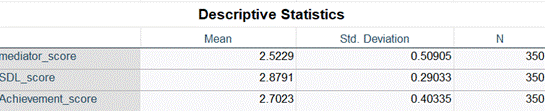
Table 16: Correlation Analysis of H4
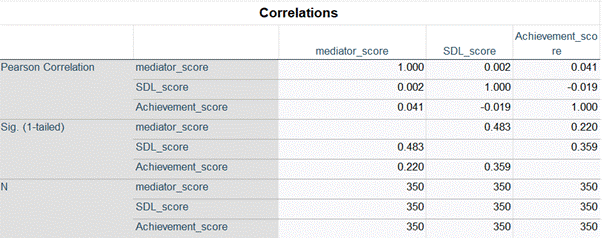
Table 17: Model Summary of H4

Table 18: ANOVA Table of H4

Table 19: Model Coefficients of H4

Discussion
The findings of the study provide new knowledge on blended environment and their interrelated dynamics with academic achievement. Regression analyses gave mixed results for the four hypotheses that some of the models showed statistically significant correlations, whereas others showed very weak or statistically insignificant correlations. As per analysis, SDL has had statistically important and a positive impact on academic achievement (H1) and has now become one of the major determinants for ensuring the student’s output. In contrast to this, however, the relationship between SDL and motivation was nonsignificant and below the expectations (H2), indicating that self-directed learning may not directly increase either intrinsic or extrinsic motivation. The comparison between students with high and low-self-directed learning levels, H3, confirmed that academic outcomes seem to be negligibly different; this supports the notion that SDL might not be the only contributor to academic success in the absence of some supporting structures or mediating factors.
In the case of the fourth hypothesis, the study attempted to characterize the mediational effect of motivation between SDL and academic achievement. Yet the results indicated an almost false mediation effect-the statistical outputs did not allow for significant predictability. The findings therefore highlight the labyrinthine nature of the interweaving motivational processes within blended contexts, where several internal and external mediators might come into play affecting the learning outcomes. Although the model in theory anticipated strong relations between SDP, motivation, and performance, data in practice showed a rather complicated picture. This, therefore, opens avenues for more holistic supportive measures toward strengthening SDL capacity and motivational drive, highlighting the need to combine behavioural, cognitive, and emotional engagement strategies suitable for integration into blended models of education. The study thus fits into the ongoing challenge of investigating how student-centred approaches to learning can be best harnessed to achieve optimal academic outcomes in digitally mediated educational settings.