DOI:https://doi-0004.org/6812/17916419873641
* Dr. Ait Ahmed Lamara Mohamed
* University of Tissemsilt
Submission date: 12.03.2026
Acceptance: 14.08.2026
Publication 13.10.2026
Abstract:
Illegal immigration is among the most important topics that have attracted and continue to attract the attention of researchers, activists and politicians.This study focuses on the reality of this threat between the African and European sides, namely migration from Southern Africa to Northern Europe. It examines irregular migration from Algeria to Europe from the perspective of the loss of the right to development as a primary motivator for migration and the search for a better life. In other words, the loss of this fundamental right justifies the right to seek a better life beyond national borders. The study also considers the African-European context through the various agreements, treaties, and meetings held over time, which have consistently addressed the phenomenon of irregular migration and its solutions. Algeria has utilized these international and regional agreements to confront this threat, which falls within its efforts to mitigate it. However, despite these efforts, the threat persists, creating numerous repercussions on the overall situation in Algeria.
introduction :
Illegal migration is closely linked to development, and from this perspective, we studied this topic because of its impact on weak development. The absence or deficiency of development has numerous dire political, social, and economic consequences, and among these consequences is the phenomenon of illegal migration. Young people find themselves, firstly, in a social environment that pushes them to seek a better life, and secondly, in surrounding economic conditions that do not provide them with the conditions for integration. Many ineffective policies are in place, restricting employment. These factors have accumulated to make illegal migration the best option to escape these surrounding circumstances because the lived reality has not provided the necessary development to address this need. Thus, the lack of development justifies and places migration in a position sought by various age groups. This study will examine this belief within the context of several Algerian policies implemented to address this situation and its negative repercussions. Accordingly, we pose the research problem.
Problem statement:
How does the weakness of economic and social development in Algeria affect the increase in illegal immigration?
Hypotheses:
- There is a correlation between development and illegal immigration; the weaker the development, the greater the desire for illegal immigration.
- There is a relationship between the awareness of the middle class and illegal immigration; the more aware they are, the less illegal immigration there will be.
- The desire of young people to emigrate abroad increases as they are marginalized and lose the conditions for a decent life.
- There is a correlation between the policies pursued and illegal immigration.
Keywords:
Algeria, illegal immigration, development.
To answer the problem, the study was divided into the following sections:
introduction
First point: The lack of development has allowed illegal immigration.
Second axis: The repercussions of illegal immigration in Algeria.
Third axis: Algerian efforts to confront it.
Conclusions
First axis: Weak development and its repercussions on the growth of illegal immigration.
Illegal migration is a relatively recent phenomenon dating back to the 1990s, when legal immigration channels were closed. Consequently, migration became a clandestine activity, conducted entirely in secret. Migrants travel across borders, avoiding checkpoints and security personnel, under the cover of night. Some define it as “that which crosses national borders and in which the migrant or refugee does not possess any official documents, meaning entry is unofficial or illegal.” Therefore, it was essential for the international community, represented by the United Nations, to take the necessary measures to curb this phenomenon, such as adopting the Convention against Transnational Organized Crime and its supplementary protocols, particularly the Protocol against the Smuggling of Migrants by Land, Sea and Air.[1]
There are several names for this phenomenon, including irregular migration, which is synonymous with illegal migration. Both terms refer to this phenomenon because it violates the laws established by countries regarding border crossings. Since it occurs clandestinely, evading border guards, it is also called clandestine migration. Migrants entering and living in this manner enter their destination country surreptitiously. However, despite the variety of these terms, international non-governmental organizations, such as the International Labour Organization, reject them all, as the descriptions “illegal” or “illegitimate” contradict the requirements of the relevant article.Article 13 of the Universal Declaration of Human Rights states that everyone has the right to freedom of movement and residence within the borders of each state. Everyone has the right to leave any country, including his own, and to return.[2]
Political, security and social problems are among the most important factors that have led to the acceleration of the pace of illegal immigration. Among the political reasons that drive immigration are the lack of democracy, civil wars and political instability, in addition to deteriorating security conditions. All of this contributes to the rush towards illegal immigration. However, economic reasons are a major factor for illegal immigration because of their ability to influence the decision to migrate. The windows of migrants for economic reasons are considered among the most important motives that specialists in immigration issues have focused on. This is evident through the position that the economic factor occupies in analyzing the reasons for migrants setting out towards other countries, especially with regard to high unemployment rates and the existence of a large percentage living below the poverty line.[3]
Algeria is among the countries that export migrants to various parts of the world, and is witnessing a growing trend among its highly educated and skilled youth to emigrate. The total number of Algerians abroad is estimated at:There were 1.764 million immigrants in 2013, and France is the first and preferred destination for Algerian immigrants, as Algerians in France represent more than 80% of the total number of Algerians abroad. Algeria hosts about 270,000 immigrants, most of them from Morocco, Palestine, Somalia and Iraq.[4]
Despite the numerous strategies and policies adopted to break free from this framework of weak development, Algeria faces many constraints that fail to meet essential social needs and guarantee a stable and decent standard of living. Among the most significant of these constraints hindering development in Algeria are…
The issue of economic development has been, and continues to be, a subject of debate as the primary option for overcoming the crisis of underdevelopment. From this perspective, development in general has been prioritized, leading to the formulation of numerous policies and plans, and the allocation of financial and human resources to achieve various aspirations. Algeria, in order to address the developmental lag inherited from various economic and security crises, focused on investment to revive growth. At the beginning of the third millennium, it strengthened public investment programs, starting with supporting economic recovery, then moving through the supplementary growth support program, and finally the economic growth consolidation program. However, despite these massive financial allocations, many questions remain regarding the extent to which the developmental goals for which they were earmarked have been achieved.[5]
In this area, Algeria faces many challenges in achieving comprehensive development that provides a decent social life for Algerian society, thus eliminating the need to think about migration and illegal immigration. Therefore, we mention all of these challenges:
- Unsustainable economic growth.
- High population growth rates that push huge numbers into the labor market every year.
- High unemployment and increasing poverty.
- A crippling economic system prevents it from moving, and there is a public sector within independent decision-making and a small, fragmented private sector that lacks the necessary dynamism.
- There is no system of high protection for the national industry.
- The absence of a developed banking sector.
- The absence of advanced industrial zones.
- Weak export capacity outside the oil sector, suggesting a lack of export industries.
- There are distortions in the price structure of goods, services, and factors of production.[6]
In addition to these restrictions, the continuous increase in demographic growth as a phenomenon in Algerian society, which has experienced a population explosion, made it necessary not to ignore this important factor when setting development policies and strategies. This was reflected in employment policies, resulting in a continuous increase in the unemployment rate, accompanied by increases in poverty rates. These two variables are among the most important social factors driving society and its inability to continue in the situation. The following table illustrates the phenomenon.
The table shows the evolution of the unemployment percentage by age group.
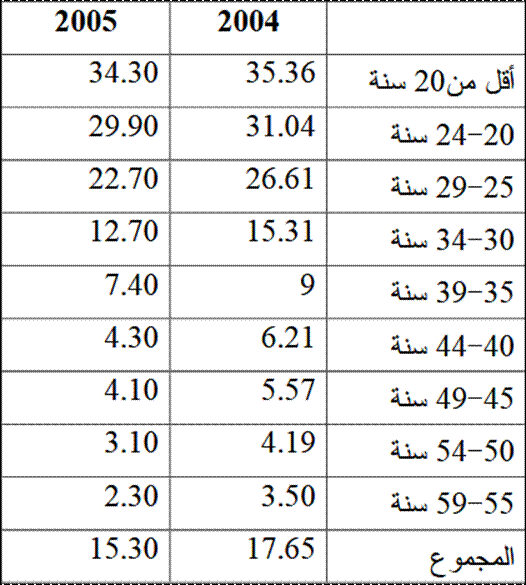
.CNES Rapport National on the Development Home. 2006. p57. Source:
The table shows that the unemployment rate varies from one group to another, and is showing a steady increase among young people..
From this we conclude that social and economic conditions play a fundamental role in the increase and development of illegal immigration outside national borders, and this is due to the weakness of the social and living conditions, especially for the youth group, which suffers from a prolonged unemployment crisis, and consequently the spread of poverty in the social environment. All these conditions are due to a severe weakness in achieving development and following development strategies that get society out of this situation. Therefore, this youth group is looking for a way out for itself and from its current position to a better situation outside its homeland, which has not responded to its aspirations. The weakness of the development strategies adopted and the spread of unemployment and poverty have enabled the youth to migrate and search for the best.
The second axis: The repercussions of illegal immigration in Algeria and its various consequences.
Illegal immigration has affected Algeria in many areas, including its security and economic aspects, and many other fields that have negatively impacted the situation in Algeria, including these aspects.
In the security field, illegal immigration creates[7]Cooperation between terrorist networks and smugglers, which affects security in the region to varying degrees, is a direct threat to Algeria’s security from all border directions. Algeria’s geopolitical position relative to its neighbors, as a gateway from Africa to Europe, facilitates the smuggling of drugs and weapons through its vast borders, creating a significant security burden for the country.[8]Algeria is now facing international drug and arms smuggling networks in this area. The vastness of Algeria’s borders provides an easy conduit for weapons to be smuggled to support terrorist groups. This has led to the spread of drug smuggling of all kinds. Here, a link emerges between illegal immigrants, smuggling, and organized crime. Numerous security investigations by Algerian security services have revealed the ease with which illegal immigrants can be recruited into organized crime, smuggling, and foreign intelligence. Thus, illegal immigrants are considered the most active in this area, which represents the greatest threat to the overall security situation in Algeria.[9]
From an economic standpoint, illegal immigration has impacted Algeria, as evidenced by the enormous budgets Algeria allocates to combat illegal immigration across its vast borders and coastlines due to the influx of waves of illegal African migrants residing in Algeria.[10]The increased unemployment rate, resulting from the availability of cheap labor seeking to secure daily sustenance, impacted the growing population and the social situation across various sectors, negatively affecting the national economy. This was evident in economic transactions, including the weakening of the national currency and the decline in citizens’ purchasing power.[11]
Socially, this economic recklessness led to the emergence of many social ills, the spread of social phenomena that have been continuously weakening the economy, such as the spread of drugs and the prevalence of bribery, and from this the citizen’s discontent and demand for change, the lack of internal stability, and the deterioration of the citizen’s situation in terms of poverty and unemployment, and consequently a direct reflection on the political situation, loss of stability, and increased migration, and these are among the most important characteristics that have been specific to the countries of the African continent.
Table showing the number of Algerians arrested in connection with illegal immigrationFrom 2000 to 2006.
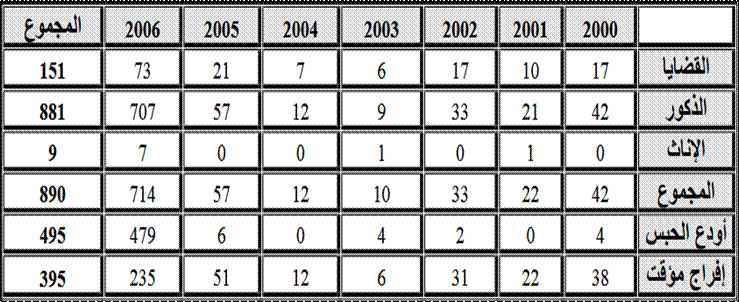
Source: Algerian National Gendarmerie Command
An illustrative graph showing the number of cases related to Algerians in the context of illegal immigration from the yearFrom 2000 to 2006.
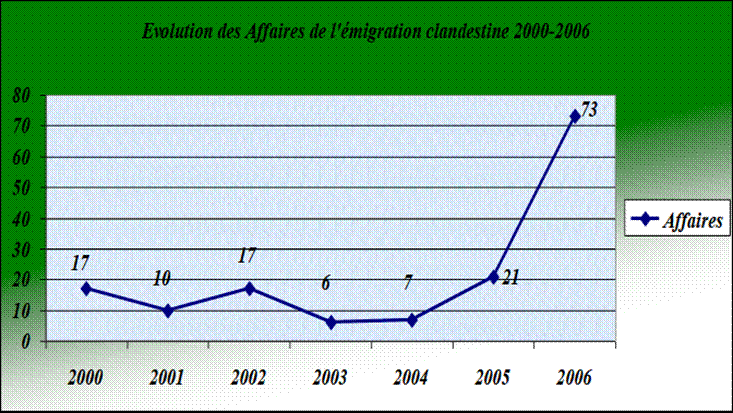
Source: Algerian National Gendarmerie Command
Third axis: Algerian strategies to combat illegal immigration.
Algeria has pursued many different policies to combat illegal immigration, including a range of security, legal, and economic policies. Through this section, we will try to summarize these Algerian efforts.[12]
Security strategy:
The vastness of Algeria has forced security policies to establish special border teams concerned with monitoring and ensuring border security in particular. These tasks are entrusted to them to prevent any illegal entry or illegal trade.[13]Among these units is the Border Guard, a branch of the People’s National Army operating along Algeria’s land borders. It ensures constant security thanks to its ground and mobile units, tasked with pursuing and thwarting all smuggling attempts, the infiltration of terrorists, and illegal immigrants. The Border Guard has apprehended hundreds of individuals of various nationalities on charges of illegal immigration. Another unit is the Coast Guard, a branch of the Ministry of National Defense, primarily responsible for guarding and protecting Algerian shores from all maritime smuggling attempts. It intervenes to foil all attempts to smuggle people and goods and provides security for foreign vessels. It has become increasingly difficult to penetrate Algerian coastlines and evade surveillance, as it has successfully intercepted numerous boats carrying illegal immigrants. The Coast Guard also conducts rescue operations, recovering bodies from the sea and rescuing individuals found aboard makeshift boats at sea.
There are also police units called the Border Police Group, which are entrusted with these specific tasks. They monitor the movement of people and goods across borders, check travel documents, identify wanted individuals, combat cells and networks supporting illegal migration, and work to combat illegal employment on the border. They also develop a deterrent strategy against illegal immigration. In addition, there is the Regional Unit for Investigating Illegal Immigration, which is tasked with investigating, identifying, and monitoring illegal immigration and migrant smuggling networks.
Despite these specialized security strategies in this field, illegal immigration in Algeria remains a source of security threat from all sides, due to the constant sighting of people stranded and dead at sea, as well as fugitives and those residing in Algeria illegally. Therefore, these security policies have not achieved their expected purpose in combating this phenomenon, despite the progress they have made in thwarting many illegal operations.
Legal strategy:
The Algerian legislature has adopted numerous laws and legal amendments aimed at curbing illegal immigration and establishing procedures for dealing with foreign nationals within a legal framework. This is evident in the ongoing fight against illegal immigration, a phenomenon that has never ceased to grow. This is being achieved through amendments to Algerian legislation under Law No.11/08 on the dateJuly 21, 2008, concerning the entry, residence, and movement of foreigners, with the aim of controlling immigration flows.[14]Contrary to the old legislation stipulated in Law No.212/66 dated July 21, 1966, which has been superseded,[15]The new law is a year2008 was more effective in dealing with migration flows because it controlled the conditions of entry, exit, residence and movement of people in Algeria in accordance with the international agreements to which Algeria is a party.
Algeria has also worked on adopting legislation and laws that criminalize illegal immigration, in accordance with Law No.09/01, which includes an amendment to the Penal Code dated February 25, 2009.[16]The article statesArticle 175 bis 01 stipulates a prison sentence of two to six months for any Algerian or resident foreigner who leaves the national territory illegally while crossing one of the land or air border crossings by using a false identity, forged document, or any other fraudulent means. The Algerian legislator also criminalized migrant smuggling in Articles 303 bis 30 to 303 bis 41, defining it as the crime of arranging the illegal departure from the national territory of a person or group of people for financial gain.[17]
These are some of the legal texts that the Algerian legislator has diligently worked to enact in order to curb illegal immigration. This demonstrates the adoption of all legal measures to address it. However, the phenomenon of illegal immigration in Algeria continues to rise, with many crossing national borders occurring despite all these efforts.
Economic strategy:
Algeria adopted an economic strategy to confront illegal immigration, because the economic factor represents the biggest motive for immigration in search of a better situation, especially the factor of unemployment. In this context, Algeria sought a strategy to combat and confront unemployment in order to reduce the desire to immigrate as much as possible.[18]
Among these economic strategies, we mention the National Employment Agency.ANEM, which operates within the framework of labor market knowledge, including supply and demand,[19]Another policy is to support the promotion of salaried employment through facilitating access to permanent job positions for young people, aiming to attract as many young people as possible. Additionally, there is another policy, the pre-employment contract program, which was adopted due to the increasing number of university graduates and the scarcity of job opportunities. This program includes categories of university degree holders. Furthermore, the National Unemployment Insurance Fund is directed towards unemployed individuals between [age range missing in original text].30 and 50 years old to support them and connect them with public employment agencies and integrate them.[20]
Therefore, it can be said and concluded that Algeria has used many economic policies, one of whose priorities was reducing unemployment, considering it one of the main reasons for illegal immigration. However, all these policies adopted to reduce unemployment and thus reduce immigration abroad are restrictive economic policies that have not had the desired results, except for an increase in spending without a positive outcome from what was planned. Unemployment is increasing, illegal immigration is increasing, and spending on these policies is increasing without positive results, which suggests that they are restrictive policies with no benefit.
Conclusions
From the above, we conclude that Algeria has adopted numerous security, legal, and economic policies, all of which seek to eliminate illegal immigration through various means. However, these policies are considered restrictive and have not yielded the desired results. What limits emigration abroad is successful development in all fields. The increase in unemployment, loss of hope, and weak investment in young human resources have driven young people to consider emigration by any means, whether legal or illegal, because the conditions for a decent life have weakened and diminished. Therefore, the most important means of preserving young talent and reducing emigration is effective and comprehensive development that provides the conditions for a decent life. Instead of focusing on punitive measures to reduce emigration, we should look for solutions to stay in the homeland out of conviction and not out of fear. Consequently, the absence of these conditions, the poor standard of living, and the increase in unemployment have instilled in the minds of young people that emigration has become a right under these circumstances.
Footnotes:
[1]Sara Hamood, African Transit Migration through Libya to Europe, the Human Cost, Forced Migration and Refugee Studies, The American University In Cairo, (2006).
[2] Abdul Malik Sayesh, “Combating Illegal Immigration – A Look at the Law”09 /Including the amendment to the Penal Code,” Academic Journal of Scientific Research, Faculty of Law and Political Science, Abdel Rahman Mira University of Bejaia, No. 1, (2011), p. 9.
[3] Ratiba Taybi, “Unemployment and its relationship to illegal immigration in Algeria,” Journal of Arts and Social Sciences, Saad Dahlab Publications, Blida, No.8 (2012), p. 103.
[4]Saleh Ziani, Towards an Algerian Policy for Integrating Migration into the Development Process, Notebooks of Politics and Law, No.13, (June 2015), pp. 311-330.
[5]Ali Talem, The Problem of Economic Development in Algeria, Economics and Development, M4, No. 2, pp. 94-113.
[6]Aïl Boukhaoua and Samra Doumi, Algerian Economic Institutions in the Market Economy Stage, Social and Human Sciences, University of Hadj Lakhdar Batna, p.6, (Juan 2002), pp. 84-100.
[7]Mustafa Abdel Aziz, The Impact of Illegal Immigration to Europe on the Image of the Arab Expatriate (Cairo: Egyptian Center for Migration Studies).2007) p. 10.
[8]Al-Akhdar Omar, Arab Experiences in Combating Illegal Immigration: A Case Study of Migration in Algeria (Naif Arab University for Security Studies)2010), p. 11.
[9]Khadija Elmadmad, Migrants who leave in Maroc, (Maroc: Hassan University 2 Ain Choc, 2004), p.20.
[10]Philip Farge, Mediterranean Migration Report Year2005 Algeria case(European University Institute)2007), p. 51.
[11]The same place.
[12]Saleh, previous reference, pp.311-330.
[13]Rachid Saïd, The Reality of Illegal Immigration in Algeria from a Human Security Perspective (Published Master’s Thesis, Mohamed Khider University of Biskra)2012), p. 14.
[14]Algeria, the law11/08 dated 21 July 2008 Official Gazette, No. 232 (22 July 2008).
[15]Algeria, Law No.212/66 (July 21, 1966).
[16]Abdelmalek Sayeg, Combating Illegal Immigration: A Look at the Law09/01, The Academy for Legal Researchers, No. 1 (2011), p. 14.
[17]The same place.
[18]Rashid, previous reference, p.22.
[19]Madani Ben Shahra, Economic Reform and Employment Policy, The Algerian Experience, (Amman: Dar Hamed for Publishing and Distribution, ed.1 (2008), p. 286.
[20]The previous reference, p.291.