DOI:https://doi-0004.org/6812/17917381175612
Dr-Alaeddine Bouzid
PhD in Management Sciences, Specialization in Business Administration, University of Jijel, Algeria, E-mail: alaeddine.bouzid@univ-jijel.dz
Received: 21/09/2026 ; Published: 10/10/2026
Abstract:
This study examines how artificial intelligence is reshaping the leadership function within organizations—not merely as a decision-support tool, but as an element that redistributes authority, responsibility, and coordination mechanisms between humans and algorithmic systems.
The study draws upon an integrative, analytical review of recent literature across the fields of management, organizational behavior, decision-making, algorithmic management, and governance. It aims to construct a framework explaining the transition from the traditional leader to the “intelligent coordinator”—a role that involves designing the hybrid decision environment rather than monopolizing the decision-making process itself.
Research indicates that the effectiveness of hybrid leadership depends on the precise distribution of decision rights, the retention of ultimate human authority for high-impact decisions, the provision of interpretable explanations, and the implementation of continuous oversight and challenge mechanisms. It also highlights the need to guard against bias, the diffusion of responsibility, and over-reliance on algorithmic recommendations. The study proposes a conceptual model for the intelligent coordinator based on five interconnected functions: system engineering, defining delegation boundaries, feedback management, facilitating adaptation, and ethical governance.
Keywords:
Hybrid leadership, human-algorithmic agency, algorithmic management, trust, interpretability, governance, accountability.
1. Introduction:
Artificial intelligence (AI) within organizations has evolved beyond a mere analytical tool; it now plays a role in forecasting, evaluation, and decision-making (Högberg, Larsson, & Lång, 2024; Rajagopal and al., 2026). This shifts the focus from the mere adoption of technology to the question of how authority and responsibility are redistributed when algorithms become integral to the organizational leadership structure.
In this context, viewing leadership simply as the concentration of power in a single individual is insufficient. Recent studies indicate that leadership emerges from the interaction between actors, contexts, and tools, and that algorithmic systems can influence initiative, review processes, and the distribution of responsibility through their interface design and usage structures.
The study addresses a gap in the literature, which remains divided between viewing AI as a decision-support tool and examining it as a mechanism for algorithmic control and management. There is a need for an integrative framework that explains how this interplay redefines the very function of leadership.
Research Problem:
This study is grounded in the central premise that integrating AI into leadership does not merely result in replacing humans with machines; rather, it leads to a restructuring of decision-making, oversight, and accountability dynamics between leaders and algorithmic systems. From this perspective, the contemporary leader is not merely a final decision-maker but an intelligent coordinator who defines the boundaries of delegation, designs pathways for intervention, and repositions human expertise within hybrid decision-making systems (Beckers & Teubner, 2023; Frimpong, 2025).
Based on the foregoing, the study’s problem can be articulated through the following question:
How does human-algorithmic agency reshape contemporary leadership models, and what impact does this have on leadership roles, decision rights, coordination mechanisms, and accountability within organizations?
Sub-questions:
The primary question gives rise to a set of sub-questions:
1. What is meant by human-algorithmic agency, and how does it differ from human-algorithmic collaboration and algorithmic management?
2. How do intelligent systems redistribute decision rights between humans and machines?
3. What distinguishes the traditional leader, the AI-supported decision-maker, and the intelligent coordinator?
Study Objectives:
The study aims to analyze the transformation in contemporary leadership models resulting from the interplay between human agency and algorithmic agency. It also seeks to propose a conceptual model for the role of the “intelligent coordinator”—an individual who manages the relationship between human judgment and algorithmic capabilities within a framework of efficiency, fairness, and accountability.
Significance of the Study:
The significance of this study can be outlined by distinguishing between its theoretical and practical importance:
– Theoretical Significance:
This study attempts to bridge the literature on distributed leadership with the concepts of hybrid intelligence, human-AI collaboration, and algorithmic management. Furthermore, it proposes the concept of the “intelligent coordinator” as a framework for understanding the shift from leadership focused on decision-making to leadership focused on designing the decision-making environment.
– Practical Significance:
The study’s findings can assist leaders and organizations in defining the boundaries for delegating decisions to intelligent systems, establishing mechanisms for review, objection, and auditing, and building workforce capabilities to utilize algorithmic systems in an informed and balanced manner.
Research Gap:
Despite the existence of numerous studies addressing human-AI collaboration, algorithmic management, and hybrid leadership, the researcher observes that these studies remain divided into two relatively distinct tracks: one focusing on AI as a tool for supporting executive decision-making, and another examining it as a means of control and work coordination. The researcher also identifies a pressing need for an integrative framework that elucidates how AI reshapes the leadership function itself, and how leaders transition from managing direct decisions to designing the coordination structure between human and algorithmic actors—while defining the conditions for effectiveness, legitimacy, and accountability.
Study Methodology:
– Type of Study:
The study employed an integrative, analytical literature review combined with an attempt to construct a conceptual model. The aim was to synthesize available theoretical and empirical findings regarding hybrid leadership, human-AI collaboration, algorithmic management, as well as governance and accountability.
It should be noted that this study does not aim to conduct a statistical analysis; rather, it seeks to build a conceptual framework that elucidates the relationships between concepts, mechanisms, and organizational outcomes.
– Scope of Studies:
The review primarily encompassed studies published between 2018 and 2026 across the fields of management, organizational behavior, leadership, decision systems, human resources, and healthcare. This was achieved by utilizing major global academic databases: Scopus, Web of Science, IEEE Xplore, ScienceDirect, and Google Scholar.
The selected studies were those that:
● Explicitly addressed the relationship between artificial intelligence and managerial or leadership work;
● Investigated human-AI collaboration or algorithmic management;
● Discussed the distribution of authority, decision rights, or responsibility;
● Addressed trust, explainability, fairness, or governance within intelligent systems;
● Were published in peer-reviewed scientific journals or reliable academic sources.
Studies were excluded if they:
● Addressed artificial intelligence from a purely technical perspective, unrelated to organization or leadership;
● Failed to provide a clear theoretical or empirical contribution;
● Were journalistic articles or non-peer-reviewed materials.
– Analysis Approach:
The studies were organized around four analytical themes:
– Distribution of authority and decision-making rights.
– Accountability, trust, and explainability.
– Performance, coordination, and organizational adaptability.
– Ethics, governance, and sectoral applications.
Based on a comparison of these themes, a conceptual model regarding the role of the “smart coordinator” was formulated.
– Study Limitations:
The study’s limitations stem from the nature of the available evidence; a significant portion of the research remains conceptual or relies on case studies and limited scenarios. Consequently, the study does not claim to establish a general causal impact of hybrid leadership; rather, it attempts to offer an explanatory framework that requires field-based and comparative testing.
2. Theoretical and Conceptual Framework:
a- From Individual Leadership to Distributed Leadership:
Literature on distributed leadership points to a significant shift: moving from viewing leadership as a trait tied to a central individual to conceptualizing it as a practice or process shaped by the interaction of multiple actors, diverse organizational roles, and interconnected contexts and tools (Bolden, 2011; Spillane, Halverson, & Diamond, 2001). This perspective does not negate formal leadership roles or equate all actors in terms of authority; rather, it emphasizes that leadership activity emerges from relationships of interaction and coordination among individuals, the organizational context, and various sources of influence.
Studies in the context of artificial intelligence demonstrate that algorithmic systems do not always function as neutral tools detached from the decision-making process; instead, they can influence the extent of human involvement in decisions and affect the distribution of roles regarding initiative, review, and accountability—particularly through the user-system interface (Bader & Kaiser, 2019). Furthermore, Shrestha, Ben-Menahem, and von Krogh (2019) highlight the potential to integrate human and algorithmic decisions through various organizational arrangements, ranging from full delegation to the machine and sequential hybrid decision-making to the combination of human and algorithmic judgment within a shared decision structure. Consequently, algorithms can be understood as influential elements within the structure of organizational decision-making and action, without implying equivalence to human actors or the attribution of moral responsibility to them.
b- Hybrid Intelligence, Not Alternative Intelligence:
Research on hybrid intelligence indicates that perceived value arises not necessarily from replacing humans, but from the integration of human and machine capabilities. Algorithms expand human capacity for data processing, pattern discovery, and predictive support, while humans contribute contextual, intuitive, and ethical judgment—particularly in strategic decisions and situations characterized by ambiguity and uncertainty (Jarrahi, 2018; Raisch & Krakowski, 2021; Wei et al., 2025). Wei et al. (2025) note that artificial intelligence augments human capabilities, yet human oversight and judgment remain essential for addressing complexities and ethical considerations. Furthermore, Sposato (2026) proposes a leadership framework for hybrid intelligence systems, wherein leadership is grounded in hybrid collaboration between human and artificial agents.
C- The distinction between the leader, the augmented decision-maker, and the intelligent coordinator:
Studies reveal an analytical progression in leadership and decision-making patterns within the era of artificial intelligence. The first pattern is traditional leadership, where decision-making authority and responsibility rest primarily with the human leader. The second pattern is algorithm-augmented decision-making, which utilizes intelligent systems to enhance judgment and analysis while maintaining human responsibility and the underlying organizational structure. The third pattern is hybrid coordinative leadership, involving a reorganization of the relationship between humans and intelligent systems through the distribution of decision-making roles, the definition of delegation boundaries, and the establishment of oversight and feedback mechanisms (Bader & Kaiser, 2019; Shrestha, Ben-Menahem, & von Krogh, 2019; Sposato, 2026; Zárate-Torres, and al., 2025).
The work of Hillebrand et al. (2025) provides a suitable integrative framework for analyzing these shifts by linking human-AI collaboration with algorithmic management.
d. The Conceptual Basis of Human-Algorithmic Agency:
Despite the prevalence of concepts such as human-AI collaboration, algorithmic management, and hybrid leadership in academic literature, the term “human-algorithmic agency” does not appear as a settled, foundational concept in any single source; rather, it is understood through a synthesis of various theoretical contributions (e.g., Beckers & Teubner, 2023; Hillebrand, Raisch, & Schad, 2025; Kellogg, Valentine, & Christin, 2020).
For the purposes of this study, human-algorithmic agency is defined as: “The shared capacity of an algorithmic system and a human actor to generate impactful organizational outcomes through the distribution of roles regarding initiative, processing, and decision influence, while ultimate ethical and legal responsibility remains vested in the human element.”
This concept is distinguished from related concepts as follows:
– Compared to human-machine collaboration: Human-algorithmic collaboration often focuses on supporting executive decision-making and enhancing performance, whereas human-algorithmic agency focuses on the redistribution of authority, responsibility, and the boundaries of delegation within the organizational leadership structure.
– Compared to algorithmic management: While algorithmic management entails the use of algorithms to regulate, coordinate, and evaluate human work, human-algorithmic agency also encompasses scenarios where humans exercise active oversight of algorithms, define the limits of their intervention, and retain the authority to veto or override them.
– In comparison to hybrid leadership: Hybrid leadership refers to a leadership style combining human and technical elements, whereas “human-algorithmic agency” represents the finer-grained analytical level explaining how roles regarding initiative and decision influence are distributed between human and algorithmic actors within this leadership style.
Accordingly, the concept of human-algorithmic agency employed in this study is a conceptual framework proposed by the researcher based on a synthesis of the literature, rather than an established term adopted verbatim from a single source.
In light of this definition—and based on a synthesis of existing studies—this study proposes viewing human-algorithmic collaboration and algorithmic management as two facets of the same phenomenon, collectively termed “human-algorithmic agency” for analytical purposes. Hillebrand et al. (2025) propose an integrative framework linking the literature on human-AI collaboration with that of algorithmic management, while Beckers and Teubner (2023) focus on the accountability of hybrid actors as digital quasi-organizers.
In this context, artificial intelligence is understood as an element that reorganizes information, proposes alternatives, and influences users’ choice-related behavior. Drawing on a synthesis of existing research—and inspired by the work of Sposato (2026) and other relevant studies—this study proposes a leadership framework for the “intelligent coordinator” comprising five functions: system architecture, boundary setting, feedback management, adaptation facilitation, and ethical governance.
This approach is significant because it shifts the focus from the question of *who* makes the decision to *how* the decision-making environment is designed.
Relevant literature suggests that the leader’s role in algorithmically augmented environments expands to encompass the design of decision architecture and the calibration of delegation boundaries, moving beyond the mere issuance of unilateral decisions (Sposato, 2026; Wang, 2026). Simultaneously, other studies emphasize that this distribution of roles does not negate the centrality of the human element in ethical judgment, fairness, and empathy—factors that serve as essential counterweights to the risks of bias, depersonalization, and abstraction (Decety, 2023; Hondrich & Ruschemeier, 2023; Kertechian, Elidrissi, & el-Farr, 2026; Kierner, Kucharski, & Kierner, 2023). Consequently, hybrid leadership represents not merely a technological adoption but a normative redefinition of the leadership function itself (Beckers & Teubner, 2023).
3. Analytical Dimensions:
A – Redistribution of Authority and Decision Rights:
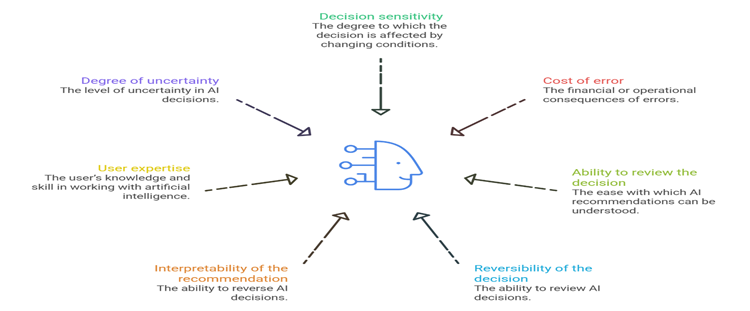
A body of research indicates that the effective integration of artificial intelligence does not rely on granting algorithms absolute autonomy; rather, it depends on a precise distribution of decision rights based on task sensitivity, interpretability, the cost of error, and the feasibility of human oversight (Bader & Kaiser, 2019; Shrestha, Ben-Menahem, & von Krogh, 2019; Wei and al., 2025). Several organizational models emerge here: extensive delegation to the machine, human-machine or machine-human sequences, or the combination of human and algorithmic decisions within a shared structure (Bader & Kaiser, 2019; Shrestha, Ben-Menahem, & von Krogh, 2019). However, (Frimpong (2025) notes that comparative studies on high-stakes applications highlight principles such as intentionality, interpretability, moral authorship, and fairness as foundations for delegating decisions while retaining the human as the ultimate responsible actor. Consequently, this implies that hybrid leadership is not merely a technical neutrality but a political and ethical arrangement of authority within the organization (Beckers & Teubner, 2023).
This conclusion is further reinforced by literature on general artificial intelligence and algorithmic governance; Studies across various contexts—such as speculative public design, public interest governance, migration, and concepts of contestability—highlight the importance of ensuring that intelligent systems allow for their outputs to be contested throughout their lifecycle. They emphasize that these systems should be built upon a dialogic relationship between those affected by them and their operators, rather than relying on closed, automated determinations (Alfrink, Keller, Doorn, & Kortuem, 2023; Alfrink, and al., 2024; Cohen & Suzor, 2024; Eneva & Mora-Gámez, 2025; Lyons, Velloso, & Miller, 2021; Yurrita, and al., 2025).
Furthermore, the legitimacy of intelligent systems is undermined when they are opaque or when genuine human oversight is replaced by merely superficial transparency (Flórez Rojas, 2025; Waldman & Martin, 2022).
In the realm of healthcare, reviews by Kierner et al. (2023) indicate that the final decision must remain with the human actor—even when advanced support systems are employed—because professional responsibility cannot simply be transferred to an intelligent system.
Effective integration of artificial intelligence does not entail granting the system absolute autonomy; rather, it relies on distributing decision-making rights based on the specific characteristics of the task, the system, and the context. The following table outlines these characteristics:
Figure 1: Factors for effective integration of artificial intelligence.
Source: Author’s elaboration based on the literature on AI governance, human oversight, explainability, and decision reversibility.
Certain frameworks have identified a set of factors that help determine the appropriate structure for human-AI collaboration, such as decision speed, result repeatability, and the interpretability of the process and outputs (Shrestha and al., 2019).
B- Accountability and Preventing the Diffusion of Responsibility:
The nature and ambiguity of responsibility constitute one of the key challenges of algorithm-driven leadership. This is best encapsulated by a critical question: Who bears responsibility for an error—the designer, the supplier, the leader, or the end-user? (Cobbe, Veale, & Singh, 2023; Di Mauro, and al., 2025). Studies indicate that the risk of responsibility diffusion increases as the gap widens between those who design the system, those who implement it, and those affected by its outcomes. In a general context, research suggests that the use of algorithms does not automatically absolve decision-makers or public institutions of accountability in the eyes of citizens (Alon-Barkat, Busuioc, Schwoerer, & Weißmüller, 2025; Ozer, Waggoner, & Kennedy, 2024).
In the medical context, there remains a need to clearly define professional and institutional accountability when utilizing artificial intelligence in healthcare; responsibility should not be assumed to automatically shift to the system itself. This necessitates robust prior documentation regarding the data, limitations, and permitted uses of such systems (Angu Bala Ganesh, Mishra, Jayanthiladevi, & Verma, 2025; Longo, and al., 2024). Consequently, the role of the modern leader expands to encompass “accountability engineering”—that is, defining who makes decisions, who conducts reviews, who provides justifications, and who holds the authority to override or object to system outputs (Al Fraidan, 2025; Ferjani, Alzahrani, & Bouzir, 2025; Sposato, 2026).
C- Trust, Transparency, and Explainability:
Numerous studies indicate that trust in intelligent leadership systems is linked to concepts such as perceived accuracy, integrity, fairness, and explainability—connections that go beyond the mere disclosure of general information about the system (Atf & Lewis, 2026; Hoeddinghaus, Sondern, & Hertel, 2021; Martens, De Wolf, & De Marez, 2024). Regarding studies addressing trust within an organizational context, Hoeddinghaus et al. (2021) found that factors influencing trust in an automated leadership agent are associated with positive organizational outcomes, such as perceived fairness and organizational support.
Research clearly distinguishes between transparency and explainability: the former may simply entail making information available regarding the system’s existence or general logic, whereas the latter refers to the user’s ability to understand the decision-making mechanism sufficiently to allow for critical evaluation (Grimmelikhuijsen, 2022). Consequently, Chaudhary (2024) notes that transparency alone is insufficient unless supported by auditability and human oversight.
Evidence concerning human resource management in organizations indicates that the quality of communication regarding an intelligent system enhances perceptions of procedural and interactional fairness—thereby boosting trust and strengthening the employee-organization relationship—yet it cannot compensate for inherent bias within the system itself (Nagtegaal, 2020; Zervas & Anagnostou, 2026). In the healthcare sector, trust is fundamentally linked to accuracy and reliability; however, partial explanations are not always sufficient to prevent erroneous compliance with an intelligent system’s recommendations (Martens, De Wolf, & De Marez, 2024). It is worth noting in this context that mere formal transparency is inadequate; a useful explanation must be:
● User-appropriate;
● Linked to the specific decision;
● Understandable;
● Reviewable;
● Available in a timely manner;
● Accompanied by the possibility of challenging it.
D- Organizational impacts on performance, coordination, and human resources:
Studies indicate that artificial intelligence can enhance forecasting, automation, innovation, and operational efficiency; it may also structure decision-making in a way that increases consistency and speed in certain contexts (Rojas Guillen & Quispe Bautista, 2025; Sposato, 2026). Some empirical studies suggest that users may place greater trust in AI recommendations than in human ones in certain contexts—results attributed to a better perception of the overall process structure. Nevertheless, available evidence does not provide sufficient, direct empirical support for a general claim that algorithmic support consistently improves the speed of command coordination or a leader’s ability to override system recommendations compared to traditional leadership (Adensamer, Gsenger, & Klausner, 2021; Jarrahi and al., 2021). Conversely, studies in the healthcare sector reveal a significant paradox: while collaboration between a physician and artificial intelligence can outperform a physician working alone, accuracy may decline if a physician discards a correct diagnosis in favor of an incorrect system recommendation—a result of low self-confidence or excessive compliance (Cabitza & Papale, 2026; Dratsch et al., 2023; Nagendran and al., 2023). High performance levels are linked to the quality of cognitive calibration rather than merely the introduction of technology into human resources; applications in this field focus on recruitment, screening, performance evaluation, talent retention, and monitoring (Bouzerda et al., 2025; Căvescu & Popescu, 2025; Murale and al., 2024). Research establishes a link between transparency and ethical governance on the one hand, and acceptance, trust, and perceived fairness on the other (Bouzerda et al., 2025; Oralbayev et al., 2025; Úbeda-García and al., 2025). Furthermore, Prasad and De (2024) indicate that trust acts as a partial mediator between user perception and organizational commitment, thereby influencing employee engagement and performance.
e- Ethical, Legal, and Governance Dimensions:
Reviews in the mental health field identify four recurring types of risks: privacy, bias, surveillance, and discrimination (Gooding & Kariotis, 2021). These risks are particularly associated with sensitive data, digital identity, and the use of models with poor interpretability in decisions affecting employment opportunities, care, or civil rights, as well as in virtual environments such as the metaverse and AI-powered avatars (Almomani and al., 2025; Boccuzzi, Manganello, & Nico, 2025; Gooding & Kariotis, 2021).
Studies also indicate that algorithmic systems can exacerbate existing inequalities or produce discriminatory effects against marginalized groups, particularly regarding “black-box” models and issues of poor interpretability (Lendvai & Gosztonyi, 2025). Consequently, the field has shifted from general ethical discourse to a multi-instrument operational governance framework encompassing “ethics-by-design,” fairness-aware algorithms, mandatory transparency, continuous auditing, stakeholder engagement, and multi-stakeholder governance (Ferjani, Alzahrani, & Bouzir, 2025; Ricciardi Celsi & Zomaya, 2025). Furthermore, some studies have proposed additional operational tools—such as model cards, data sheets, and regulatory sandboxes—to enhance documentation and continuous review (Ferjani, Alzahrani, & Bouzir, 2025). Beckers and Teubner (2023) argue that responsible hybrid leadership is measured not merely by model accuracy, but by the maturity of the governance structure framing its use.
4. Sectoral Applications:
a. In Business:
According to some studies, artificial intelligence in business environments is linked to improved efficiency, candidate screening, interview analysis, performance evaluation, the prediction of employee turnover, and the automation of administrative tasks (Căvescu & Popescu, 2025; Murale and al., 2024; Oralbayev and al., 2025). However, the success of these applications depends on trust, transparency, and the perception of fairness; otherwise, they may become a source of resistance or foster feelings of surveillance and depersonalization (Úbeda-García, Marco-Lajara, Zaragoza-Saez, & Poveda-Pareja, 2025; Zervas & Anagnostou, 2026).
b. In the Public Sector:
In the public sector, algorithmic leadership becomes a matter of institutional legitimacy rather than merely efficiency. Literature suggests that mechanisms such as human oversight and review, impact assessments, and understandable explanations can enhance trust and procedural accountability within the public sector (Al Fraidan, 2025; Alfrink, Keller, Doorn, & Kortuem, 2023; Alon-Barkat, Busuioc, Schwoerer, & Weißmüller, 2025).
c. In Healthcare:
The potential benefit in the healthcare sector is evident in the support or enhancement of specific diagnostic decisions. Conversely, however, there is a risk of eroding physicians’ professional judgment and fostering over-reliance on intelligent systems. There is a clear need to define professional and institutional accountability when utilizing artificial intelligence in healthcare, and… …assuming the automatic transfer of responsibility to the system (Kierner and al., 2023). Consequently, this sector strongly exemplifies the “human-in-the-loop” principle, as human oversight remains essential even when utilizing advanced support systems (Angu Bala Ganesh and al., 2025).
5.The Intelligent Coordinator Model:
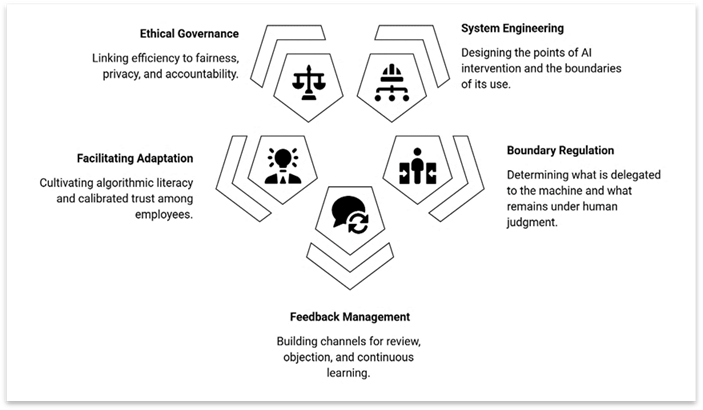
Based on prior studies and available evidence, this study proposes an explanatory model positing that successful hybrid leadership rests on five interconnected functions, drawing upon the work of Sposato (2026) and relevant literature on hybrid leadership and algorithmic governance:
O System Architecture: Designing points of AI intervention and the boundaries of its use (Sposato, 2026)
O Boundary Regulation: Defining what is delegated to the machine versus what remains exclusively within the realm of human judgment (Frimpong, 2025; Wei and al., 2025)
O Feedback Management: Establishing channels for review, objection, and continuous learning (Al Fraidan, 2025; Alfrink, Keller, Doorn, & Kortuem, 2023)
O Facilitating Adaptation: Cultivating algorithmic literacy and calibrated trust among the workforce (Diaz and al., 2025)
O Ethics Governance: Linking efficiency with fairness, privacy, and accountability (Beckers & Teubner, 2023)
This model asserts that the contemporary leader does not disappear entirely; rather, they transition from a singular locus of authority into an “intelligent coordinator” managing a network of human and algorithmic agents (Hillebrand, Raisch, & Schad, 2025; Kellogg, Valentine, & Christin, 2020). However, this transformation does not occur automatically upon the introduction of an intelligent system into the organization; it requires a redesign of processes, authority structures, responsibilities, and evaluation mechanisms. The following figure presents a visual representation of the various functions of the smart coordinator model.
Figure 2: Hybrid Leadership Model
Source: Elaborated by the author based on the reviewed hybrid leadership literature (Sposato, 2026; Hillebrand et al., 2025; Beckers & Teubner, 2023)
Table 2 outlines the executive and structural functions of the “Intelligent Orchestrator” model, linking each function to a critical guiding question while specifying the organizational mechanism for its implementation and the expected institutional output.
Table 2: Functions of the Intelligent Orchestrator
| Expected Outcome | Organizational Mechanism | Leadership Question | Function |
| Usage scope clarity | Designing points of automation and augmentation | Where does AI intervene? | System Engineering |
| Minimizing authority conflicts | Distribution of decision rights | What does the machine do and what does the human do? | Boundary Regulation |
| Correctability | Review, contestability, and learning | How is the decision corrected? | Feedback Management |
| Calibrated trust | Training and algorithmic literacy | How do employees use the system? | Facilitating Adaptation |
| Accountability and risk reduction | Auditing, documentation, and fairness testing | How do we ensure legitimacy? | Ethics Governance |
Source: Compiled by the author based on the reviewed literature.
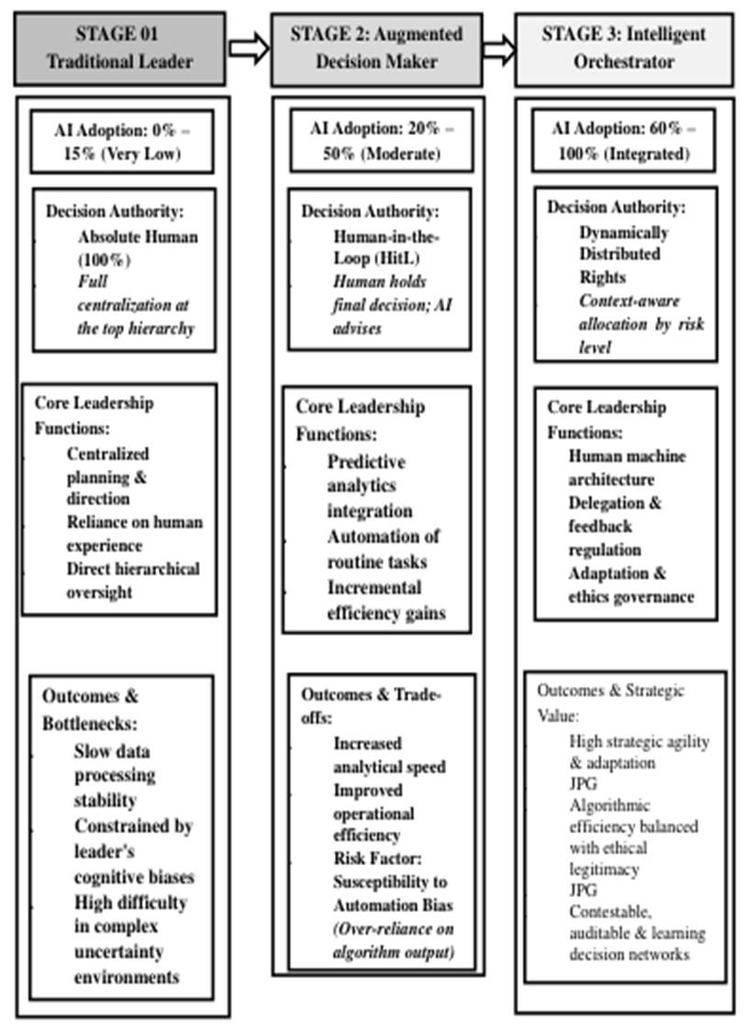
*The following table presents a comparative analytical framework for the evolution of organizational leadership models across three successive stages: the “Traditional Leader,” the “Algorithm-Augmented Decision Maker,” and the “Intelligent Orchestrator.” This comparison is grounded in four key dimensions: core leadership functions, the nature of decision-making authority distribution, the level of AI technology adoption, and the organizational outcomes and implications associated with each stage. This analysis illustrates how organizations transition from centralized hierarchical models—relying entirely on human judgment—to hybrid work environments where authority is dynamically distributed to balance algorithmic efficiency with ethical legitimacy.
Table 3: Evolution of Leadership Models Across the Three Stages
| Comparison Dimension | Stage 1: Traditional Leader | Stage 2: Algorithm-Augmented Decision Maker | Stage 3: Intelligent Orchestrator |
| Core Leadership Functions | • Centralized planning and direction. • Traditional analysis relying on human experience. • Direct and hierarchical oversight. | • Utilizing predictive analytics to enhance estimation accuracy. • Automating routine tasks. • Improving decision efficiency without structural redesign. | • Engineering human-machine interaction architecture. • Regulating delegation boundaries and feedback channels. • Facilitating adaptation, ethics governance, and accountability. |
| Decision Authority | Absolute Human (100%) Full concentration of authority at the top hierarchy without technical intervention in judgment. | Human-in-the-Loop (HitL) Human holds final decision authority but is influenced by algorithmic recommendations. | Dynamically Distributed Rights Decision rights and boundaries are distributed between humans and AI based on risk levels. |
| AI Adoption Level | Very Low to None (0% – 15%) Almost complete reliance on traditional records and manual tools. | Moderate & Incremental (20% – 50%) AI tools are used as analytical assistants and predictive support. | High & Fully Integrated (60% – 100%) Hybrid infrastructure where technology acts as an intertwined organizational actor. |
| Leadership Outcomes & Impacts | • Slow stability in processing large volumes of data. • Limitations tied to the leader’s cognitive biases. • Difficulty handling complex uncertainty. | • Increased analysis speed and predictive accuracy. • Improved operational efficiency. • Risk of over-reliance on machine output (Automation Bias). | • Strategic agility and continuous organizational adaptation. • Balancing algorithmic efficiency with ethical legitimacy. • Decision network open to contestation, auditing, and learning. |
Source: Compiled by the author based on the reviewed literature (Bader & Kaiser, 2019; Hillebrand et al., 2025; Shrestha et al., 2019; Sposato, 2026; Zárate-Torres et al., 2025).
Note: The percentages presented in the table represent a proposed, illustrative classification by the researcher, rather than the results of empirical measurement.
Figure 3 illustrates the evolutionary spectrum of leadership models in the age of artificial intelligence, tracing the shifts in decision-making authority, core functions, adoption levels, and organizational outcomes across three key stages:
Figure 3: Evolution of Leadership Models Across the Three Stages
Source: Elaborated by the author based on Bader & Kaiser (2019), Hillebrand et al. (2025), Shrestha et al. (2019), and Sposato (2026)”)
5. Conclusion:
Studies reveal that artificial intelligence does not merely add a new tool to the leadership toolkit but fundamentally alters the architecture of leadership itself (Hillebrand, Raisch, & Schad, 2025; Sposato, 2026). The core transformation lies in shifting from a leader who monopolizes decision-making to an intelligent coordinator who designs the interaction between human judgment and algorithmic logic (Shrestha, Ben-Menahem, & von Krogh, 2019; Zárate-Torres, and al., 2025).
Furthermore, research indicates that legitimacy and effectiveness hinge on three conditions: retaining the ultimate human point of reference; moving beyond superficial transparency toward intelligible explainability; and establishing operational governance that encompasses documentation, auditing, mechanisms for objection, and continuous review (Ferjani, Alzahrani, & Bouzir, 2025; Grimmelikhuijsen, 2022; Zárate-Torres, and al., 2025).
Consequently, the critical scholarly question is no longer whether algorithms will lead in the future, but rather how humans will lead by designing environments where algorithms drive action without escaping accountability (Beckers & Teubner, 2023; Wang, 2026).
Practical and Research Recommendations:
Practical Recommendations:
– Retain final human oversight for high-impact decisions, including clear override authority—particularly in high-risk areas such as recruitment, credit, and financial compliance. This aligns with principles of human oversight found in AI governance literature (Grimmelikhuijsen, 2022; Ferjani, Alzahrani, & Bouzir, 2025).
– Shift from superficial transparency to explanations that are both understandable and auditable. Interpretability has a greater impact on trust and legitimacy than merely making technical information available—a finding supported by Gremmelikhuijsen’s (2022) study on automated decision-making in public administration.
– Establish continuous objection, auditing, and documentation pathways (audit trails) that record who reviewed a decision, when the review occurred, and the rationale for acceptance or rejection. This aligns with literature on co-governance and legal accountability in AI systems (Ferjani, Alzahrani, & Bouzir, 2025), particularly within the context of AI-supported assessment, as demonstrated in Al Fraidan’s (2025) study on language assessment in Saudi universities. – Training leaders and analysts in high-stakes contexts to understand the dynamics of trust in algorithmic recommendations, utilize explainability mechanisms (XAI) to reduce decision fatigue, and exercise meaningful human oversight, in alignment with the conceptual framework of Dynamic Trust Modulation (Diaz and al., 2025).
Research Recommendations:
– Expand conceptual and empirical studies on the impact of algorithmic systems on the distribution of responsibility and on leadership and organizational coordination. The researcher identifies a need for further research linking the design of algorithmic decision-support systems (ADS) to patterns of responsibility and coordination within organizations, particularly in high-stakes contexts (such as policing, justice, and financial compliance). Studies on organizational accountability in the context of “Computer Says No” scenarios reveal clear research gaps in this area, while literature on algorithmic management highlights shifts in leadership and coordination roles driven by these systems (Adensamer, Gsenger, & Klausner, 2021; Jarrahi and al., 2021).
– Examine the conditions under which explanations improve actual judgment rather than merely increasing perfunctory compliance.
Despite significant effort in developing Explainable AI (XAI) techniques, evidence remains conflicting regarding when explanations improve system understanding and judgment quality, versus when they merely increase acceptance of or compliance with algorithmic recommendations. Studies on human-AI collaboration indicate that the type of explanation, the decision context, and user characteristics are critical factors in this outcome; this underscores the urgent need for systematic empirical research to define the conditions for effective explanation (Grimmelikhuijsen, 2022; Longo and al., 2024; Nagendran, Festor, Komorowski, Gordon, & Faisal, 2023). Developing a comparative theory of hybrid leadership across high- and low-risk sectors:
With the increasing emergence of AI systems that perform leadership functions—such as motivating, supporting, and guiding—there is a pressing need for theoretical frameworks that compare hybrid leadership across diverse sectors (e.g., healthcare, finance, education, and algorithmically organized work) and varying risk levels (ranging from critical, high-stakes decisions to routine ones). This research gap represents a logical extension of the literature on algorithmic management and leadership within hybrid intelligence systems, which emphasizes the need for a deeper understanding of the dynamics of authority, accountability, and performance (Jarrahi and al., 2021; Sposato, 2026).
References:
Adensamer, A., Gsenger, R., & Klausner , L. (2021). “Computer says no”: Algorithmic decision support and organisational responsibility. Journal of Responsible Technology, 7-8, 1-10. doi:10.1016/j.jrt.2021.100014
Al Fraidan, A. (2025). Procedural Transparency and Legal Accountability to Sustain AI-Mediated Language Assessment in Saudi Arabia. SAGE, 01-13. doi:10.1177/21582440251396113
Alfrink, K., Keller, I., Doorn, N., & Kortuem, G. (2023). Contestable Camera Cars: A Speculative Design Exploration of Public AI That Is Open and Responsive to Dispute. https://doi.org/10.1145/3544548.3580984(8), 1-16. doi:https://doi.org/10.1145/3544548.3580984
Alfrink, K., Keller, I., Semperena, M., Bulygin, D., Kortuem, G., & Doorn, N. (2024). Envisioning Contestability Loops: Evaluating the Agonistic Arena as a Generative Metaphor for Public AI. She Ji: The Journal of Design, Economics, and Innovation, 10(1), 53-93. doi:https://doi.org/10.1016/j.sheji.2024.03.003
Almomani, A., Al-Qerem, A., Alauthman, M., Aldweesh, A., Aoudi, S., & Salloum, S. (2025). Ethical Foundations of AI-Driven Avatars in the Metaverse for Innovation and User Privacy. IEEE Access, 13, 130610-130628. doi:10.1109/ACCESS.2025.3589714
Alon-Barkat, S., Busuioc, M., Schwoerer, K., & Weißmüller, K. (2025). Algorithmic discrimination in public service provision: Understanding citizens’ attribution of responsibility for human versus algorithmic discriminatory outcomes. Journal of Public Administration Research and Theory, 35(4), 469–488. doi:https://doi.org/10.1093/jopart/muaf024
Angu Bala Ganesh, K., Mishra, V., Jayanthiladevi, A., & Verma, A. (2025). Building clinician trust in AI-assisted neurodiagnostics: A case-based evaluation. Interdisciplinary Neurosurgery: Advanced Techniques and Case Management, 42, 1-10. doi:10.1016/j.inat.2025.102144
Atf, Z., & Lewis, P. (2026). Is Trust Correlated With Explainability in AI? A Meta-Analysis. IEEE Transactions on Technology and Society, 7(1), 1-9. doi:10.48550/arXiv.2504.12529
Aziz, M., Rajesh, J., Jahan, F., McMurrray, A., Ahmed, N., Narendran, R., & Harrison, C. (2024). AI-powered leadership: a systematic literature review. Journal of Managerial Psychology, 40(5), 604-630. doi:10.1108/JMP-05-2024-0389
Bader, V., & Kaiser, S. (2019). Algorithmic decision-making? The user interface and its role for human involvement in decisions supported by artificial intelligence. Sage Journals , 26(5), 1-39. doi:10.1177/1350508419855714
Beckers , A., & Teubner, G. (2023). Human–algorithm hybrids as (quasi-)organizations? On the accountability of digital collective actors. Journal of Law and Society, 100-119. doi:10.1111/jols.12412
Boccuzzi, G., Manganello, F., & Nico, A. (2025). Delegated Authority and Algorithmic Power. A Rapid Review of Ethical Issues in AI-Based Educational Assessment. GoodIT ’25: International Conference on Information Technology for Social Good (pp. 1-5). New York, NY: Association for Computing Machinery. doi:https://doi.org/10.1145/3748699.3749766
Bolden, R. (2011). Distributed Leadership in Organizations: A Review of Theory and Research. International Journal of Management Reviews, 251-269. doi:https://doi.org/10.1111/j.1468-2370.2011.00306.xDigital Object Identifier (DOI)
Bouzerda, K., Hani, S., Rahmani, H., Hebaz, A., Dibi, A., & Mharzi, H. (2025). The rise of AI in human resource management: A systematic review of task automation through PRISMA. HumanResourcesManagementandServices, 7(4), 1-16. doi:https://doi.org/10.18282/hrms4595
Cabitza, F., & Papale, A. (2026). How AI Agreement Shapes Confidence: Evidence Across Clinical Skill Levels. Studies in Health Technology and Informatics (SHTI) (pp. 690 – 694). Amsterdam, The Netherlands: IOS Press (Studies in Health Technology and Informatics). doi:10.3233/SHTI260259
Căvescu, A., & Popescu, N. (2025). Predictive Analytics in Human Resources Management: Evaluating AIHR’s Role in Talent Retention. Applied Math, 5(99), 1-30. doi:https://doi.org/10.3390/appliedmath5030099
Chaudhary, G. (2024). Unveiling the Black Box: Bringing Algorithmic Transparency to AI. Masaryk University Journal of Law and Technology, 18(1), 93–122. doi:https://doi.org/10.5817/MUJLT2024-1-4
Cobbe, J., Veale, M., & Singh, J. (2023). Understanding accountability in algorithmic supply chains. FAccT ’23: Proceedings of the 2023 ACM Conference on Fairness, Accountability, and Transparency. (pp. 1186 – 1197). New York, NY, USA: Association for Computing Machinery (ACM). doi:https://doi.org/10.1145/3593013.3594073
Cohen, T., & Suzor, N. (2024). Contesting the public interest in AI governance. Internet Policy Review, 13(3), 1-32. doi:10.14763/2024.3.1794
Decety, J. (2023). Les apports et les limites de l’empathie dans la décision morale : la perspective des neurosciences sociales. Œconomia, 1083-1138. doi:https://doi.org/10.4000/oeconomia.14485
Di Mauro, L., Capasso , E., Tettamanti, C., Casella , C., Francaviglia, M., Volonnino, G., . . . Esposito, M. (2025). The role of artificial intelligence in analyzing clinical malpractice disputes through medical record management. Journal of Forensic and Legal Medicine, 115, 1-9. doi:10.1016/j.jflm.2025.102941
Diaz, J., Alsadoon, A., Jerew, O., Osman, A., Aljahdali, H., Abuobieda, A., & Elsafi, A. (2025). Dynamic Trust Modulation and Human Oversight in AI-Driven AML Systems: A Conceptual Framework for Compliance. International Journal of Advanced Computer Science and Applications, 16(12), 92-111. doi:https://doi.org/10.14569/IJACSA.2025.0161209
Dratsch, T., Chen, X., Mehrizi, M., Kloeckner, R., Mähringer-Kunz, A., Püsken, M., . . . Pinto dos Santos, D. (2023). Automation Bias in Mammography: The Impact of Artificial Intelligence BI-RADS Suggestions on Reader Performance. Radiology, 307(4), 1-9. doi:https://doi.org/10.1148/radiol.222176
Eneva, S., & Mora-Gámez , F. (2025). Civil society and the (im)possibilities of algorithmic contestation in migration governance. Sociol, 10, 1-15. doi:https://doi.org/10.3389/fsoc.2025.1641898
Ferjani , I., Alzahrani, F., & Bouzir, N. (2025). Navigating Responsible AI: A Systematic Review of Governance Mechanisms and Future Co-Governance Scenarios. Procedia Computer Science. 270, pp. 4726-4735. Elsevier B.V. doi:10.1016/j.procs.2025.09.598
Flórez Rojas, M. (2025). Algocracia en el Poder Judicial: un desafío a la confianza en el sistema. Revista de Estudios Sociales(93), 107-128. doi:https://doi.org/10.7440/res93.2025.06
Frimpong, V. (2025). Algorithmic Authority and the Complexities of Delegated Decision-Making: Case Studies on Ethical Challenges for 21st-Century Leadership. International Journal of Organizational Leadership, 637-655. doi:https://doi.org/10.33844/ijol.2025.60525
Gooding, P., & Kariotis, T. (2021). Ethics and Law in Research on Algorithmic and Data-Driven Technology in Mental Health Care: Scoping Review. JMIR Ment Health, 8(6), 1-22. doi:10.2196/24668
Gopinath, C., & Becker, T. (2000). Communication, Procedural Justice, and Employee Attitudes: Relationships Under Conditions of Divestiture. Journal of Management, 26(1), 63–83. doi:10.1177/014920630002600107
Grimmelikhuijsen, S. (2022). Explaining Why the Computer Says No: AlgorithmicTransparency Affects the Perceived Trustworthiness ofAutomated Decision-Making. Public Administration Review, 241-262. doi:10.1111/puar.13483
Hillebrand, L., Raisch, S., & Schad, J. (2025). Managing With Artificial Intelligence: An Integrative Framework. Academy of Management Annals, 343-375. doi:https://doi.org/10.5465/annals.2022.0072
Hoeddinghaus, M., Sondern, D., & Hertel, G. (2021). The Automation of Leadership Functions: Would People Trust Decision Algorithms? Computers in Human Behavior, 116, 1-53. doi:10.1016/j.chb.2020.106635
Högberg, C., Larsson, S., & Lång, K. (2024). Engaging with artificial intelligence in mammography screening: Swedish breast radiologists’ views on trust, information and expertise. Sage Journal, 10, 1-12. doi:https://doi.org/10.1177/2055207624128795
Hondrich, L., & Ruschemeier, H. (2023). Addressing Automation Bias through Verifiability. 3442. Winterthur: CEUR Workshop Proceedings. Retrieved from https://ceur-ws.org/Vol-3442/paper-45.pdf
Hossain, S., Fernando, M., & Akter, S. (2025). The influence of artificial intelligence-driven capabilities on responsible leadership: A future research agenda. Journal of Management & Organization, 31(5), 2360–2384. doi:doi:10.1017/jmo.2025.10010
Jarrahi, M. (2018). Artificial Intelligence and the Future of Work: Human-AI Symbiosis in Organizational Decision Making. Business Horizons, 61(4), 577-586. doi:10.1016/j.bushor.2018.03.007
Jarrahi, M. H., Newlands, G., Lee, M. K., Wolf, C. T., Kinder, E., & Sutherland, W. (2021). Algorithmic management in a work context. Sage Journals, 8(2), 1-14. doi:https://doi.org/10.1177/20539517211020332
Kellogg, K., Valentine, M., & Christin, A. (2020). Algorithms at Work: The New Contested Terrain of Control. Academy of Management Annals, 14(1), 366-410. doi:https://doi.org/10.5465/annals.2018.0174
Kertechian, K., Elidrissi, R., & el-Farr, H. (2026). A bibliometric analysis of algorithmic governance and employee experience in the modern workplace. Cogent Business & Management, 13(1), 1-25. doi:https://doi.org/10.1080/23311975.2026.2655925
Kierner, S., Kucharski , J., & Kierner, Z. (2023). Taxonomy of hybrid architectures involving rule-based reasoning and machine learning in clinical decision systems: A scoping review. Journal of Biomedical Informatics, 144, 1-14. doi:10.1016/j.jbi.2023.104428
Kyriakou, K., & Otterbacher, J. (2023). In humans, we trust Multidisciplinary perspectives on the requirements for human oversight in algorithmic processes. Discover Artificial Intelligence, 3(44). doi:https://doi.org/10.1007/s44163-023-00092-2
Lendvai, G., & Gosztonyi, G. (2025). Algorithmic Bias as a Core Legal Dilemma in the Age of Artificial Intelligence: Conceptual Basis and the Current State of Regulation. Laws, 14(41), 1-15. doi:https://doi.org/10.3390/laws14030041
Longo, L., Brcic, M., Cabitza , F., Choi, J., Confalonieri, R., Del Ser, J., . . . Stumpf, S. (2024). Explainable Artificial Intelligence (XAI) 2.0: A manifesto of open challenges and interdisciplinary research directions. Information Fusion, 106, 1-22. doi:10.1016/j.inffus.2024.102301
Lyons, H., Velloso, E., & Miller, T. (2021). Conceptualising Contestability: Perspectives on ContestingAlgorithmic Decisions. Proceedings of the ACM on Human-Computer Interaction, 5(CSCW1), 1-25. doi:https://doi.org/10.1145/3449180
Martens, M., De Wolf, R., & De Marez , L. (2024). Trust in algorithmic decision-making systems in health: A comparison between ADA health and IBM Watson. Cyberpsychology: Journal of Psychosocial Research on Cyberspace, 18(1). doi:https://doi.org/10.5817/CP2024-1-5
Melon, M., Uddin, R., Rahman, M., & Akhtar, S. (2026). The Role of AI in Transforming Organizational. 2026 Innovations in Machine, Engineering, and Digital Conference, IMED 2026. Kota Kinabalu, Malaysia: IEEE. doi:10.1109/IMED68921.2026.11484861
Murale, V., Vandana, M., Prasad, R., & Raman, R. (2024). Transformative AI in human resource management: enhancing workforce planning with topic modeling. Human Resource Management, 11(1), 1-23. doi:https://doi.org/10.1080/23311975.2024.2432550
Nagendran, M., Festor, P., Komorowski, M., Gordon, A., & Faisal, A. (2023). Quantifying the impact of AI recommendations with explanations on prescription decision making. npj Digital Medicine, 6(206), 1-7. doi:https://doi.org/10.1038/s41746-023-00955-z
Nagtegaal, R. (2020). The impact of using algorithms for managerial decisions on public employees’ procedural justice. Government Information Quarterly, 38(1), 1-28. doi:10.1016/j.giq.2020.101536
Oralbayev, A., Bekbolat, N., Begdildayev , A., Azhibay, A., Serikbay , D., & Keser, E. (2025). Effectiveness of Artificial Intelligence in Recruitment. Herald of the Kazakh British Technical UNiversity, 2(73), 412-422. doi:https://doi.org/10.55452/1998-6688-2025-22-2-412-422
Ozer, A., Waggoner, P., & Kennedy, R. (2024). The Paradox of Algorithms and Blame on Public Decision-makers. Business and Politics, 26(2), 200-217. doi:10.1017/bap.2023.35
Prasad , K., & De , T. (2024). Generative AI as a catalyst for HRM practices: mediating effects of trust. Humanities and Social Sciences Communications, 11(1362), 1-16. doi:https://doi.org/10.1057/s41599-024-03842-4
Raisch, S., & Krakowski, S. (2021). Artificial Intelligence and Management: The Automation–Augmentation Paradox. Academy of Management Review, 46(1), 1-48. doi:10.5465/2018.0072
Rajagopal, S., Karchi, R., Hatture, S., Bulla, C., Tamrakar, P., Golhar, Y., & Hema, K. (2026). Artificial Intelligence-Enabled Predictive Decision Support Systems for Smart Enterprise and Industrial Applications. Journal of Intelligent Decision Making and Information Science, 3(4), 1331-1347.
Ricciardi Celsi, L., & Zomaya, A. (2025). Perspectives on Managing AI Ethics in the Digital Age. Information, 16(4), 1-32. doi:https://doi.org/10.3390/info16040318
Rojas Guillen, J., & Quispe Bautista, W. (2025). The influence artificial intelligence on business operational efficiency: a systematic review. LACCEI 2025 – The 23rd LACCEI International Multi-Conference for Engineering, Education, and Technology. (pp. 1-9). Mexico: LACCEI. doi:https://laccei.org/LACCEI2025-Mexico/meta/FP200.html
Shrestha, Y., Ben-Menahem, S., & von Krogh, G. (2019). Organizational Decision-Making Structures in the Age of Artificial Intelligence. Sage Journal, 61(4), 1-18. doi:https://doi.org/10.1177/0008125619862257
Spillane, J., Halverson, R., & Diamond, J. (2001). Investigating school leadership practice: A distributed perspective. Educational Researcher, 30(3), 23–28. doi:https://doi.org/10.3102/0013189X030003023
Sposato, M. (2026). Leading hybrid intelligence systems: a general systems theory approach to organizational leadership in hybrid intelligence knowledge ecosystems. VINE Journal of Information and Knowledge Management Systems, 01-22. doi:https://doi.org/10.1108/VJIKMS-06-2025-0220
Úbeda-García, M., Marco-Lajara, B., Zaragoza-Saez, P., & Poveda-Pareja, E. (2025). Artificial intelligence, knowledge and human resource management: A systematic literature review of theoretical tensions and strategic implications. Journal of Innovation & Knowledge, 10(6), 1-12. doi:10.1016/j.jik.2025.100809
Waldman, A., & Martin, K. (2022). Governing algorithmic decisions: The role of decision importance and governance on perceived legitimacy of algorithmic decisions. Big Data & Society, 9(1), 1-16. doi:https://doi.org/10.1177/20539517221100449
Wang, Y. (2026). Algorithmic decision-making in organizations: a systematic review toward an integrated tension alignment framework. Organization Management Journal, 23(1), 115-131. doi:https://doi.org/10.1108/OMJ-11-2024-2342
Wei, J., Qi, S., Wang, W., Jiang, L., Gao, H., Zhao, F., . . . Wan, A. (2025). Decision-Making in the Age of AI: A Review of Theoretical Frameworks, Computational Tools, and Human-Machine Collaboration. Contemporary Mathematics, 6(2), 2089-2112. doi:https://doi.org/10.37256/cm.6220256459
Yurrita, M., Verma, H., Balayn, A., Alfrink, K., Gadiraju, U., & Bozzon, A. (2025). Identifying Algorithmic Decision Subjects’ Needs forMeaningful Contestability. Proceedings of the ACM on Human-Computer Interaction, 9(7), 1-29. doi:https://doi.org/10.1145/3757415
Zárate-Torres, R., Rey-Sarmiento, C., Acosta-Prado, J., Gómez-Cruz, N., Rodríguez Castro, D., & Camargo, J. (2025). Influence of Leadership on Human–Artificial Intelligence Collaboration. Behavioral Sciences, 15(7), 1-20. doi:https://doi.org/10.3390/bs15070873
Zervas, I., & Anagnostou, E. (2026). Algorithmic HR decisions as communication events: Fairness, trust, and employee–organization relations in AI-mediated workplaces. Human Systems Management. doi:10.1177/01672533261485056